
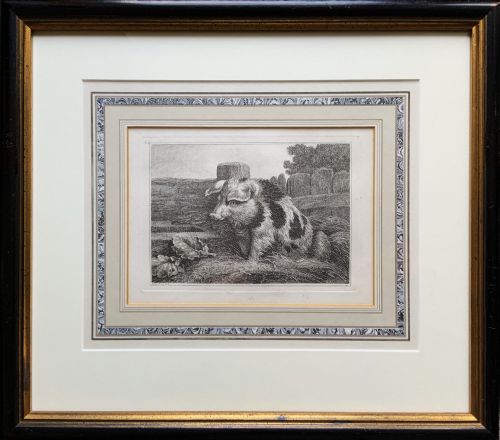


Vintage Agricultural Wall Art
Vintage agricultural wall art brings rural labour, shire horses and traditional farmyards onto the wall through period paintings and rustic objects.
Vintage Agricultural Wall Art
Vintage agricultural wall art encompasses framed paintings, watercolours, prints and rural objects that depict farming life, livestock and country landscapes. Buyers searching for vintage agricultural wall art typically encounter oil paintings on canvas and paper watercolours dating from the nineteenth century through to the mid-twentieth century.
The subjects on this page range from heavy shire horses and plough teams to harvest scenes, farmyards and cattle grazing near historic landmarks. Traditional country realism and British impressionism dominate the styles, capturing the everyday toil and pastoral quiet of rural communities.
Alongside flat art, the selection includes functional items adapted for display, such as wooden shoulder yokes and prune drying racks. These pieces offer a tangible connection to historical farming practices, moving beyond simple pictorial representation into actual material heritage.
Assessing quality and execution
Quality in these works rests upon the artist's command of anatomy, light and spatial depth, particularly when rendering working horses and livestock. Stronger pieces display confident brushwork and accurate observation, whereas lesser works rely on formulaic compositions and rigid figures.
Framing and material preservation also influence the standing of a piece, with original burr wood or ebonised frames enhancing the overall integrity. The age of the canvas or paper, combined with stable pigment retention, marks the distinction between ordinary decorative items and accomplished fine art.
Listings feature works spanning the nineteenth and twentieth centuries, using oil on canvas, watercolour and wood.
Percival Glenfern·J.C. Grey·James William Booth·George Soper·Arthur Winter Shaw·Herbert Royle·Rowland Henry Hill·W.A. Clark·Joseph Paulman·John Percy Cooke·Walter Duncan·William Sidney Cooper·George Graham·Charles James Adams·George Wright
The Vintage Agricultural Wall Art Glossary
- Shire horse
- A heavy draught horse breed frequently depicted in historical ploughing and harvest scenes. Artists valued them for their immense strength and distinctive feathered hooves.
- Watercolour
- A painting method where fine pigment is suspended in a water-based solution on paper. This medium allows for luminous washes and subtle atmospheric effects in rural landscapes.
- Shoulder yoke
- A curved wooden implement placed across the shoulders to carry heavy loads such as milk pails. Dairy maids utilised these balanced devices for daily farm transport.
- Ebonised frame
- A wooden picture surround treated to imitate ebony wood through dark staining and polishing. Victorian and mid-century makers often used this finish to create a sharp contrast with canvas paintings.
- Pastoral realism
- An artistic style focusing on accurate portrayals of rural life and agricultural labour without romantic exaggeration. Practitioners aimed to record the genuine appearance of the countryside.
Vintage Agricultural Wall Art: Frequently Asked Questions
What periods do these pieces cover?
The works span from the mid-nineteenth century through the Victorian and Edwardian eras up to the mid-twentieth century. This timeline captures the transition from traditional horse-powered farming to later rural documentation.
Most items date between eighteen-fifty and nineteen-sixty, reflecting changing artistic approaches to the British countryside over a single century.
How were shoulder yokes used?
Dairy maids and farm workers wore these carved wooden beams across their shoulders to distribute the weight of heavy pails evenly. The curved shape fitted the body to ease the daily transport of milk and water around the farmyard.
Today, these functional implements are repurposed as decorative wall hangings that highlight historical rural craftsmanship.
What subjects appear most often?
Heavy horses at work dominate the imagery, including shire horses, plough teams and cart horses hauling harvests. Farmyards, cattle pastures, barns and rural workers also feature prominently across the paintings and prints.
Artists focused heavily on the daily rhythms of agricultural labour, documenting haymaking, threshing and livestock management.
How do I care for antique canvas art?
Keep paintings away from direct sunlight and excessive humidity to prevent the canvas from sagging and the oil paint from cracking. Dust them gently with a soft, dry brush without applying pressure to the pigment surface.
Avoid using liquid cleaners on old canvases or watercolours, as moisture damages both the paper supports and traditional oil mediums.