


Ruby Crystal Vase
These ruby crystal vase pieces bring rich colour and brilliance to a room, catching the light in a way few other glass forms do.
Ruby Crystal Vase
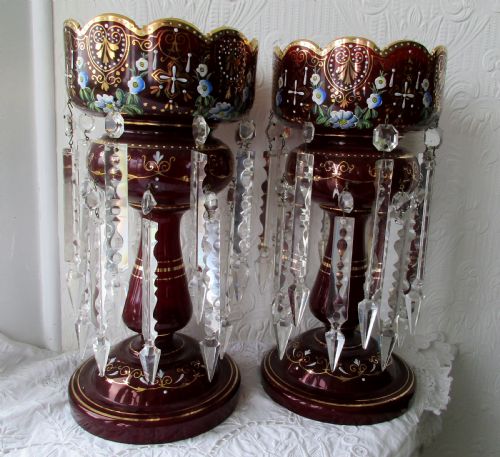
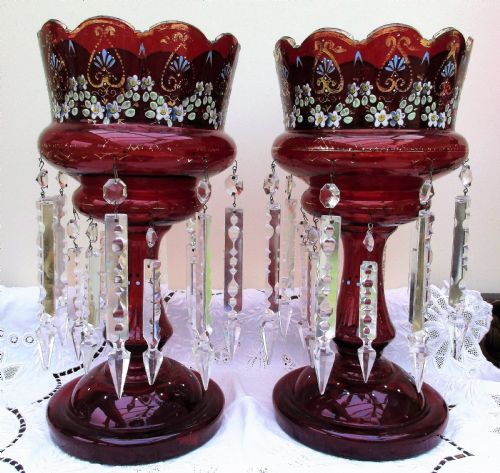
When you search for ruby crystal vase, you encounter Victorian and early twentieth-century examples ranging from the 1860s to the 1930s. The selection on this page centres on ruby glass, cranberry glass, and crystal overlay forms, often appearing as tall vases or mantel lustres.
English and Bohemian makers dominate these listings, showing the distinct regional approaches to flashed and layered glass. You will frequently find pairs designed for mantelpieces, alongside single vases that showcase deep red tones over clear crystal bases.
How they were made
The makers of these pieces relied on cased or flash glass techniques, fusing a thin layer of intense red glass over a colourless crystal core. Craftsmen then cut through the exterior red layer to reveal the clear crystal underneath, creating sharp geometric or floral patterns.
Many examples incorporate hand-painted enamel details and applied gold leaf to enhance the rich red surface. Glass blowers shaped the molten material into fluted rims, lily forms, and bulbous bodies before fire-polishing the surfaces to a high gloss.
Listings span the nineteenth century and the Art Deco period, featuring materials such as lead crystal, enamel, and gold leaf.
What varies in quality
The depth and saturation of the red colour layer set the finest pieces apart from simpler work. Superior examples display even cased layers without cloudiness, while lesser pieces show pooling or uneven thickness in the red coating.
Execution of the cut work determines the crispness of the design where the clear crystal meets the ruby surface. Hand-applied enamel and gilding that remain sharp and intact indicate superior workshop standards from the period.
Val St. Lambert
The Ruby Crystal Vase Glossary
- Ruby glass
- A deep red glass coloured with gold compounds during the melting process. This rich hue defines the primary aesthetic of these Victorian and Bohemian pieces.
- Cranberry glass
- A transparent pinkish-red glass created using gold chloride. It appears frequently in nineteenth-century mantel lustres and lily vases.
- Flash glass
- A colourless glass vessel coated with a thin outer layer of coloured glass. This technique allowed artisans to cut away parts of the red layer to expose the clear crystal beneath.
- Mantel lustre
- A decorative glass vase fitted with a ring of pendant crystal prisms hung from the rim. These items were traditionally placed on drawing-room mantelpieces to reflect candlelight.
- Cut crystal
- Glass shaped and patterned by abrasive wheels. The faceting creates sharp refractive edges that catch and scatter light.
Ruby Crystal Vase: Frequently Asked Questions
What is a ruby crystal vase?
A ruby crystal vase is a decorative glass vessel made with a deep red exterior layer over clear crystal. These pieces date primarily from the nineteenth and early twentieth centuries.
They often feature hand-cut facets, enamel work, or gilding that highlights the contrast between the dark red surface and the clear crystal underneath.
How do I identify Victorian glass?
Victorian glass pieces often display rich colours like cranberry or ruby, frequently paired with applied enamel and gold leaf decoration. Look for characteristic nineteenth-century forms such as mantel lustres and lily vases.
Examination of the base often reveals polished pontil marks left by the glassblowing rod, pointing to period production methods.
What are mantel lustres?
Mantel lustres are decorative vases fitted with hanging glass prisms suspended from the rim. Victorians used them on mantelpieces to catch and refract ambient light in formal rooms.
They appear frequently in ruby and cranberry glass, often manufactured in pairs for balanced display.
How do I clean ruby glass?
Clean ruby glass gently using lukewarm water and a mild, non-abrasive liquid soap. Avoid soaking pieces that feature delicate enamel work or gold leaf.
Dry the glass immediately with a soft, lint-free cloth to prevent water spots and protect the surface finish.