
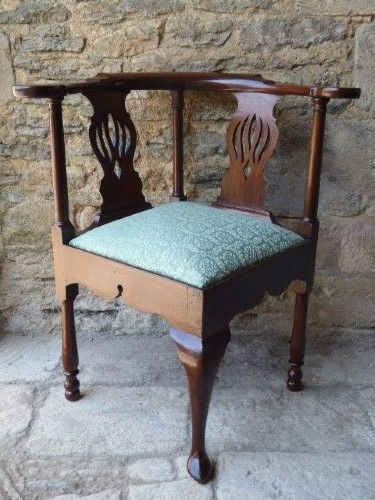
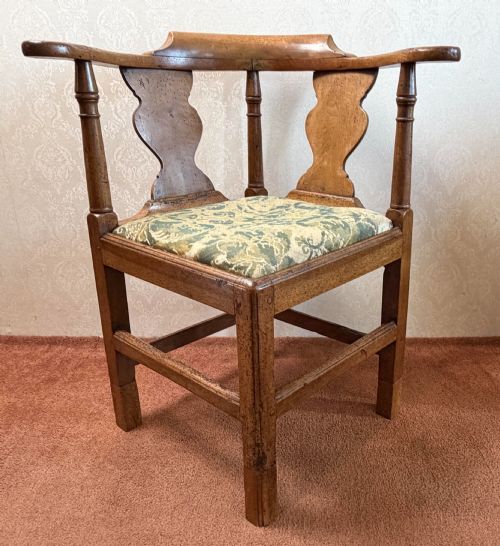
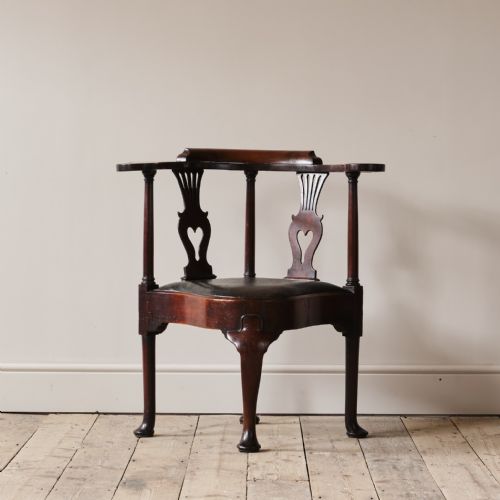


Roundabout Armchair
A roundabout armchair is a clever corner seat designed to fit neatly into domestic interiors while offering sturdy support.
Roundabout Armchair
A roundabout armchair, also known as a corner chair, presents a distinctive shape with a curved backrest designed to fit snugly into the corner of a room or stand independently. These forms date primarily from the eighteenth century, with Georgian and Queen Anne examples appearing alongside later Victorian and Edwardian interpretations.
Buyers will encounter various incarnations ranging from plain eighteenth century models to later carved revival pieces. The accent chairs utilise drop-in seats covered in fabric, leather, or textile upholstery.
How they were made
Joiners and cabinetmakers utilised solid timbers such as mahogany, oak, walnut, and fruitwood to build the structural frames of these corner seats. Traditional woodworking techniques involved pegged joints and shaped corner blocks to ensure stability across the angled seat frame.
Turned wooden supports and spindles frequently form the gallery beneath the curved back rail, secured with mortise and tenon joints. Upholstered drop-in pads lined with fabric, leather, or textiles were fitted directly into the wooden frame.
Some roundabout armchairs were built with an extra-wide leg span to accommodate the voluminous skirts worn in the seventeen-hundreds.
What varies in quality
The refinement of the timber and the crispness of any carved detail separate standard examples from finer pieces. Superior versions display carefully selected grain figures in mahogany or walnut, whereas simpler utilitarian items rely on plain oak or fruitwood.
Structural integrity and originality of the wooden frame dictate the standing of a roundabout armchair. Pieces retaining their early joined construction without extensive timber replacement command greater respect among collectors.
The Roundabout Armchair Glossary
- Roundabout armchair
- A seating form featuring a curved back rail that spans three corners, creating an angled seat designed for placement in a room corner. This layout provides an enclosed seating position.
- Drop-in seat
- A removable wooden frame upholstered in fabric or leather that fits into the rebated top of the chair rails. It allows for straightforward reupholstering without altering the main structure.
- Fruitwood
- Timber sourced from fruit-bearing trees such as pear or apple, utilised by cabinetmakers for provincial furniture. It offers a dense grain and warm tone.
- Corner chair
- An alternative descriptor for a roundabout armchair, highlighting the diagonal footprint and placement capability. These seats were popular in domestic interiors from the early eighteenth century onwards.
Roundabout Armchair: Frequently Asked Questions
Where were roundabout armchairs placed?
These chairs were historically designed to fit snugly into the corner of a room, saving floor space while providing a comfortable seat. They were also positioned near writing desks or tables.
The unique angled footprint allowed them to sit flush against two intersecting walls, making efficient use of domestic interiors during the eighteenth century and later periods.
How do I identify an eighteenth century roundabout armchair?
Early examples display traditional timber construction methods, such as hand-cut joinery and native woods like oak, walnut, or early mahogany. The turning on the vertical supports often follows styles typical of the Queen Anne or George periods.
Examining the underside reveals the age of the wood and the presence of hand tools rather than modern machinery. Later Victorian and Edwardian revivals tend to exhibit heavier carving and different patination.
What woods were used for these chairs?
Cabinetmakers utilised a variety of native and imported timbers depending on the period and region of manufacture. Mahogany and walnut appear frequently in higher-status Georgian pieces.
Simpler or provincial examples often employ oak or fruitwood. The choice of material heavily influences the colour and overall character of the furniture piece.
Are these chairs comfortable to sit in?
The curved back rail offers substantial support around the sides and back, creating an enclosed feeling. Upholstered drop-in seats provide a cushioned surface for the user.
Because of their distinctive shape, they encourage a slightly turned seating posture. They function well as accent seating in studies, bedrooms, or living spaces.