

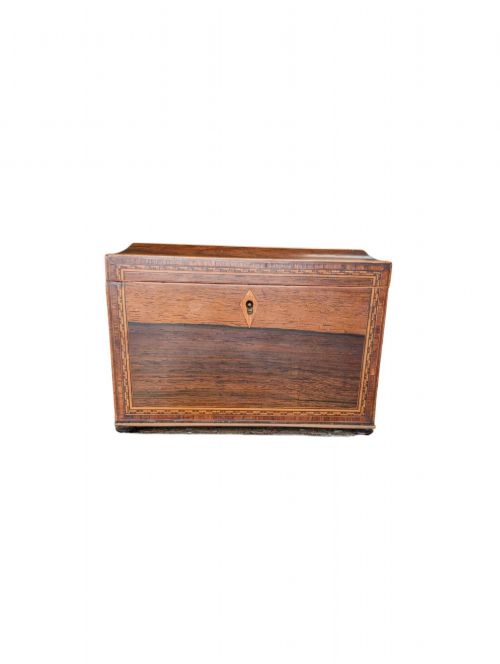
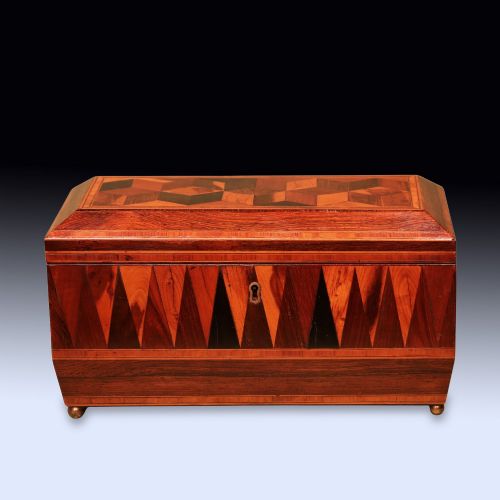

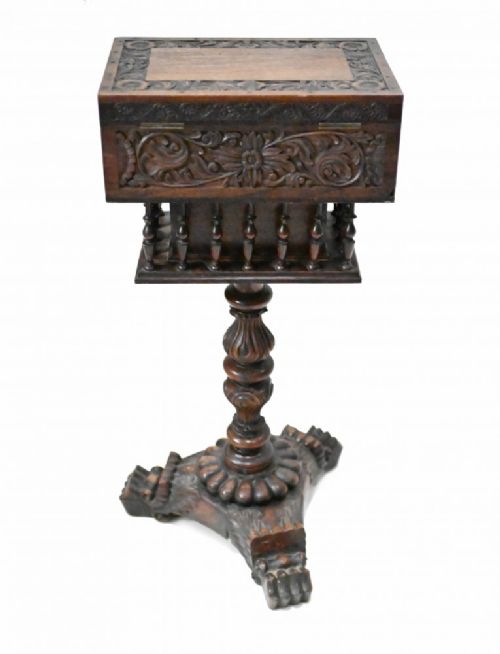


Rosewood Tea Caddy Chest
A rosewood tea caddy chest is a remarkably dense domestic container designed for storing dried leaf, and collectors prize these for their rich dark grain and fine brass or wood inlay.
Rosewood Tea Caddy Chest
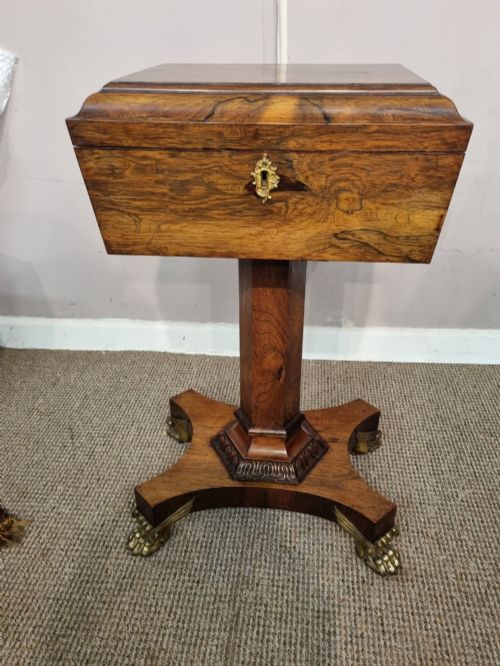
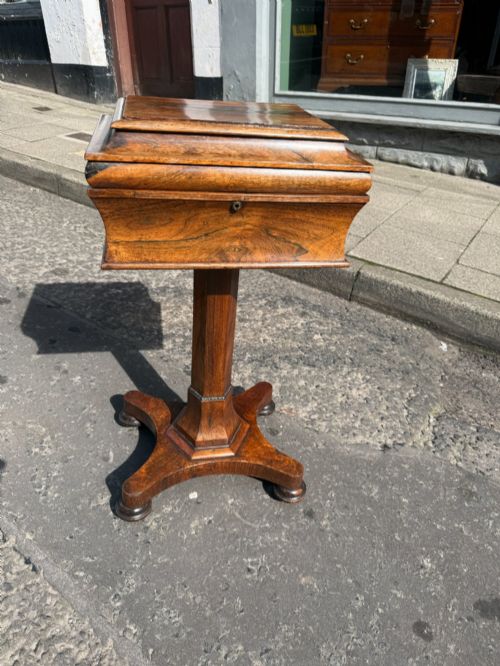
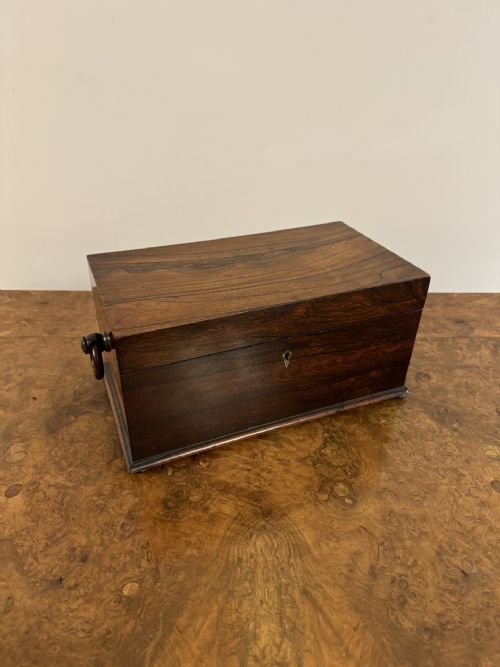
A rosewood tea caddy chest is primarily found in Regency, Georgian, and Victorian forms, encompassing table-standing caddies, sarcophagus shapes, and larger freestanding teapoys.
The pieces on this page span the early nineteenth century into the late Victorian era, with Regency sarcophagus and oblong tapered examples appearing frequently alongside Victorian mosaic boxes.
Makers and workshops constructed these boxes to sit securely in drawing rooms, using compartmented interiors to keep black and green teas separate and secure under lock.
How they were made
Craftsmen utilised dense rosewood timbers as the primary body, often combining boxwood, satinwood, and mixed wood inlay to create geometric parquetry and intricate Tunbridge Ware mosaic bands.
Metalwork played a structural and decorative role, with brass inlay, brass stringing, and cast lion mask handles fitted to heavier sarcophagus lids.
Internal elements frequently incorporate fitted glass mixing bowls alongside lidded canisters, all housed within velvet or silk lined compartments.
Listings feature rosewood, boxwood, bone, and walnut materials across Georgian, Regency, and Victorian periods.
What varies in quality
The sophistication of the surface decoration sets apart standard containers from exceptional works, particularly the precision of Tunbridge Ware mosaic detailing and complex brass parquetry.
Structural integrity in the timber housing and the survival of original internal components, such as matching tea canisters and glass mixing bowls, dictate the standing of a piece.
The execution of cabinetmaker details, from the curve of a sarcophagus lid to the neatness of boxwood stringing, reveals the hand of a skilled workshop.
Henry Hollamby
The Rosewood Tea Caddy Chest Glossary
- Teapoy
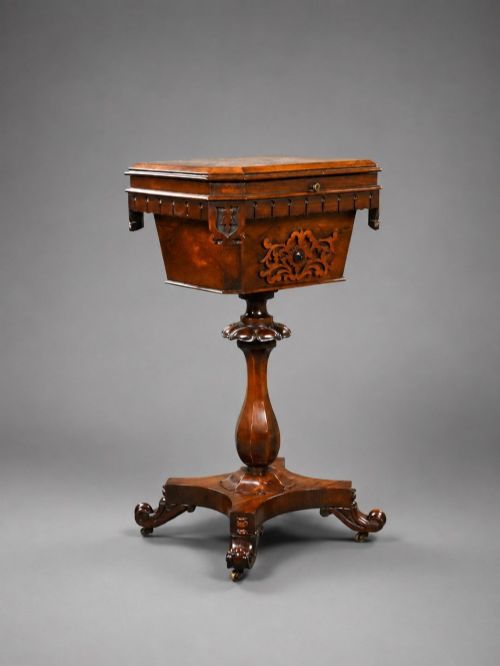
- A freestanding table with a lidded container mounted on a pillar, utilised for serving tea in the drawing room. These often double as work boxes.
- Sarcophagus form
- A box shape featuring a domed or sloping lid reminiscent of an ancient stone coffin. This profile became popular during the Regency period.
- Tunbridge Ware
- Small wooden objects decorated with mosaic tile work made from multiple natural coloured woods to form pictorial or geometric patterns.
- Parquetry
- Geometric mosaic woodwork arranged in regular patterns like cubes or stripes across the surface of the lid and sides.
- Stringing
- Thin inlay lines of a contrasting light wood, such as boxwood, embedded into the darker rosewood surface to outline panels.
Rosewood Tea Caddy Chest: Frequently Asked Questions
What is a rosewood tea caddy chest?
A rosewood tea caddy chest is a lidded container created to store valuable loose leaf tea safely away from damp air and light. These containers date primarily from the Georgian, Regency, and Victorian periods.
Inside, the timber carcass is divided into compartments for different tea varieties, often accompanied by a central glass bowl used for blending leaves.
How were teapoys used?
Teapoys served as portable or freestanding tea stations in the drawing room, allowing the host to prepare tea without summoning servants. The container top lifts to reveal internal canisters and mixing spaces.
Many examples include sturdy pillar supports and storage bags beneath the box for sewing or needlework.
How do I identify a Regency caddy?
Regency caddies often display classical architectural proportions, featuring sarcophagus shapes, heavy brass lion mask handles, and precise brass stringing or inlay. The wood grain on these pieces tends to be deeply figured rosewood.
Interior fittings usually consist of two lidded foil-lined canisters flanking a central aperture for a glass bowl.
What is Tunbridge Ware inlay?
Tunbridge Ware inlay consists of tiny mosaic pieces assembled from different coloured natural woods to create detailed geometric or floral motifs. Craftsmen glued these mosaic bands onto the surface of rosewood boxes.
This meticulous technique is characteristic of nineteenth century production in Kent.