
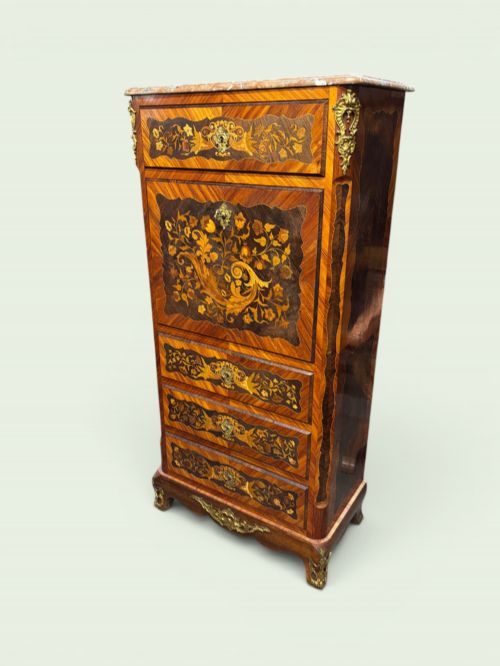


Rosewood Secretaire Desk
A rosewood secretaire desk combines rich timber with a clever drop-front writing surface that conceals fitted drawers and compartments.
Rosewood Secretaire Desk
A rosewood secretaire desk serves as a dual-purpose piece of furniture, functioning as both a chest of drawers or cabinet and a dedicated writing surface. Buyers searching for a rosewood secretaire desk encounter various forms, including upright abattants, campaign chests, chiffoniers, and Wellington chests spanning the eighteenth, nineteenth, and mid-twentieth centuries.
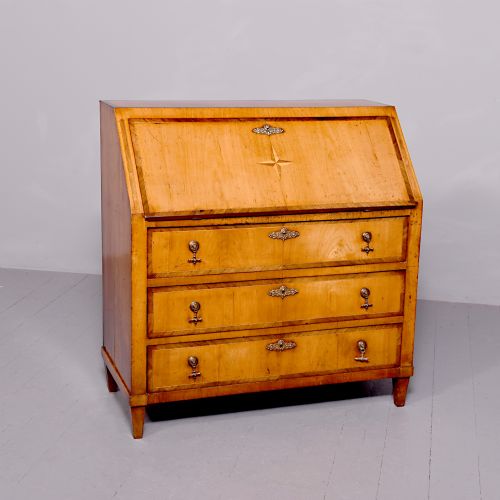
Most pieces date from the nineteenth century, encompassing Regency, Victorian, and later revival periods, though eighteenth-century bureau bookcases and mid-century French examples also appear. These variations in form and period mean buyers can find everything from compact writing cabinets to large library pieces.
Materials and construction methods
Makers utilised dense, heavily figured rosewood veneers applied to foundational cabinet timbers, often pairing the dark grain with contrasting brass inlay, kingwood, or walnut. Brass hardware, handles, and occasional ormolu mounts provide structural accents and decorative borders on both English and continental pieces.
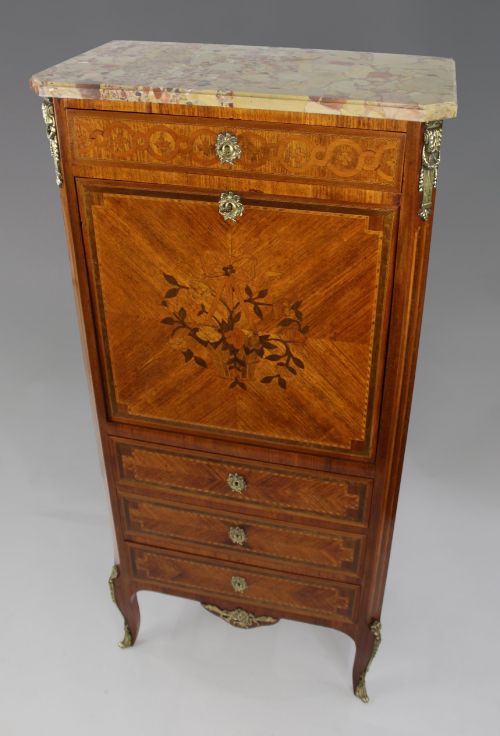
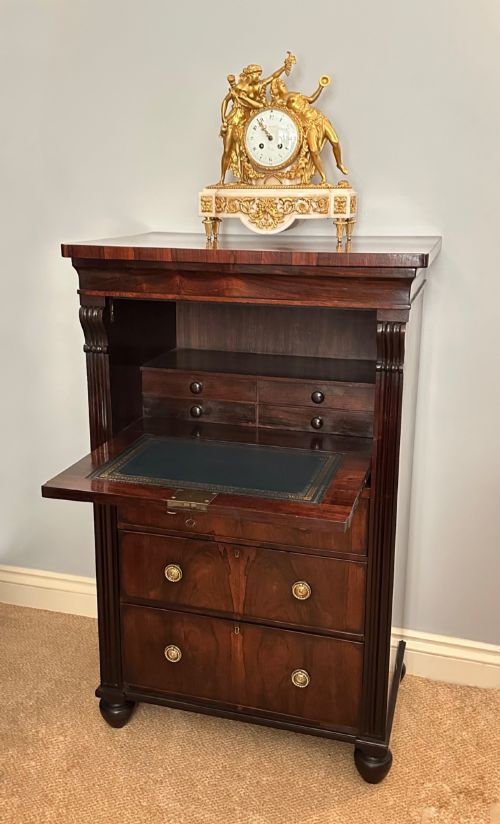
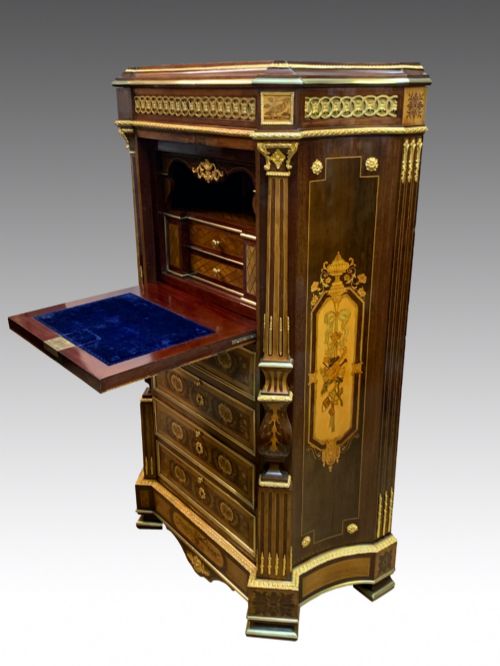
Writing surfaces frequently incorporate fitted leather writing inserts within the drop-front flap, opening to reveal internal compartments, small drawers, and occasionally secret locking mechanisms. French examples frequently incorporate original marble tops and detailed marquetry scenes executed in various contrasting wood veneers.
Rosewood Secretaire Desk Retail Price Guide 2026
Typical asking prices for rosewood secretaire desk among the pieces listed under this phrase on Sellingantiques today, from the lower quarter to the upper quarter. They describe what is for sale here now, not the wider market.
The listings on this page span the 18th, 19th, and 20th centuries, featuring rosewood, kingwood, walnut, marble, and ormolu.
Factors influencing quality and craftsmanship
The quality of a rosewood secretaire desk rests upon the precision of the cabinetwork, the depth and figuring of the timber veneer, and the integrity of the internal writing compartment. Superior pieces display seamless grain matching across drawer fronts and drop-front panels, alongside robust internal mechanics that support the writing surface securely.
Decorative elements such as hand-chased ormolu mounts, intricate marquetry, and original marble slabs distinguish high-grade continental cabinets from simpler domestic pieces. The presence of original brass inlay, functioning secret drawers, and well-preserved leather inserts further elevates the standing of an individual desk.
Maison Krieger
The Rosewood Secretaire Desk Glossary
- Secretaire a abattant
- A tall, upright writing cabinet featuring a hinged fall-front panel that drops down to create a desk surface. This vertical format is particularly common in French nineteenth-century furniture.
- Wellington chest
- A tall, narrow chest of drawers secured by a locking side pilaster or hinged locking bar. Some variants incorporate a central secretaire drawer that folds down for writing.
- Marquetry
- Decorative patterns formed by the insertion of various coloured wood veneers into a structured background. It frequently appears on French revival cabinets listed here.
- Chiffonier
- A low cabinet or sideboard with drawers and shelving, often adapted during the Regency and Victorian periods to include a secretaire drawer.
- Ormolu
- Gilded bronze mounts and decorative trimmings applied to furniture. It is characteristic of nineteenth-century continental and French revival pieces.
- Vernis Martin
- A type of simulated Japanese lacquer developed in France, found on select nineteenth-century secretaire cabinets.
Rosewood Secretaire Desk: Frequently Asked Questions
What is a secretaire abattant?
A secretaire abattant is a tall, upright cabinet with a hinged front panel that folds down horizontally to serve as a writing desk.
Inside, it typically reveals a collection of small pigeonholes and drawers for correspondence.
How do I use the drop-front desk?
The drop-front panel is supported by hinges and internal desk stays or pulls to create a sturdy writing surface.
When closed, it conceals the stationery and keeps the room looking neat.
Are these desks suitable for daily work?
Many of these pieces offer sufficient depth and surface area for modern writing tasks and laptop use.
Buyers should check the interior height of the drop-front to ensure comfortable seating.
How do I date a rosewood secretaire?
Dating relies on architectural styles, construction methods, and secondary timbers used inside the drawers.
Regency and Victorian pieces display distinct mouldings and hardware markers specific to their eras.
What maintenance does rosewood require?
Rosewood benefits from stable indoor humidity and occasional treatment with appropriate furniture wax.
Direct sunlight should be avoided to prevent fading the rich natural grain.