

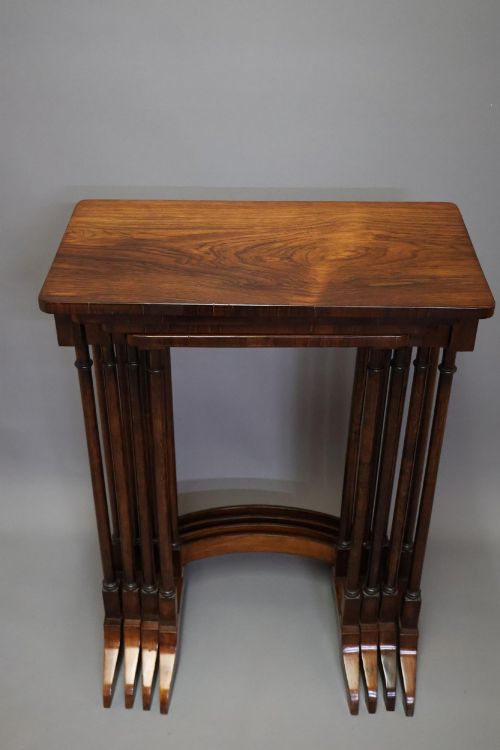

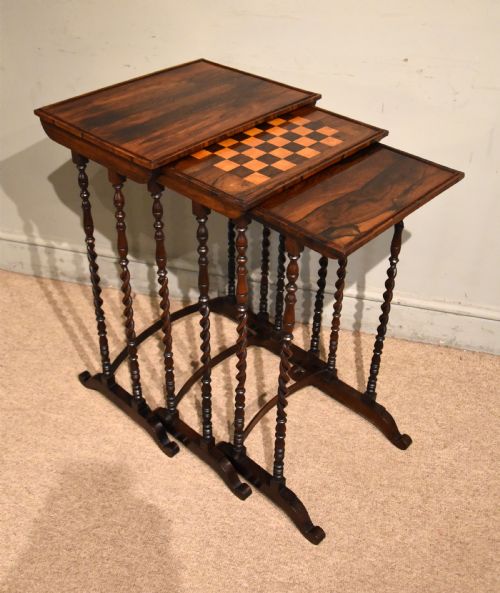


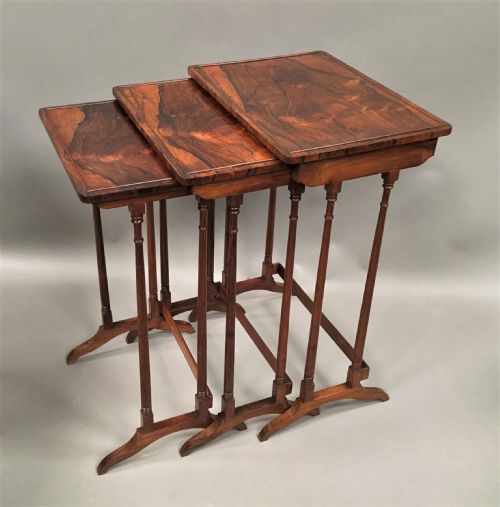

Rosewood Quartetto Nest
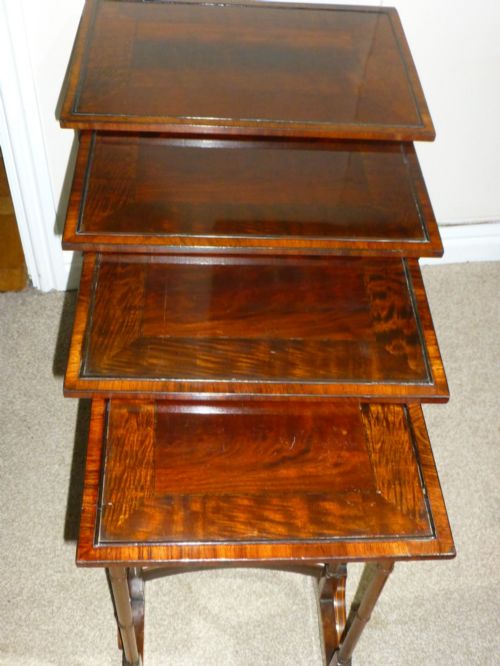
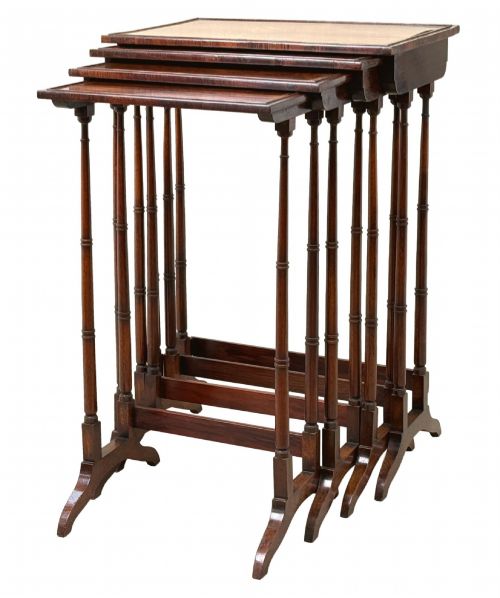
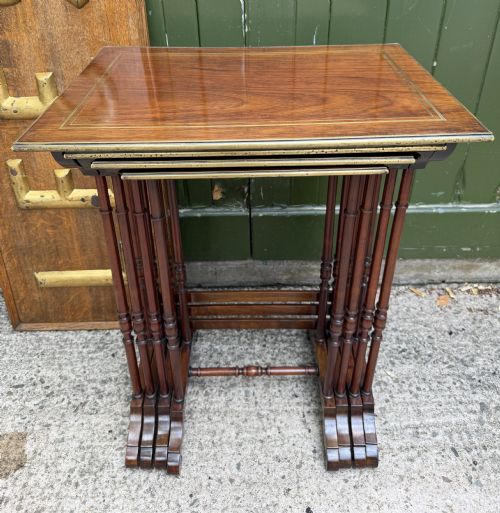
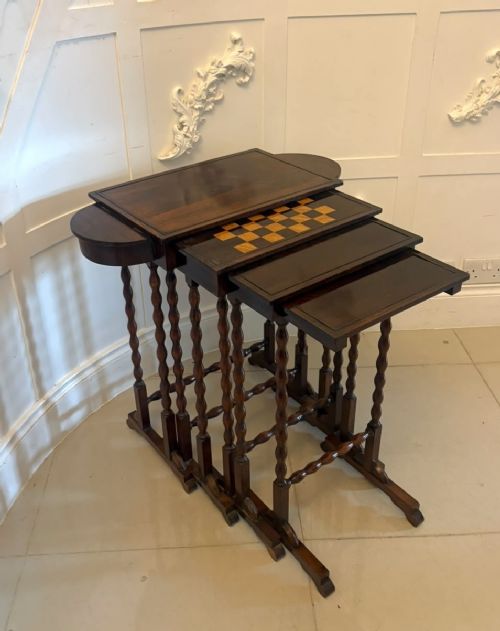
These rosewood quartetto nest tables slide neatly together to save floor space while offering multiple surfaces for tea or games.
Rosewood Quartetto Nest
The form appears primarily as occasional tables, sometimes incorporating integrated chess boards or brass inlay. Dating ranges from the Georgian and Regency periods through to the late nineteenth century and the early nineteen-hundreds.
What varies in quality
Quality rests upon the choice of timber figure, the precision of the graduated sizing, and the crispness of any brass inlay or carved detail. Superior examples display carefully matched grain across all four surfaces and retain their original structural rigidity when freestanding.
Attribution to documented makers or workshops elevates a piece, as does the inclusion of functional additions like integrated chess boards. Inferior construction shows in clumsy scaling, poor timber selection, or sloppy joints that prevent the tables from nesting smoothly.
Materials recorded across these tables include rosewood, satinwood, brass, boxwood, mahogany, leather, and carved hardwood.
Gillows·W&C Wilkinson London
The Rosewood Quartetto Nest Glossary
- Quartetto nest
- A set of four tables designed to graduate in size and slide into one another. This term originates from the nineteenth century for sets of four.
- Brass inlay
- Metal strips or motifs embedded flush into the timber surface for decoration. Regency makers favoured this technique to outline tabletops.
- Padouk
- A heavy tropical hardwood with a reddish tint, frequently utilised in Chinese export furniture. It shares similar weight and durability with rosewood.
- Satinwood
- A pale, lustrous timber utilised for contrasting stringing and banding on darker surfaces. Cabinetmakers employed it to highlight table edges.
- Graduated tables
- A series of tables built in diminishing proportions so they stack together. Each individual table fits precisely under the next one up in size.
Rosewood Quartetto Nest: Frequently Asked Questions
Why are they called quartetto tables?
The term quartetto derives from the musical grouping of four, applied specifically to nests of four tables during the Regency period.
Cabinetmakers and retailers adopted the name to describe sets designed to be used together or pulled apart as required.
How do I spot a Regency nest?
Regency tables typically feature dark rosewood timber, often enhanced with brass inlay or slender turned legs.
They display proportion and restraint, predating the heavier carved ornamentation seen on later Victorian or Chinese export examples.
Can I use them separately?
Each table functions as an independent surface, making them practical for holding drinks or books around a room.
When guests leave, the smaller frames simply slide back into the largest table to clear the floor space.
Are Chinese export nests different?
Chinese export versions from the late nineteenth and early twentieth centuries utilise dense hardwoods like padouk and feature carved motifs.
They follow the same graduated nesting principle as British Regency tables but reflect Eastern decorative traditions.