


Brass Stringing Rosewood Table
A brass stringing rosewood table brings warm timber and bright metal together, offering the refined presence collectors want from the Regency period.
Brass Stringing Rosewood Table
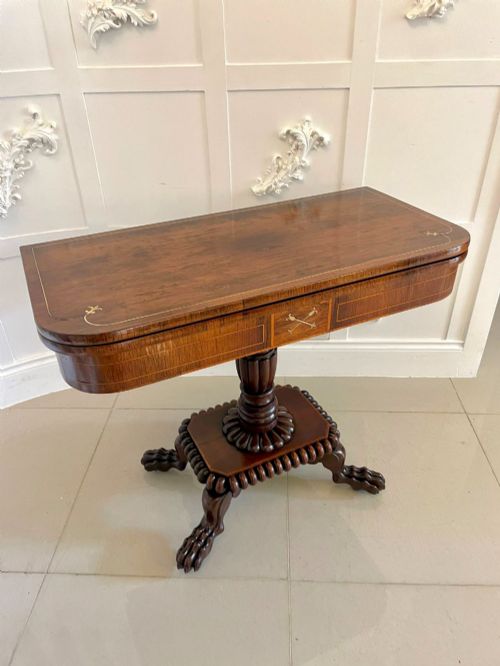
A brass stringing rosewood table is a piece of furniture defined by dark, rich timber highlighted with fine lines of bright metal inlay. When you search for this phrase, you find items that date primarily to the Regency period and the wider nineteenth century.
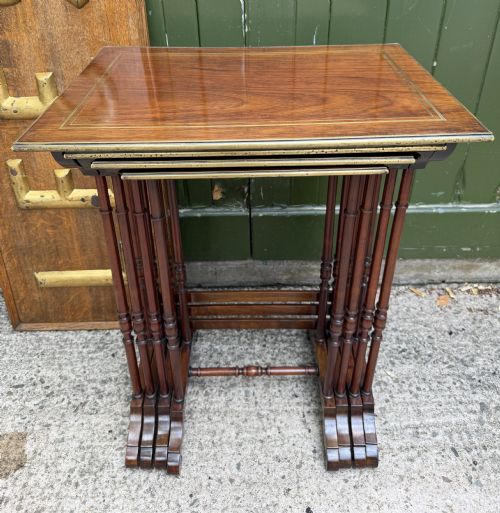
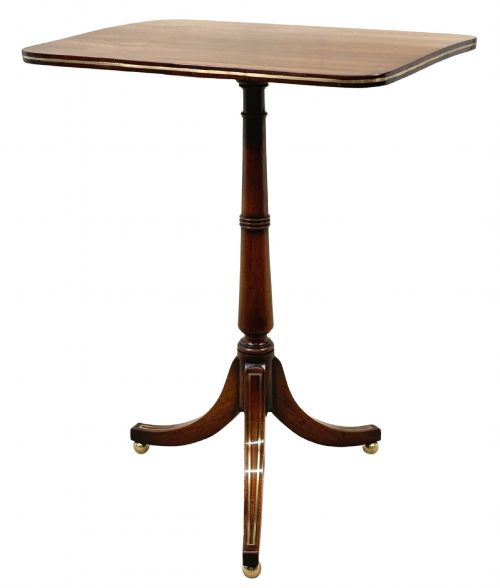
The pieces on this page take several distinct forms, most commonly card tables, games tables, and occasional lamp tables. You also encounter sewing tables, teapoys, sofa tables, and nests of quartetto tables alongside occasional clocks.
Grand Regency styling appears frequently, showing the formal design vocabulary of the era. Whether configured as a fold-over console or a tripod support, each piece uses contrasting metal lines to define its edges and panels.
Judging quality and execution
Quality in these pieces rests upon the precision of the brass inlay work and how tightly the metal sits within the rosewood channels. Finer examples display immaculate alignment where the metal meets the timber without gaps or uneven edges.
The selection of the rosewood timber itself dictates much of the visual success, with richly figured grain elevating the piece above plainer surfaces. Proportion, stability in folding mechanisms, and crispness of any carved wooden details further distinguish superior examples.
Even the tea leaves required a lock and key during the Regency, which explains why teapoys possess such secure little compartments inside their polished rosewood lids.
The Brass Stringing Rosewood Table Glossary
- Brass stringing
- Inlay formed of narrow strips of brass sunk flush into channels cut in the wood surface. This technique creates delicate geometric borders and highlights the structural lines of the furniture.
- Rosewood
- A heavy, dark timber with a pronounced grain figure prized for cabinetmaking throughout the nineteenth century. Its deep colour provides a strong visual contrast to bright metal inlay.
- Card table
- A folding table designed for evening card games, featuring a top that opens to reveal a baize-lined playing surface. Many examples include a swivel mechanism to support the opened leaf.
- Teapoy
- A small stand or box on a pillar support intended for storing and serving tea leaves. Regency versions often utilise rosewood and brass decoration to match other drawing-room furniture.
- Quartetto tables
- A set of four graduated nesting tables designed to slide one beneath another when not in use. The nineteenth-century examples on this page employ brass-inlaid rosewood across the set.
Brass Stringing Rosewood Table: Frequently Asked Questions
What is a brass stringing rosewood table?
A brass stringing rosewood table is a nineteenth-century piece of furniture built from dark rosewood and decorated with thin lines of inlaid brass. These tables date primarily to the Regency period and include forms like card tables, sewing tables, and occasional lamp stands.
The style relies on the contrast between polished dark timber and bright metallic lines. Cabinetmakers used this technique to accent table tops, friezes, and pedestal bases.
How were card tables used originally?
Card tables served as functional furniture for evening entertainment in Regency drawing rooms. The hinged top folded closed against the wall when not in use and opened out flat for games.
Many of these tables feature clever pivoting mechanisms to support the opened leaf. Lined interiors provided a stable surface for cards while concealing small compartments for counters.
Where does a teapoy fit in a room?
A teapoy functions as a compact occasional stand or storage piece. Historically, they held valuable tea leaves under lock and key in a principal room.
Today, collectors place them beside seating or in hallways as decorative display pieces. Their small footprint makes them versatile additions to various interior layouts.
How do you identify a Regency piece?
Regency furniture style is recognised by classical proportions, architectural lines, and refined ornament. The use of rosewood combined with precise brass inlay is a hallmark of high-status pieces from this era.
Construction methods, such as traditional jointing and hand-cut timber thickness, also help confirm the period. Examining the underside and interior surfaces often reveals period woodworking traits.