
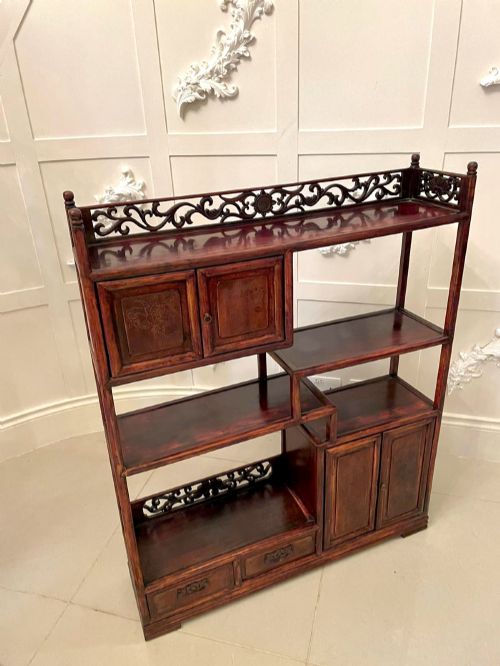
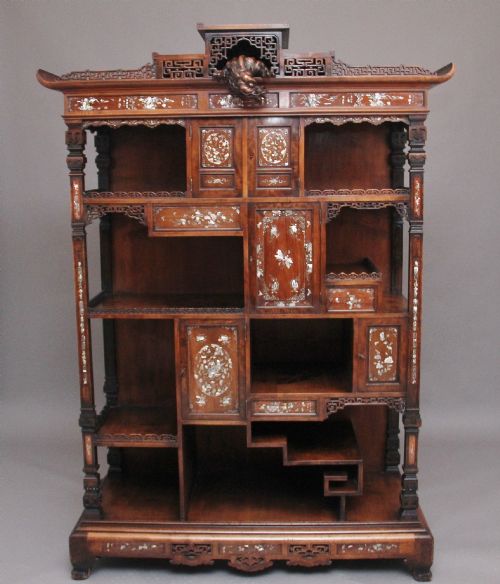
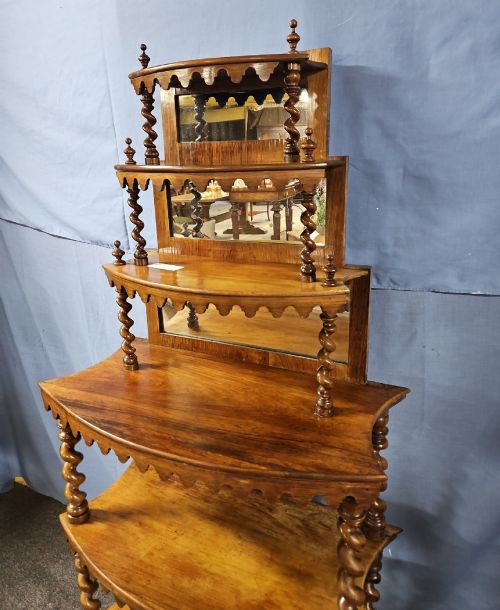

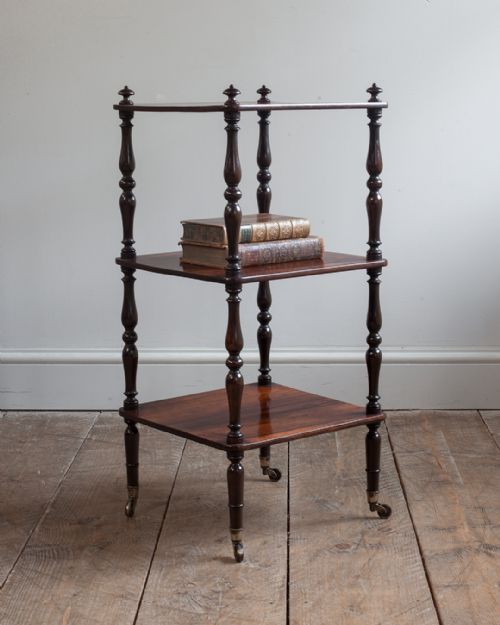
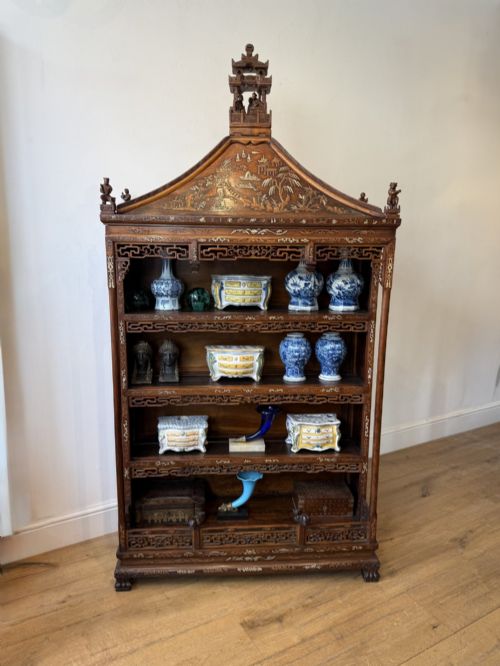
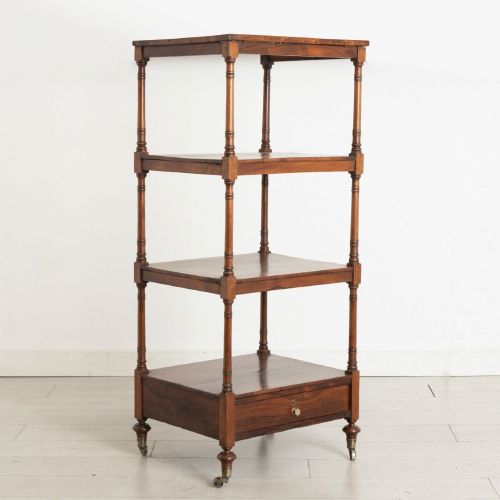


Rosewood Etagere Shelf
These rosewood etagere shelf designs combine tiered display platforms with rich timber grain, serving collectors who value open display furniture.
Rosewood Etagere Shelf
A rosewood etagere shelf provides graduated tiers supported by upright posts, designed for displaying decorative objects in domestic interiors. Buyers examining this page encounter forms spanning the Regency, Victorian, and Georgian periods alongside related Chinese hardwood cabinets and French wall shelves.
The inventory leans heavily toward multi-tiered Victorian and Regency freestanding whatnots and etageres. These pieces range from compact three-tier corners to six-tier stands incorporating brass mounts, inlaid details, and lower cupboards or dumb waiter configurations.
Assessing build and material quality
Quality reveals itself in the choice of timber figure, the crispness of turned supports, and the stability of tiered joins. Superior examples maintain rigid uprights and precise joinery across multiple levels without sagging shelves.
Decoration distinguishes standard utility pieces from exceptional ones through refined brass stringing, elaborate marquetry inlay, or dense hand-carving. The weight and density of the rosewood timber further separate workshop standards.
Materials span rosewood, brass, mother-of-pearl, and bone inlay across various tier configurations.
Samson & Son London
The Rosewood Etagere Shelf Glossary
- Etagere
- A piece of furniture consisting of a set of open shelves for displaying small objects. These tiered stands developed in France during the eighteenth century.
- Whatnot
- A freestanding piece of furniture with multiple shelves used for ornaments or books. Victorian homes used these extensively in principal reception rooms.
- Ormolu
- Gilded bronze mounts applied to furniture edges and corners. French cabinet makers favoured this technique during the nineteenth century.
- Canterbury
- A small stand with sloped partitions designed for holding sheet music or books. Some Victorian examples integrate this function beneath a standard display shelf.
- Shodana
- An Asian multi-tiered display cabinet featuring staggered shelving compartments. Nineteenth-century European makers drew inspiration from these forms.
Rosewood Etagere Shelf: Frequently Asked Questions
What is a rosewood etagere shelf used for?
These tiered shelving units serve to display porcelain, silver, and decorative ornaments in principal rooms. Their open construction allows items to be viewed from multiple angles.
Historically, nineteenth-century households utilised them in drawing rooms and parlours for ornamental display. Today, they function well in contemporary spaces for books and collections.
How do I date a nineteenth-century whatnot?
Dating relies on stylistic shifts between Regency restraint and Victorian elaboration. Regency examples from around 1820 display classical proportions and simpler turned supports.
Later Victorian pieces from the 1860s and 1870s often feature heavier tiers, elaborate marquetry inlay, or added drawer sections. Material choices like mother-of-pearl or brass mountings also point toward specific mid-century decades.
Are these shelves sturdy enough for books?
Freestanding tiers handle moderate weights of small volumes, though they are primarily designed for decorative objects rather than heavy libraries. Corner versions offer additional stability through wall bracing.
Checking the tightness of the upright joints ensures the structure remains safe for displaying valuable ceramics or glassware.
How do I care for rosewood furniture?
Maintain rosewood by keeping pieces away from direct sunlight and sudden temperature shifts that dry the timber. Dust regularly with a dry, soft cloth.
Apply a microcrystalline wax periodically to preserve the natural grain and sheen without building up heavy residues.