
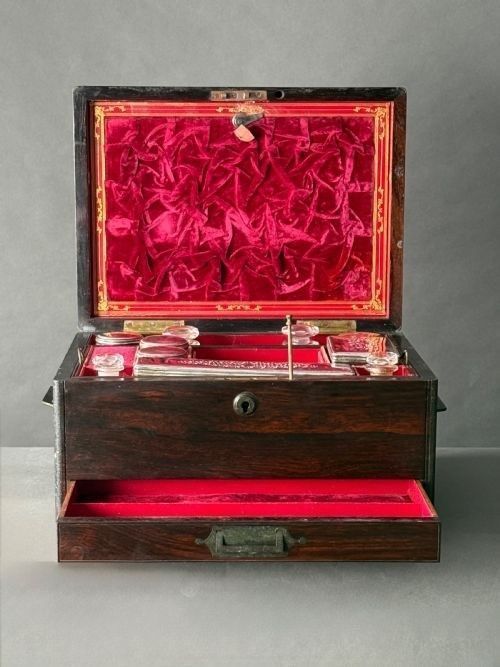


Rosewood Dressing Case
These rosewood dressing cases are portable personal chests for travel and toilet, built to hold grooming implements, writing gear and jewels.
Rosewood Dressing Case
A rosewood dressing case is a fitted box designed for personal grooming and travel, often incorporating compartments for jewellery, writing equipment and cosmetics. The examples here span several decades from the Georgian era through the Regency and Victorian periods to the Edwardian years.
The version most commonly encountered on this page is the Victorian rosewood travelling vanity box, frequently banded in brass and lined with velvet or leather. These boxes also appear under related descriptions such as writing slopes, workboxes and vanity cases.
Originating from English and French workshops, these pieces served travellers who required their personal items organised securely on the road. Today, they function as decorative containers for modern trinkets and precious items.
How they were made
Carpenters constructed the carcasses of these cases in dense rosewood timber, frequently applying brass banding to reinforce the corners and edges for travel. Inlays of mother of pearl or brass scrollwork often decorate the lids and escutcheons.
Interiors rely on precision woodworking to create fitted compartments, secret drawers and removable trays lined with velvet, silk or leather. Glass bottles with silver-plated or silver tops are integrated into the lower tiers alongside specialised slots for razors and brushes.
Some Victorian cases conceal secret compartments activated by pressing hidden wooden pins, rewarding curious owners with extra space for hidden treasures.
What varies in quality
The standard of a rosewood dressing case depends on the integrity of its internal fitments and the complexity of its compartments. Boxes retaining their original glass bottles, silver elements and velvet linings demonstrate a higher degree of completeness.
Construction methods also separate utilitarian pieces from luxury items, particularly the presence of branded mechanisms like Bramah locks and secret drawers operated by concealed release buttons.
The Rosewood Dressing Case Glossary
- Bramah lock
- A patented high-security lock mechanism invented by Joseph Bramah, commonly found on better-quality Regency and Victorian travelling boxes. It requires a cylindrical key with longitudinal slits.
- Escutcheon
- A small plate surrounding the keyhole of a box, usually cast in brass to protect the surrounding rosewood from wear. It often matches the corner brackets and banding.
- Writing slope
- A desktop box with a hinged, slanted writing surface that opens to reveal inkwell holders and storage compartments for paper. Many dressing cases double as writing surfaces.
- Mother of pearl
- An iridescent nacre material harvested from mollusc shells, utilised for geometric or floral inlays on rosewood box lids. It provides contrast against the dark wood grain.
- Campaign case
- A portable box or chest designed for military or travel use, characterised by flush brass handles and reinforced corners for durability on journeys.
Rosewood Dressing Case: Frequently Asked Questions
What did people put inside a dressing case?
Owners stored personal grooming tools, glass perfume bottles, razors, brushes and cosmetic jars within the upper and lower tiers of the box. Many also included space for correspondence supplies and small jewellery items.
These compartments kept everything secure during carriage by coach or ship, ensuring travellers had their complete toilet set ready upon arrival at a destination.
How do I date a rosewood box?
Dating relies on stylistic clues, hardware types and construction methods visible in the woodwork and linings. Regency examples often feature distinct brass inlay patterns, while Victorian pieces frequently display heavier brass banding or fitted velvet interiors.
Makers' marks on locks or paper labels inside the drawers can also provide specific periods of manufacture, spanning from Georgian times to the Edwardian era.
Are the keys usually original?
Original keys are uncommon because travellers frequently misplaced them over the decades of use. Many boxes survive with replacement keys or functional locks that have been adjusted by specialists.
Finding a box with its original functioning key and branded lock mechanism is a notable feature for collectors of these pieces.
How should I clean rosewood furniture?
Rosewood surfaces require gentle dusting with a soft, dry cloth to prevent the accumulation of grit in the grain. Avoid chemical sprays and excessive moisture, which can damage the old polish and the surrounding brass work.
Occasional application of appropriate wax polish helps maintain the lustre of the timber without building up heavy residue over time.