


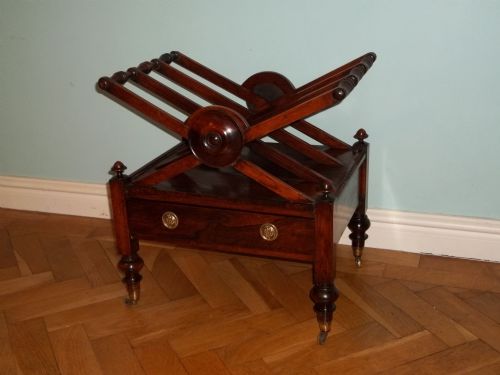


Rosewood Drawer Canterbury
These rosewood drawer canterbury pieces are freestanding partition stands built to hold sheet music, newspapers and magazines with a lower compartment.
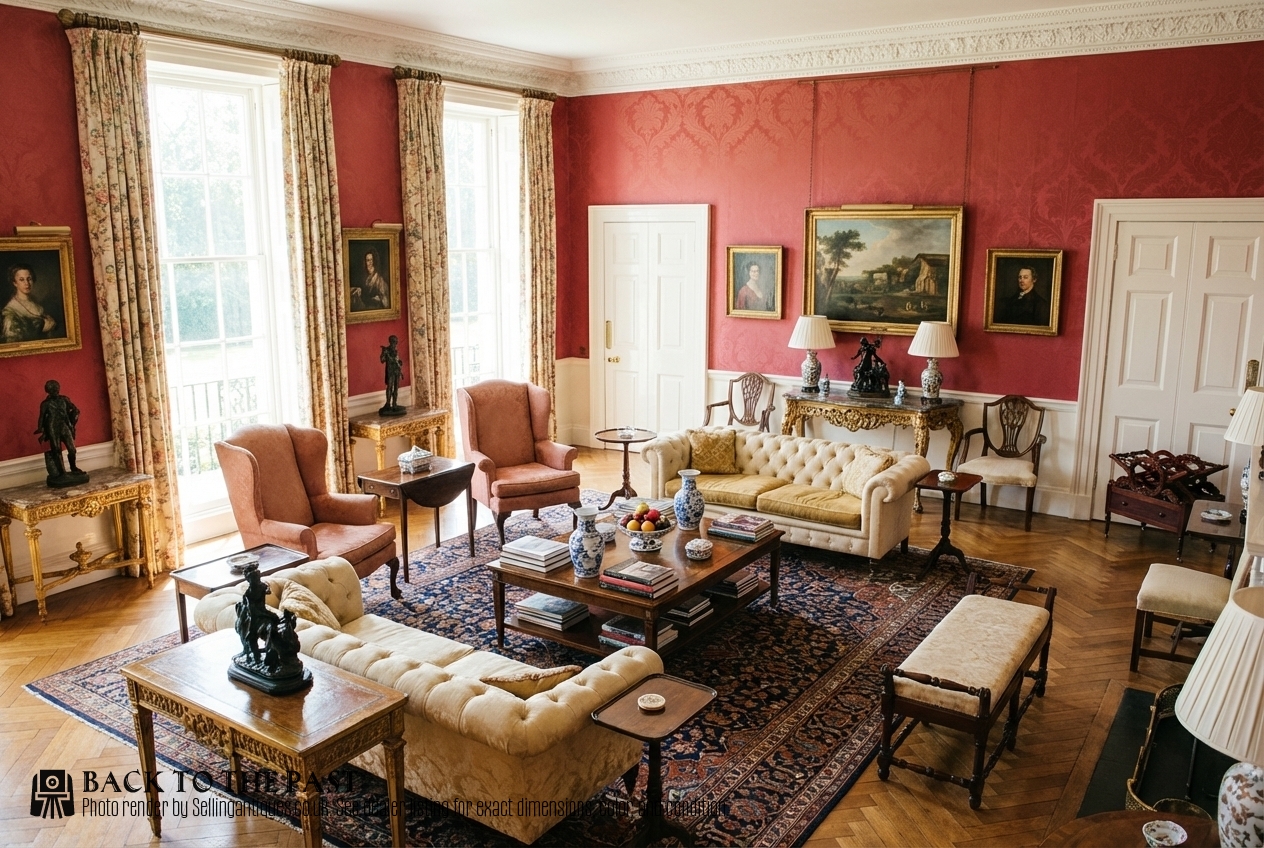
Rosewood Drawer Canterbury
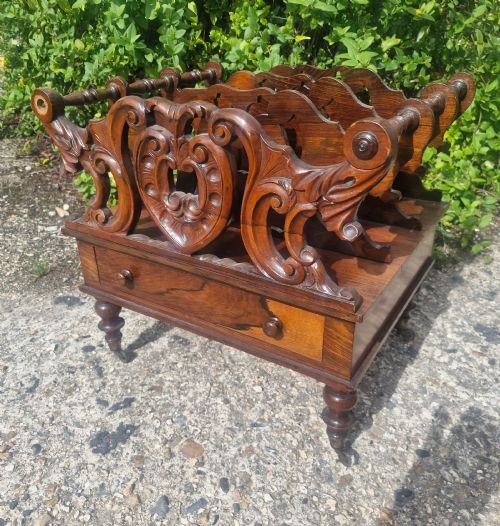
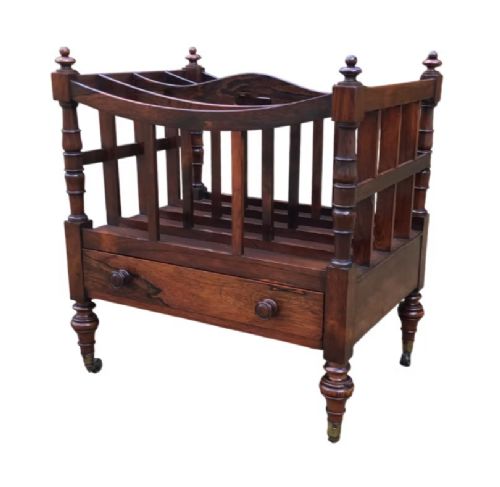
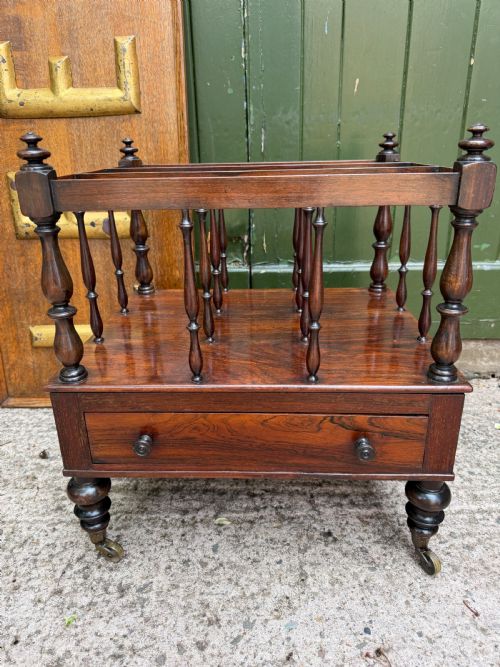
A rosewood drawer canterbury is a distinct piece of nineteenth-century furniture designed to keep folios, journals and sheet music close to hand in the sitting room or music salon. Most examples met on this page date from the Regency, George IV, William IV and Victorian periods, often taking the form of open vertical partitions mounted above a single shallow base drawer.
The format varies from boat-shaped Regency designs to compartmented stands featuring carrying handles and carved supports. These items served busy households as tidy stands for daily newspapers, periodicals and sheet music before evolving into general magazine racks.
Materials and construction
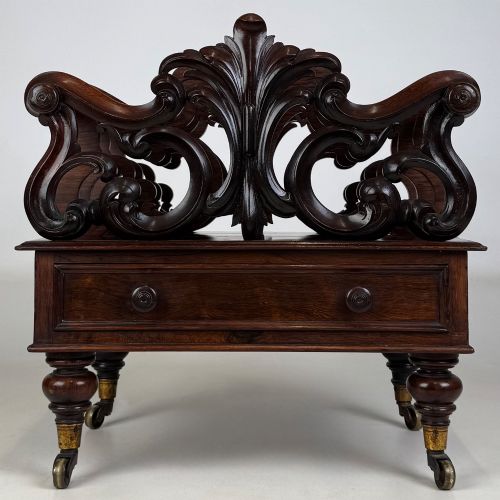
Makers utilised rich rosewood veneers applied to solid secondary timbers, often incorporating brass castors and turned pillars to support the slatted divisions. Details such as carved Prince of Wales feathers, foliate motifs and brass handles distinguish finer workshop output.
Listings span the nineteenth century, covering Regency, George IV, William IV and Victorian periods.
What separates the finest examples
Quality rests upon the crispness of carved woodwork, the figured grain of the rosewood veneer and the structural integrity of the vertical slats. Pieces that retain their original brass castors and turning without replacement parts command greater appreciation.
Proportion and balance define the superior items, where the integration of the lower drawer does not compromise the slender elegance of the upper frame.
The Rosewood Drawer Canterbury Glossary
- Canterbury
- A low stand with vertical partitions used originally for holding sheet music and later for newspapers and magazines. It often includes a small drawer at the base.
- Regency
- A British design style spanning the early nineteenth century characterised by classical restraint, elegant proportions and refined decorative motifs. Pieces from this era often display clean architectural lines.
- William IV
- A transitional nineteenth-century style noted for robust carving, scrolled supports and heavier proportions than preceding Regency furniture. Rosewood was frequently utilised during this period.
- Veneer
- A thin layer of decorative timber applied to a sounder secondary wood to provide a figured surface. In these pieces, rosewood veneers create rich contrast and grain patterns.
Rosewood Drawer Canterbury: Frequently Asked Questions
What is a canterbury used for?
A canterbury is designed to hold sheet music, newspapers, and periodicals within upright divisions.
The integrated lower drawer provides additional space for smaller items like scores or reading accessories.
How do I date a canterbury?
Dating relies on stylistic clues such as Regency curves, William IV scrollwork, or Victorian foliate carving.
Construction methods like hand-cut dovetails in the drawer also help establish the nineteenth-century origin.
Where should I place a canterbury?
These compact stands suit sitting rooms, studies, or music rooms beside seating or pianos.
They function well as accessible storage for current reading material while displaying timber grain.
Are all canterburys made of rosewood?
The pieces listed on this page feature rosewood as the primary material, often combined with secondary woods.
Brass handles, ceramic elements, and metal fittings also appear across various nineteenth-century examples.