
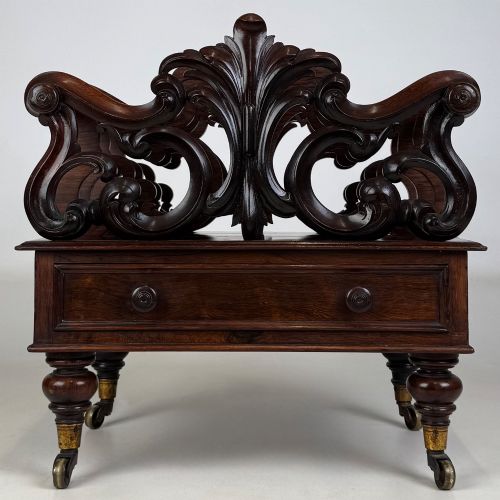
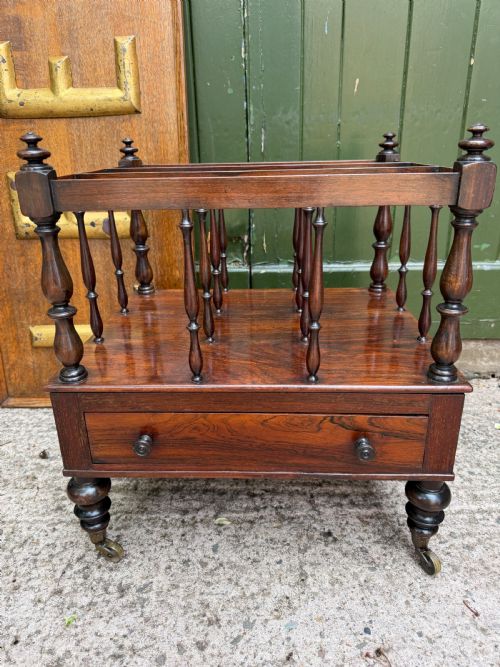


Vintage Rosewood Paper Stand
These vintage rosewood paper stand pieces are practical furniture designed to hold newspapers, sheets of music and periodicals.
Vintage Rosewood Paper Stand
A vintage rosewood paper stand typically takes the form of a Canterbury or magazine rack, designed to organise daily reading materials in the home. These items span periods from the Georgian era through Regency and William IV to the Victorian epoch, reflecting changing domestic tastes in storing paper.
The most common form encountered on this page is the Canterbury, often featuring slatted dividers to hold folios upright alongside a low drawer at the base. Alongside these, related pieces such as whatnots and etageres appear, demonstrating the variety of small display and storage furniture produced in the nineteenth century.
How they were made
These items are constructed primarily from rosewood, frequently complemented by secondary timbers like mahogany and accented with brass fittings or metal castors. The timber is chosen for its rich grain and deep colour, which suited formal nineteenth-century interiors.
Construction techniques include carved details such as foliate designs or carved Prince of Wales feathers, showing the hand of skilled cabinet makers. Slatted partitions and low drawers are integrated into the joinery to provide both structural support and functional utility for paper storage.
The listings here span the nineteenth century, including Georgian, Regency, William IV, and Victorian periods, executed in rosewood, mahogany, and brass.
What varies in quality
The refinement of the carving separates standard examples from finer pieces, particularly where artisans applied intricate foliate designs or carved motifs like the Prince of Wales feathers. Crispness in the woodwork and the integration of secondary elements such as brass castors or fitted drawers indicate the original grade of manufacture.
Proportion and the handling of the rosewood grain also dictate the distinction between pieces, with superior examples exhibiting carefully selected veneers and balanced architectural lines. The integrity of the slatted dividers and the smoothness of the drawer action further distinguish the better workshops.
The Vintage Rosewood Paper Stand Glossary
- Canterbury
- A low stand fitted with divisions for holding sheet music, newspapers, or books, often mounted on castors with a single drawer below. This form became popular in the late eighteenth century and remained a staple of Victorian drawing rooms.
- Whatnot
- An open set of multiple shelves used for displaying ornaments or holding books and papers. These pieces appeared in various forms throughout the nineteenth century.
- Regency
- An English design period spanning the early nineteenth century, characterised by classical restraint and neoclassical motifs. Furniture from this era often incorporates dark timbers like rosewood alongside brass details.
- William IV
- A transitional design period bridging Regency and early Victorian styles, spanning the 1830s. Pieces from this era typically display robust proportions and confident carved details.
- Etagere
- A piece of furniture consisting of a set of open shelves for display, similar in function to a whatnot. The French influence is often visible in nineteenth-century examples of this form.
Vintage Rosewood Paper Stand: Frequently Asked Questions
What is a Canterbury used for?
A Canterbury is a traditional stand designed to hold newspapers, magazines, and sheets of music within easy reach in a sitting room or study. The vertical divisions keep papers upright and sorted.
Over time, these pieces adapted to changing household needs while retaining their core function as movable storage for unbound reading materials.
How do I date a rosewood paper stand?
Dating relies on stylistic clues such as the transition from Regency classical lines to heavier Victorian carving. The presence of specific design motifs and construction methods helps place a piece within the nineteenth century.
Examining secondary timbers and hardware also assists in narrowing down the period of manufacture between the Georgian era and the late Victorian decades.
Where should I place a paper stand at home?
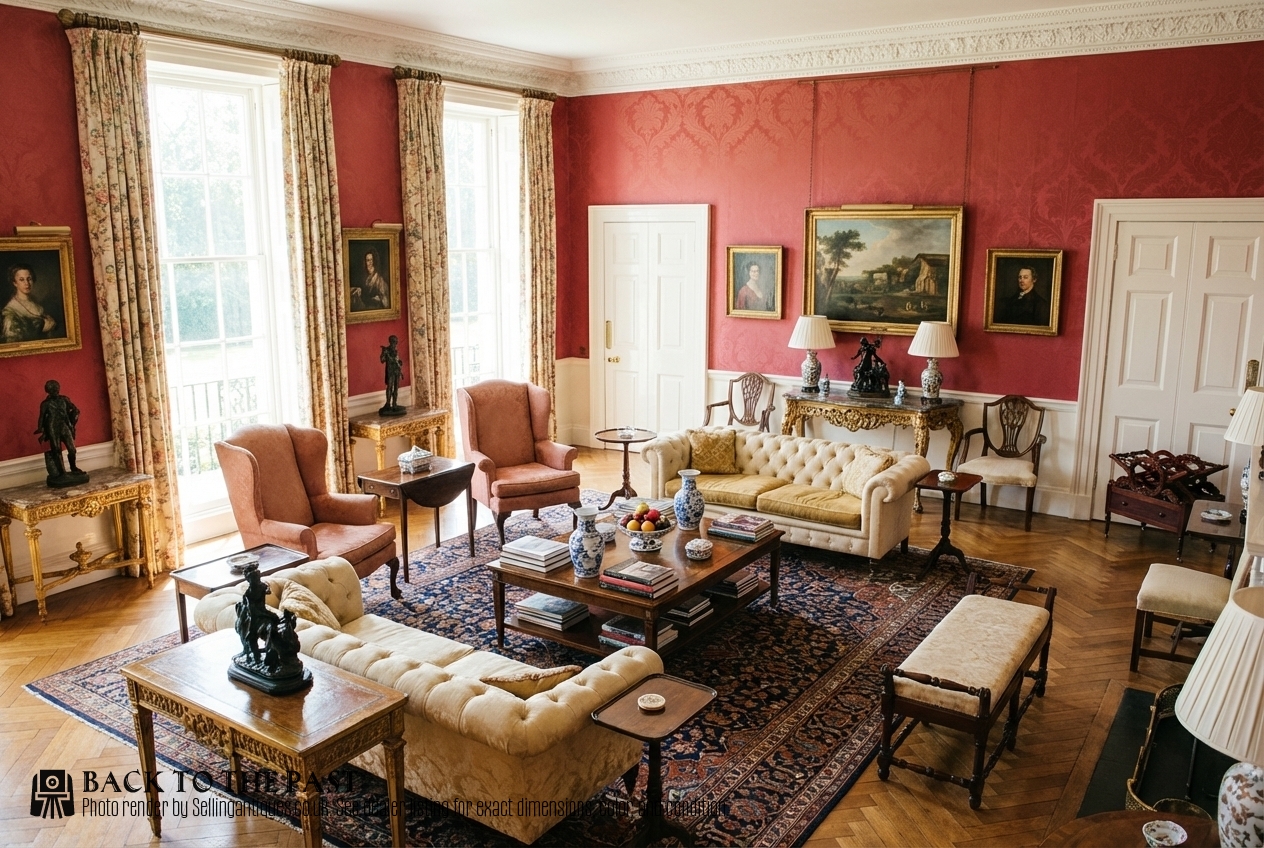
These stands suit sitting rooms, studies, or hallways where periodicals and newspapers accumulate. Their compact footprint allows them to sit beside a sofa or desk.
Because they feature finished woodwork on all sides, they can stand away from walls rather than needing to sit flush against them.
What is the difference between a Canterbury and a whatnot?
A Canterbury is specifically constructed with upright partitions for holding papers and frequently includes a low drawer at the base. A whatnot consists primarily of stacked open shelves intended for display.
While both serve as nineteenth-century occasional furniture, their primary internal layouts cater to different domestic chores.