

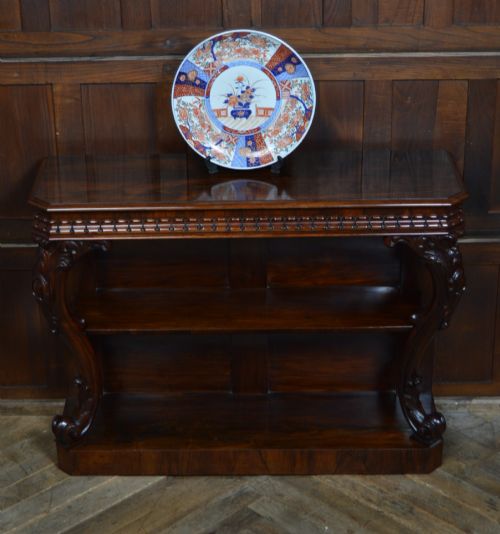


Rosewood Credenza Table
A rosewood credenza table is a substantive 19th-century display piece valued for its rich timber and refined surface integration.
Rosewood Credenza Table
A rosewood credenza table brings together dense, dark exotic timber with functional surface tops of marble, glass, or polished wood. Buyers searching this phrase will encounter sophisticated 19th-century forms that bridge the gap between enclosed storage and display furniture.
The pieces listed on this page span the Regency, William IV, and Victorian periods, alongside specific regional interpretations such as Scottish and Irish works. Forms include console tables, chiffoniers, side cabinets, and breakfronted display pieces rather than standard dining furniture.
Makers and craftsmen of the era utilised styles ranging from classical Regency lines to French Louis XV marquetry and Anglo-Indian detailing. The most likely version met here is a marble-topped rosewood console or chiffonier dating from the nineteenth century.
How they were made
Construction relies heavily on solid rosewood and matched veneers laid over stable secondary timbers, often accented with kingwood inlay or carved elements. Cabinetmakers shaped the heavy wood into breakfronts and curved console bases designed to support substantial weight.
Surface adornment integrates cast or chased ormolu mounts, brass details, and inset porcelain plaques into the wooden frame. Heavy marble slabs sit directly upon the timber bases, requiring precise carpentry to distribute the immense top weight evenly.
Internal spaces utilise fitted glass doors and mirrored backs to catch and reflect light within display cabinets and chiffoniers. Marquetry inlay techniques introduce contrasting tones of wood across French-influenced side cabinets.
Rosewood Credenza Table Retail Price Guide 2026
Typical asking prices for rosewood credenza table among the pieces listed under this phrase on Sellingantiques today, from the lower quarter to the upper quarter. They describe what is for sale here now, not the wider market.
Some Victorian cabinets hid their treasures behind heavy glass while displaying porcelain mounts that could easily trick the eye into thinking a French palace had been shrunk.
What varies in quality
Quality rests upon the selection and matching of the rosewood grain, where continuous figures and rich natural dark tones elevate a piece above standard workshop production. The crispness of hand-carved details and the integration of marquetry show the artisan's direct skill.
The choice of top material dictates much of the original cost and overall execution, with thick polished marble or fine porcelain mounts marking out superior commissions. Structural integrity in supporting heavy marble tops without sagging reveals the underlying joinery standard.
Hardware execution, from chased ormolu mounts to fitted brass grilles and functional mirror glass, separates standard utility furniture from high-status cabinet work.
Robert Strahan
The Rosewood Credenza Table Glossary
- Credenza
- A sideboard or cabinet used for displaying plate and serving food, evolving into a glazed display piece during the nineteenth century. It typically sits low against a wall.
- Chiffonier
- A low cabinet featuring shelves or enclosed cupboards beneath, popular throughout the Regency and Victorian eras. These pieces often incorporate a marble top.
- Ormolu
- Gilded bronze mounted onto furniture as decorative trim, requiring careful casting and mercury gilding techniques. It contrasts brightly against dark rosewood timbers.
- Marquetry
- The art of applying small pieces of veneer to a structure to form decorative patterns or pictures. Craftsmen used contrasting timbers like kingwood for this detailed work.
- Breakfront
- A piece of furniture where the central section projects forward from the flanking wings. This architectural arrangement creates depth and shadow on sideboards and cabinets.
Rosewood Credenza Table: Frequently Asked Questions
What is a rosewood credenza table?
A rosewood credenza table is a nineteenth-century furniture form combining rich tropical timber with display surfaces like marble or glass. These pieces served as decorative storage units in formal reception rooms.
They encompass console tables, chiffoniers, and side cabinets decorated with brass, ormolu, or porcelain mounts. The category spans Regency, William IV, and Victorian manufacturing periods.
How were these tables used originally?
Original nineteenth-century rooms utilised these cabinets for displaying porcelain, silver, and decorative objects while concealing household items behind doors. Their flat tops provided surfaces for lamps and ornamental figures.
Dining rooms and grand parlours housed these units against main walls to display wealth and host serving items. Glazed sections protected delicate collections from dust and handling.
How do I care for rosewood furniture?
Rosewood requires stable indoor humidity levels to prevent timber splitting and veneer lifting across large flat surfaces. Regular dusting with a dry, soft cloth maintains the polished finish without chemical buildup.
Direct sunlight should be avoided to prevent the dark rosewood grain from fading unevenly over decades. Marble and glass elements on top can be cleaned with mild, non-abrasive solutions.
How do I tell Regency from Victorian pieces?
Regency pieces often display restrained classical proportions inspired by Greek and Roman architecture, dating roughly from the early nineteenth century. Ormolu mounts and brass inlay are typical of this lighter, balanced aesthetic. Ninteenth-century Victorian examples tend to feature heavier proportions, bolder carving, and denser ornamentation. Cabinet makers of this later era frequently combined varied woods like kingwood and rosewood.