

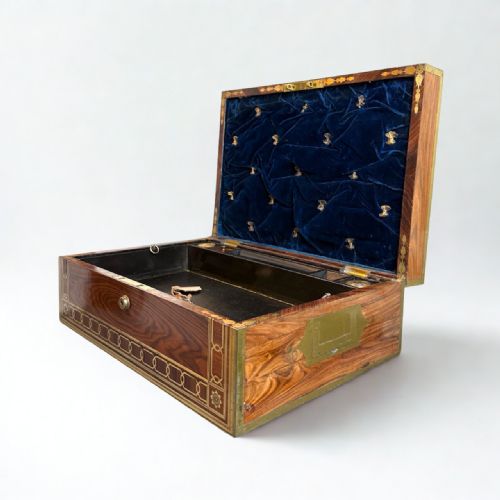


Rosewood Campaign Chest
A rosewood campaign chest offers portable elegance with rich timber grain, built for travel during the Georgian, Regency, and Victorian eras.
Rosewood Campaign Chest
When you search for a rosewood campaign chest, you are looking at practical portable furniture designed for officers and travellers across the nineteenth century, including Georgian and Regency periods. The forms on this page span chests of drawers, secretaire campaign chests, dressing boxes, writing slopes, and merchants trunks.
You are most likely to meet 19th century examples in rosewood, often featuring brass mounts and handles intended for rugged journeys. These pieces combine compact storage with sophisticated joinery, reflecting global movement during the colonial era and the height of the British Empire.
How they were made
Cabinetmakers constructed these items using dense rosewood, sometimes combined with mahogany, satinwood, and hongmu wood, built to withstand the rigours of transport. Brass inlay and heavy-duty brass corners reinforced the structural integrity while protecting vulnerable edges from impact.
Internal compartments often include glass, velvet, silver, and bone fittings to secure personal items, writing instruments, and jewellery during transit. Sectional construction allowed larger chests to separate into two parts for easier loading onto ships and carriages.
Many writing boxes retain tiny secret compartments hidden behind false drawer bottoms, designed to guard private letters from prying eyes.
What varies in quality
The sophistication of the internal fittings and the precision of the brass hardware distinguish finer examples from standard travel items. Superior pieces display seamless integration of secret drawers, clever folding mechanisms, and meticulously matched rosewood grain across multiple sections.
The origin and stylistic influences also shape the character of each piece, ranging from Anglo-Indian colonial craftsmanship to French campaign design and Chinese workshop traditions. The crispness of the brass inlay and the integrity of the original linings demonstrate the maker's original intent and subsequent care.
The Rosewood Campaign Chest Glossary
- Campaign chest
- Portable furniture built in sections with recessed brass handles and corner brackets, designed for military officers on the move. These pieces dismantle easily for transport across rough terrain.
- Secretaire
- A cabinet or chest featuring a pull-out writing drawer with a drop-front, concealing small drawers and pigeonholes. It combines a writing desk with storage.
- Writing slope
- A portable box with a hinged sloping lid that opens to reveal a slanted surface for writing, alongside inkwell compartments and storage. They were essential desk accessories for travellers.
- Hongmu wood
- A dense, dark tropical hardwood used in traditional Chinese furniture and travelling boxes. It offers durability and a deep reddish-brown colour.
- Brass inlay
- The technique of embedding thin strips of brass into the wood surface to form geometric or decorative patterns. This added both strength and ornamentation to travel chests.
Rosewood Campaign Chest: Frequently Asked Questions
What is a campaign chest?
A campaign chest is sturdy, portable furniture made in sections so officers could transport their belongings easily during military movements.
These chests feature recessed brass hardware to prevent snagging and damage during rough transit.
How do I date a rosewood chest?
You can date these chests by examining the construction methods, hardware styles, and the specific wood combinations used by makers in the Georgian, Regency, and Victorian periods.
Cabinetmakers adapted their designs over the nineteenth century, shifting from Georgian proportions to more elaborate Victorian and colonial styles.
Where were these chests used?
Officers, merchants, and diplomats used them across the British Empire, India, China, and Europe while travelling on military campaigns or long voyages.
Their modular design allowed them to be packed onto ships, wagons, and pack animals with minimal fuss.
How should I clean rosewood?
Maintain rosewood furniture by dusting gently with a soft cloth and occasionally applying quality beeswax to nourish the timber grain.
Avoid placing these pieces in direct sunlight or near heat sources to prevent the wood from drying out and cracking.