


Antique Rosewood Secretaire
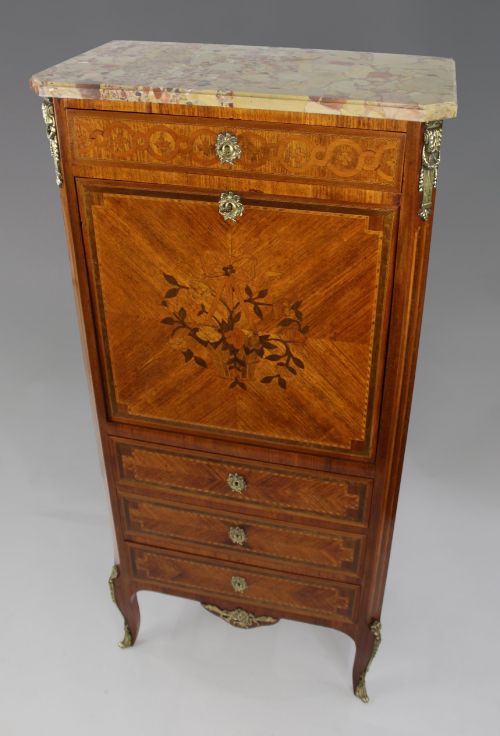
These antique rosewood secretaire pieces combine concealed writing surfaces with fine cabinetmaking, offering both fitted storage and a elegant display.
Antique Rosewood Secretaire
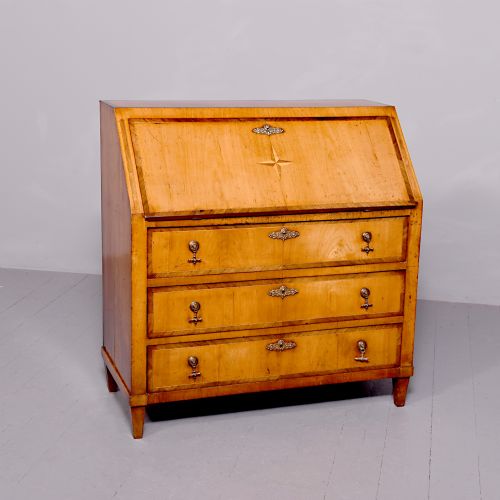
An antique rosewood secretaire is a cabinet or chest housing a drop-down writing flap or sliding drawer that conceals a fitted interior of small drawers and pigeonholes. When exploring this selection, a buyer encounters forms ranging from compact Wellington chests and upright abattants to low chiffoniers and elaborate French revival cabinets.
The material character defines the grouping, with rich dark timbers appearing alongside contrasting veneers such as kingwood, walnut, and maple. Pieces span periods from the eighteenth century through the Regency and Victorian eras into twentieth-century continental interpretations, often incorporating marble tops and metal mounts.
How they were made
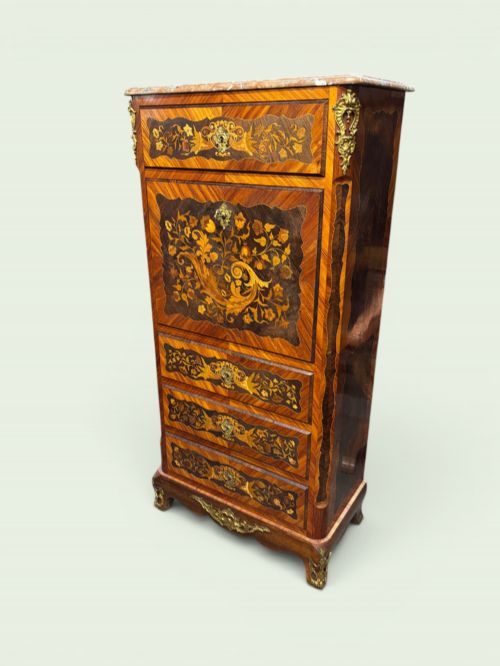
Cabinetmakers utilised dense tropical rosewood veneers laid over sturdy secondary timbers, sometimes employing intricate marquetry and contrasting brass inlay to decorate the primary surfaces. Metal elements such as ormolu mounts and brass stringing provide structural highlights and decorative borders.
Interiors frequently integrate fitted leather writing surfaces within the drop-down flaps or pull-out drawers, complemented by marble slabs fitted to the upper surfaces of continental and French cabinet forms.
Listings feature nineteenth-century Regency, Victorian, and French Rococo Revival styles alongside marble-topped and brass-inlaid rosewood forms.
What varies in quality
The standard of execution depends heavily on the precision of the veneer work, the tightness of the jointing in the concealed desk compartments, and the integration of secondary woods. Superior examples maintain crisp brass inlay and well-matched grain patterns across the primary facade.
Hardware integrity and the smoothness of operation in drop-front mechanisms, secret drawers, and locking systems distinguish finer workshop production from simpler utility pieces.
Maison Krieger
The Antique Rosewood Secretaire Glossary
- Secretaire abattant
- An upright wall cabinet featuring a vertical front that folds down to create a writing desk surface. This form typically conceals multiple internal pigeonholes and small drawers.
- Wellington chest
- A tall, narrow chest of drawers secured by a hinged locking stile on one vertical edge. Rosewood versions frequently incorporate a secretaire drawer within the upper section.
- Ormolu
- Gilded bronze mounts cast in decorative scrollwork or classical motifs. These elements are applied to the corners, feet, and friezes of French revival cabinets.
- Marquetry
- The art of forming decorative patterns by fitting together contrasting veneer slices. Craftsmen utilise various coloured woods to produce floral or geometric imagery on the cabinet face.
- Escritoire
- A light writing cabinet or desk designed for correspondence. The term encompasses various continental and English freestanding writing furniture types.
Antique Rosewood Secretaire: Frequently Asked Questions
What is a secretaire?
A secretaire is a piece of furniture equipped with a writing flap or a drawer that pulls out to reveal a desk surface and small compartments for stationery.
These pieces combine the storage capacity of a cabinet or chest with the utility of a dedicated writing desk.
How do I identify a Regency secretaire?
Regency pieces often display classical proportions, dark rosewood surfaces, and precise brass inlay work.
They frequently take the form of chiffoniers or low cabinets with integrated writing drawers designed for early nineteenth-century domestic use.
What is an abattant?
An abattant is an upright cabinet featuring a fall-front door that drops down horizontally to serve as a writing platform.
This vertical format maximises storage floor space while providing a concealed writing compartment.
How do I care for rosewood?
Rosewood furniture requires stable indoor humidity levels and protection from direct sunlight to prevent veneer drying or fading.
Gentle dusting with a soft, dry cloth preserves the polished timber surface without needing heavy chemical polishes.