
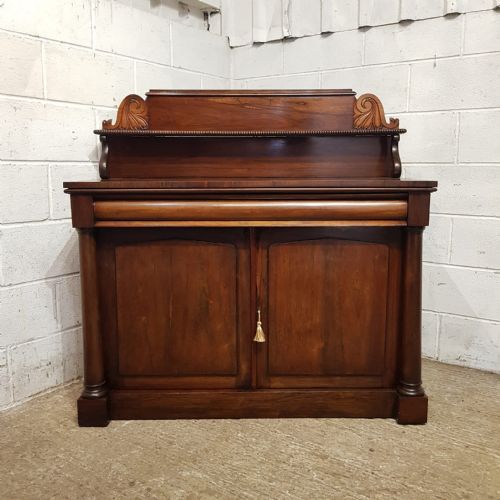
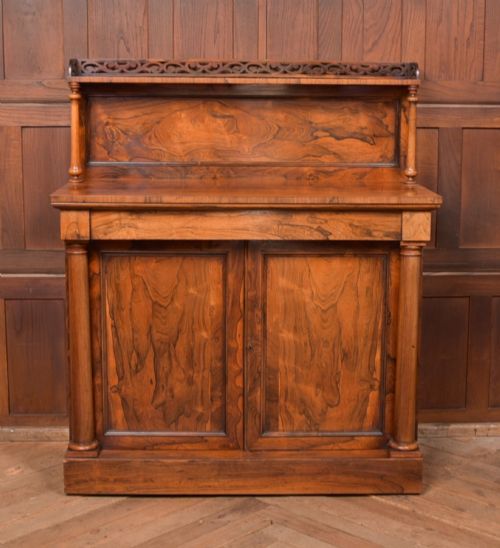


Rosewood Buffet Cupboard
These rosewood buffet cupboard examples combine rich timber with practical storage, offering a sophisticated centrepiece for dining rooms and drawing rooms alike.
Rosewood Buffet Cupboard
A rosewood buffet cupboard brings substantial presence and rich grain to a room, functioning primarily as a serving station or display surface. Buyers seeking a rosewood buffet cupboard encounter various forms, most commonly Victorian chiffoniers and Regency side cabinets featuring enclosed lower storage.
The objects span multiple periods including Regency, William IV, and Victorian, alongside George III revival pieces and Anglo-Indian colonial examples. These items serve multiple purposes within a domestic interior, combining counter space with cupboards and occasionally shelving above.
Common forms listed encompass side cabinets, chiffoniers, credenzas, and four-door variants. Most pieces belong to the nineteenth century, reflecting the popularity of dark, exotic hardwoods during that era.
How They Were Made
Cabinet makers utilised dense rosewood veneers applied to solid secondary timbers, often accentuating the design with contrasting satinwood or ebony stringing and marquetry. Brass mounts, grille doors, and mirror glass appear frequently across the pieces, adding textural contrast to the dark timber.
Structural elements frequently incorporate fabric panels behind glass doors, carved architectural details, and fitted interior shelving. The construction techniques range from simple carcases to elaborate revival work featuring detailed hand carving.
Sigmund Jaray brought Viennese flair to British tastes, ensuring your buffet cupboard comes with a proper passport.
What Varies in Quality
Quality rests upon the selection and matching of the rosewood veneer, the crispness of any applied carving, and the integrity of the secondary timbers. Superior examples display thoughtful grain continuity across doors and drawers, alongside robust internal construction.
The refinement of brass hardware, the execution of marquetry details, and the overall proportion separate standard production from exceptional cabinet work. Maker attribution, where present, further distinguishes the standing of an individual piece.
Sigmund Jaray Wien
The Rosewood Buffet Cupboard Glossary
- Chiffonier
- A low sideboard or cabinet, typically featuring a raised shelf or superstructure at the back and enclosed cupboards below. This form became particularly popular during the Regency and Victorian periods for storing china and linens.
- Marquetry
- Decorative veneer work formed by fitting together small pieces of various coloured woods, ivory, or shell to create pictorial or geometric patterns. Makers used this technique on high-status surfaces to display technical skill.
- Veneer
- A thin layer of superior timber applied to a base of a cheaper wood to provide a decorative exterior surface. High-grade examples employ thick rosewood slices carefully laid to preserve natural grain symmetry.
- Credenza
- A sideboard or buffet cabinet originally designed for displaying plate, lacking the high back of a traditional chiffonier. The form evolved through the nineteenth century into low, multi-door storage units.
- Stringing
- Inlaid lines of contrasting timber used to edge panels, tabletops, and drawer fronts. This subtle detail defines borders and frames the distinct grain of the primary wood.
Rosewood Buffet Cupboard: Frequently Asked Questions
What is a rosewood buffet cupboard?
A rosewood buffet cupboard is a nineteenth-century storage piece made from dense, dark timber, designed primarily for dining rooms or reception spaces. These items combine a flat top surface with enclosed lower compartments for tableware and provisions.
They appear in various styles including Regency, William IV, and Victorian, reflecting the shifting tastes of the period.
How do I date a rosewood cabinet?
Dating relies upon observing stylistic markers, construction methods, and the specific proportions associated with periods like Regency or Victorian cabinet making. Regency pieces often exhibit classical restraint, while Victorian variants may feature heavier carving and Renaissance revival motifs.
Material choices, such as the inclusion of satinwood stringing or mirror glass, also help narrow the decade of manufacture.
Where were these cabinets placed?
These pieces traditionally stood against dining room walls to hold serving dishes, cutlery, and glassware during meals. In drawing rooms, they served as display surfaces for decorative objects while concealing books or papers inside.
The inclusion of shelves or mirrors on certain chiffonier variants suggests a secondary role for display.
How do I care for rosewood furniture?
Maintenance involves keeping the timber away from direct sunlight and sudden temperature shifts to prevent the veneer from drying or cracking. Regular dusting with a soft, dry cloth preserves the polished finish without building up residue.
Occasional treatment with appropriate wax maintains the moisture and deep lustre of the rosewood surface.
What distinguishes a chiffonier from a side cabinet?
A chiffonier typically incorporates a raised superstructure or shelf back mounted above the main surface, whereas a standard side cabinet presents a flat top. Both share enclosed lower storage accessed via doors.
Chiffoniers are more commonly found in Regency and Victorian contexts, whereas side cabinets span a broader range of revival styles.