
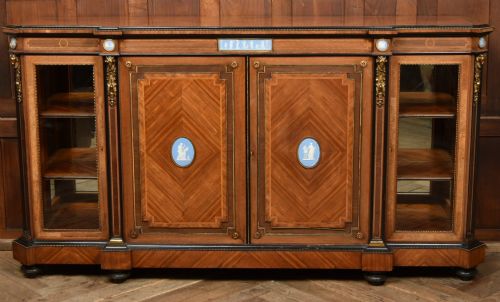
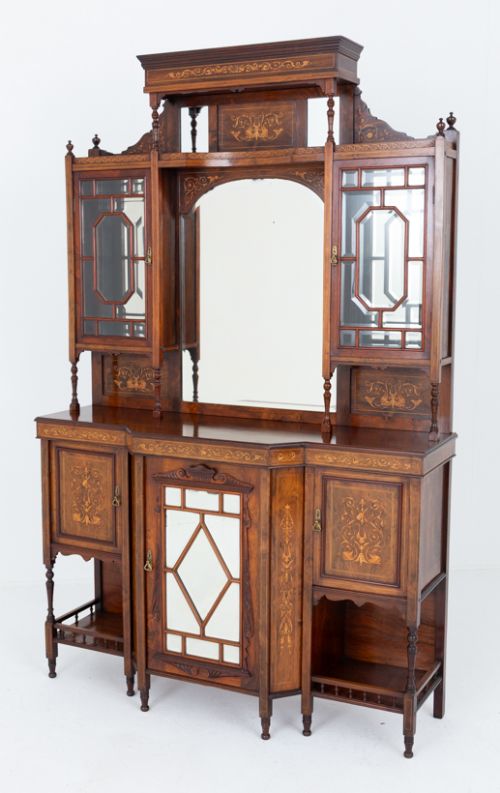


Rosewood Breakfront Sideboard
A rosewood breakfront sideboard anchors a grand dining room or parlour with figured timber and a stepped, projecting central section.
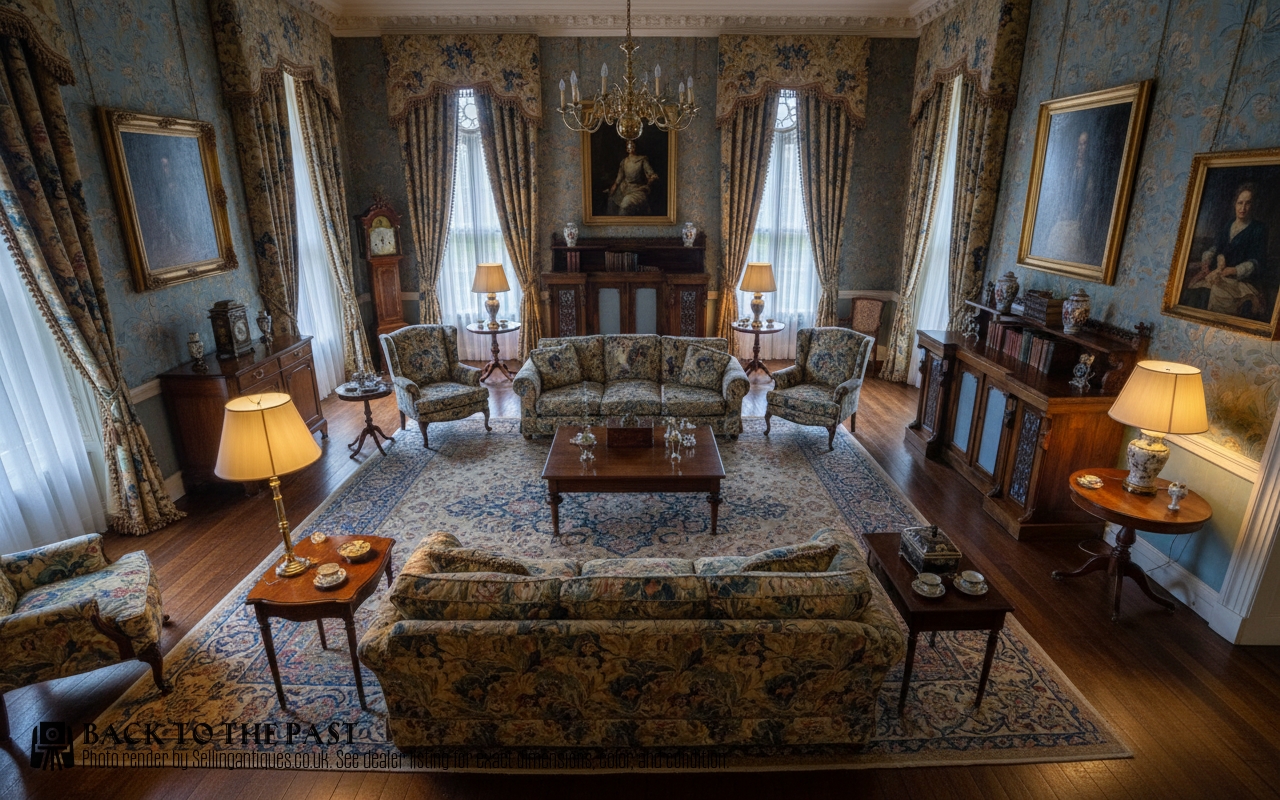
Rosewood Breakfront Sideboard
A rosewood breakfront sideboard brings together substantial storage and formal display, appearing primarily in Regency and Victorian designs across the evidence. The form relies on a central section that steps forward from flanking cabinets, creating depth and shadow across the front elevation.
Makers utilised rich tropical timbers to construct these pieces, often pairing the main structure with brass inlay, mirror glass, or marble tops. Examples on this page span the early nineteenth century through to later Victorian interpretations, including related forms such as chiffoniers and credenzas.
How They Were Made
Cabinetmakers built these pieces using dense rosewood veneers laid over secondary carcase timbers, sometimes substituting simulated rosewood for the solid grain. Surface decoration frequently involved brass stringing, boullework, or marquetry panels set directly into the timber doors.
Secondary materials such as marble, ormolu mounts, and mirrored glass appear across the nineteenth-century examples to enhance the formal appearance of the cabinets. Structural details range from turned columns to glazed display doors framed in the same dark wood.
Miniature side cabinets appear alongside full-scale furniture, offering tea caddies configured to mimic grand breakfront proportions.
What Varies in Quality
Quality rests upon the selection and matching of the rosewood grain across the broad expanses of the doors and central breakfront section. Finer workshops ensured that the timber figures mirrored symmetrically, while simpler items relied on uniform dark staining or simulated grain.
The precision of the brass inlay and the integration of secondary elements like marble tops or ormolu mounts dictate the tier of the piece. Robust internal shelving and well-fitted doors distinguish standard production cabinets from grander attribution pieces.
Collinson and Lock·Gillow·Howard and Sons
The Rosewood Breakfront Sideboard Glossary
- Breakfront
- A cabinet front where the central section projects forward from the flanking wings. This architectural arrangement creates a dynamic play of light and shadow across the timber surface.
- Credenza
- A low sideboard or cabinet often featuring glass doors or open shelving for display. The form gained popularity in formal reception rooms during the Victorian period.
- Chiffonier
- A compact sideboard equipped with enclosed shelving and frequently a raised superstructure or mirrored back. It serves as a practical serving and storage station.
- Boullework
- An elaborate marquetry technique using brass and tortoiseshell inlaid in intricate patterns. It adorns high-status nineteenth-century French and English cabinetwork.
- Marquetry
- Decorative patterns formed by fitting together thin veneers of various coloured woods. Craftsmen applied these pictorial designs to cabinet doors and friezes.
Rosewood Breakfront Sideboard: Frequently Asked Questions
How do I clean rosewood furniture?
Dust the timber regularly with a soft, dry cloth to prevent grit accumulation on the polished surface. Avoid silicone-based sprays and excess moisture, which can damage nineteenth-century polish.
Apply a traditional beeswax sparingly when the wood appears dry, buffing it gently to maintain the natural sheen of the rosewood grain.
Where should I place a breakfront sideboard?
Position the piece against a substantial wall in a dining room, hallway, or principal reception space where its proportions can be appreciated. Ensure it remains away from direct heat sources and strong sunlight to protect the sensitive veneers.
Allow sufficient clearance in front of the cabinet for the doors to open fully without obstruction from other furniture.
What is the difference between a sideboard and a chiffonier?
A sideboard is typically a longer, lower piece designed primarily for dining room storage and serving. It offers generous cupboard space and a broad top surface.
A chiffonier is generally more compact and frequently includes a raised shelf or back panel, reflecting its evolution as a multi-functional parlour cabinet.
How do I distinguish Regency from Victorian pieces?
Regency pieces often display classical architectural restraint, clean lines, and restrained brass inlay or brass grilles. The timber selection tends toward dark, richly grained rosewood with minimal carving.
Victorian examples frequently introduce heavier proportions, more elaborate marquetry, barley twist columns, or glazed display sections designed to showcase decorative objects.