


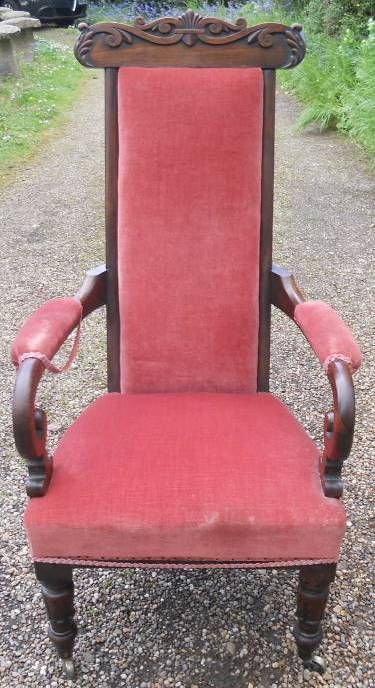


Rosewood Armchair on Castors
A rosewood armchair on castors brings the rich grain and solid weight of nineteenth-century seating directly into a room.
Rosewood Armchair on Castors
A rosewood armchair on castors is a substantial piece of seating designed for the library or study during the Regency, William IV, and Victorian eras. These chairs combine rich timber with mobility, allowing a heavy seat to move across a carpet without marking the floor.
The versions most commonly met on this page date from the nineteenth century, including specific styles from the Regency, George IV, Early Victorian, and William IV periods. They often appear as single library chairs or matched pairs.
Makers shaped these chairs from dark rosewood, sometimes utilising simulated or faux finishes on alternative woods. They range from low open armchairs to high-backed library seats upholstered in leather, velvet, cane, or textile.
How they were made
Cabinet makers built these frames using dense rosewood, selecting timber for its dark grain and polished finish. Some workshops used simulated rosewood or faux finishes on alternative timbers to achieve the desired dark aesthetic.
Brass castors, frequently featuring cup designs, were fitted to the base of the legs to provide smooth movement across heavy floor coverings. Upholstery methods incorporated traditional materials such as leather, cane, velvet, and various textiles fastened to the supportive framework.
Rosewood Armchair on Castors Retail Price Guide 2026
Typical asking prices for rosewood armchair on castors among the pieces listed under this phrase on Sellingantiques today, from the lower quarter to the upper quarter. They describe what is for sale here now, not the wider market.
Bobbin-turned woodwork brings a cheerful, spool-like rhythm to the frame of a faux rosewood chair.
What varies in quality
The distinction between standard examples and the finest work lies in the depth of the timber carving and the sophistication of the frame proportions. Superior library chairs display crisp execution in structural details and careful selection of figured rosewood veneer.
Attribution to known workshops or the presence of original brass castors and high-grade upholstery materials elevates a piece. Simpler versions, including simulated rosewood or stickback designs, represent more utilitarian production from the same period.
Gillows
The Rosewood Armchair on Castors Glossary
- Rosewood
- A dense, heavily grained tropical hardwood prized for its dark colour and fine polish. It was the material of choice for high-status seating during the nineteenth century.
- Bergère
- An enclosed upholstered armchair with a wooden frame where the sides are often filled with canework. This style gained popularity during the Regency and early Victorian periods.
- Castor
- A small wheel mounted on a swivel assembly attached to the bottom of a furniture leg. Brass cup versions are frequently found supporting heavy nineteenth-century library chairs.
- Regency
- A British design period spanning the early nineteenth century, characterised by classical revival motifs and refined proportions. Furniture from this era often incorporates bold architectural lines.
Rosewood Armchair on Castors: Frequently Asked Questions
What periods do these armchairs come from?
These pieces date from the nineteenth century, spanning the Regency, George IV, William IV, and early Victorian eras.
Craftsmen built them across a broad timeframe from approximately eighteen hundred to eighteen fifty, reflecting evolving stylistic tastes.
Why do they have castors?
Castors were fitted to heavy library chairs to allow easy movement across thick carpets and heavy rugs.
This mobility made it simple to reposition a substantial timber chair near a fireplace or desk without lifting its weight.
What is simulated rosewood?
Simulated or faux rosewood is an alternative timber painted or grained to mimic the dark, figured appearance of genuine rosewood.
This technique offered a cost-effective way to achieve a high-status aesthetic during the nineteenth century.
How do I identify a library chair?
Library chairs are typically sturdy, heavy armchairs designed for prolonged sitting in study spaces.
They often feature robust rosewood frames, supportive upholstered or caned backs, and practical castors for mobility.