
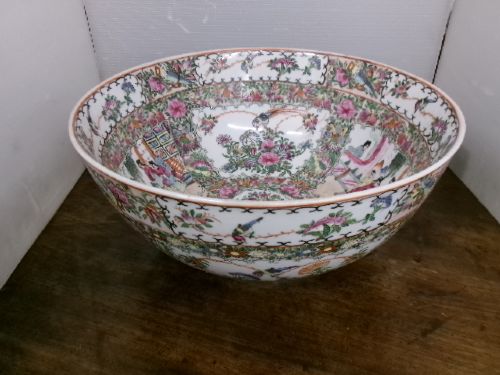
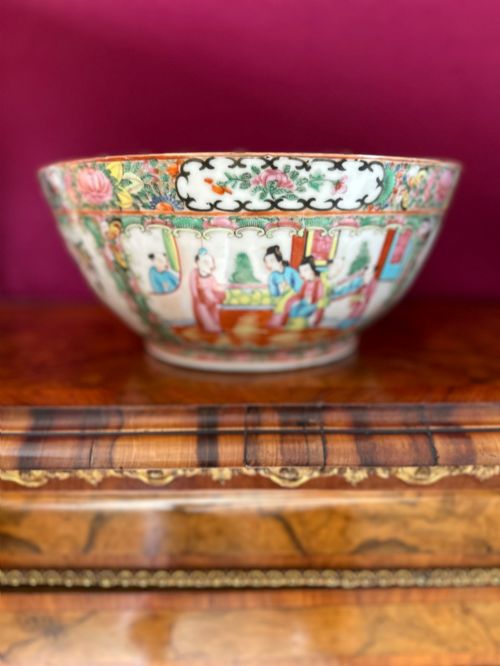

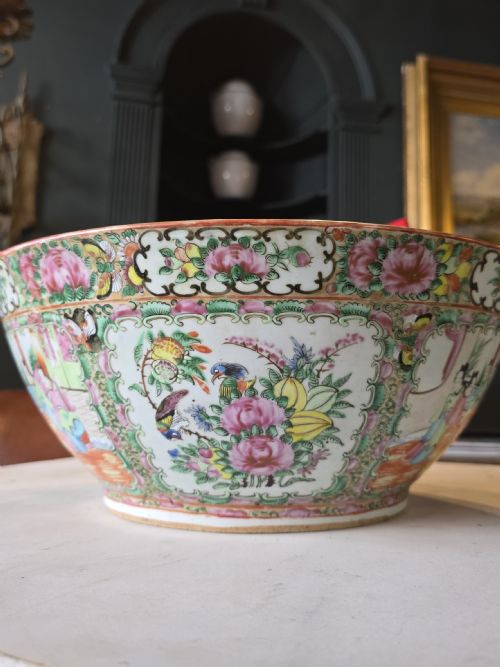


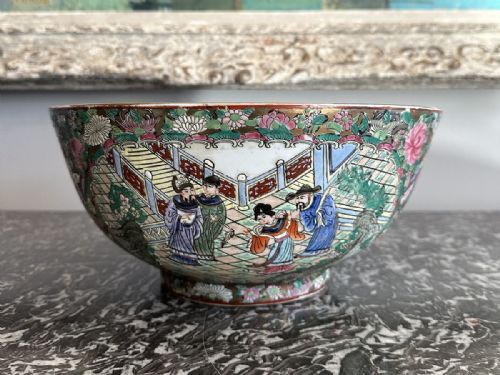


Rose Medallion Bowl
These rose medallion bowls are vibrant, panel-painted Chinese export vessels that bring rich nineteenth-century Cantonese colour to a room.
Rose Medallion Bowl
A rose medallion bowl presents panels of figures and birds set among dense floral ground, a signature of Cantonese decoration. When you search for a rose medallion bowl, you encounter porcelain vessels primarily originating from nineteenth-century China, with pieces spanning the Victorian era and the twentieth century.
The forms range from standard decorative bowls and centrepiece pieces to substantial punch bowls reaching up to twenty inches in diameter. Many examples arrive paired with hardwood stands or ormolu mounts, adding height and presence to the table.
The production aligns closely with Qing Dynasty export ware and Chinese export porcelain, capturing a distinct aesthetic that blends storytelling scenes with intricate botanical detail. These vessels function naturally as centrepieces, drawing the eye through sheer scale and painted complexity.
Materials and construction
The foundation rests on white porcelain, fired and then painted by hand in workshops that specialised in export porcelain for Western markets. Overglaze enamel colours are applied with precision, often complemented by gold leaf or gilt highlights that catch the light across the rim and panels.
Makers integrated gilt bronze mounts on certain pieces, combining European metalwork with Chinese porcelain. Hardwood stands provide a stable base for the larger bowls, turned and fitted to cradle the rounded profile of the vessel securely.
The listings span from the eighteenth century through to the Victorian era and the mid-twentieth century, predominantly featuring porcelain and overglaze enamel.
Assessing quality and finish
The refinement of the hand-painted figures dictates the standing of a piece, with superior examples showing crisp detail in facial expressions and botanical motifs. The density and execution of the surrounding floral ground separate standard output from the finest workshop commissions.
Scale and proportion also influence the tier of the piece, particularly in punch bowls and large twenty-inch basins where maintaining a balanced circle during firing demands high technical skill. The preservation of the overglaze enamel and the brightness of the gilding remain central to the visual strength of the object.
The Rose Medallion Bowl Glossary
- Overglaze enamel
- Pigments applied on top of the fired glaze and fixed with a lower temperature second firing. This technique allows for brilliant pinks and greens that define the palette.
- Ormolu
- Gilded bronze mounts applied to the exterior of certain bowls. This French mounting style was often added in Europe to elevate decorative export pieces.
- Famille rose
- A ceramic palette dominated by opaque pink enamel, introduced during the Qing Dynasty. It forms the foundation of the colouring on these vessels.
- Punch bowl
- A large, deep bowl historically utilised for mixing and serving communal drinks. Their capacity necessitated robust porcelain walls and wide diameters.
- Chinese export
- Porcelain manufactured in China specifically for international markets in Europe and America. These pieces reflect a fusion of Eastern technique and Western taste.
Rose Medallion Bowl: Frequently Asked Questions
How were these bowls originally used?
These vessels served as punch bowls for communal gatherings or as grand decorative basins in prominent rooms. Their expansive surfaces were designed to display wealth and artistic patronage during formal dining.
Over time, many transitioned into pure display pieces, placed on central tables or mounted stands to showcase the painted panels.
How do I date a nineteenth century piece?
Dating relies on examining the weight of the porcelain, the vibrancy of the overglaze enamels, and the style of the hand-painted figures. Nineteenth-century examples often exhibit characteristic Qing Dynasty export traits and heavier potting.
Archival records and comparison with documented Victorian imports help narrow the production window further.
How do I care for a porcelain bowl?
Dust the surface gently with a soft, dry cloth to prevent accumulation within the intricate enamel crevices. Avoid harsh chemical cleaners that might degrade the delicate overglaze colours and gilt highlights.
Ensure the bowl rests securely on a level surface, utilising a fitted hardwood stand if the base is rounded.