


Rococo Revival Etagere
A rococo revival etagere brings tiered elegance and fluid curves into a room, offering both display space and decorative presence.
Rococo Revival Etagere
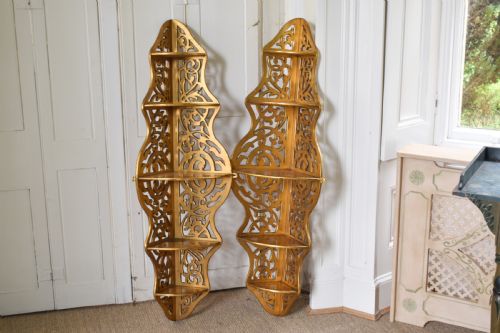
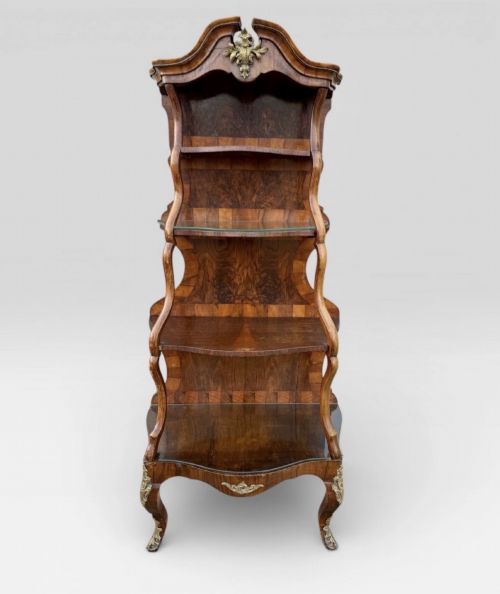
A rococo revival etagere is typically found as a tiered shelf, wall bracket, or corner unit designed for displaying small objects. These pieces draw on nineteenth-century design, featuring the characteristic serpentine lines and asymmetrical scrolls of the style.
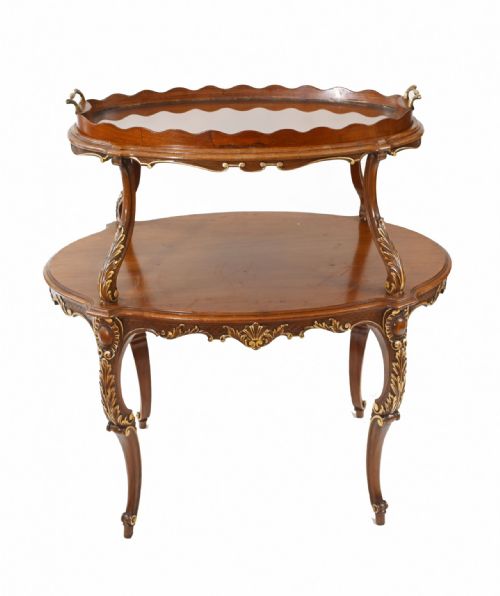
The versions appearing here range from Victorian walnut and mahogany examples to later painted and gilded wall etageres. Buyers encounter both floor-standing tiered tables and hanging wall shelves, reflecting the varied domestic needs of the nineteenth and early twentieth centuries.
Forming part of the broader category of etageres and whatnots, these items combine practical shelving with ornamental carved woodwork. Their origins span English and continental workshops, encompassing specific Victorian interpretations as well as French Louis XV style influences.
Materials and construction
Makers utilised timber such as walnut and mahogany alongside giltwood, gesso, and ormolu mounts to build these structured display units. The primary framework often involved carved wood finished with applied gilding or polished grain.
Mirrored backs and glass elements appear in several pieces, adding depth and reflection behind the displayed items. Carved details and serpentine mouldings define the structural silhouettes, uniting traditional cabinet-making with ornate surface decoration.
Listings feature items from the nineteenth century up to 1930, utilising walnut, mahogany, giltwood, and glass mirror.
Judging the standard
Quality rests in the crispness of the carved woodwork and the integration of gilt metal mounts or gesso ornament. Smoother serpentine lines and more complex tiered arrangements distinguish finer examples from simpler provincial pieces.
The handling of secondary materials, such as mirrored glass and applied finishes, indicates the level of care taken during production. Stronger construction in joints and shelf supports separates robust utility from purely decorative fragility.
The Rococo Revival Etagere Glossary
- Etagere
- A piece of furniture consisting of a set of open shelves for displaying small objects or ornaments. These tiered stands developed in France and became popular across European interiors.
- Whatnot
- A nineteenth-century multi-shelved stand used for storage and display. The term emerged as these open pieces accommodated whatever objects owners wished to exhibit.
- Ormolu
- Gilded bronze or brass applied as decorative mounts on furniture. This technique provided metallic highlights that complemented carved wood and gilt finishes.
- Serpentine
- A curved line or edge that waves inward and outward, resembling a snake. This contour is central to rococo design, giving furniture an organic sense of movement.
- Gesso
- A plaster-like mixture applied to wood surfaces as a base for gilding or painting. It allowed craftsmen to build up relief ornamentation before applying gold leaf.
Rococo Revival Etagere: Frequently Asked Questions
What is an etagere?
An etagere is an open piece of furniture featuring multiple tiers designed for displaying small decorative objects. These units provide vertical storage while keeping items fully visible.
They developed in various forms, including freestanding tables, corner shelves, and wall-mounted brackets, serving both utility and ornamentation in period rooms.
How were these shelves used?
These pieces served as display surfaces for porcelain, small bronzes, books, and curiosities in nineteenth-century interiors. Their open tiers allowed collectors to showcase prized possessions.
Placed in corners, against walls, or beside seating, they maximised display space without overwhelming smaller sitting rooms.
Where do I put an etagere?
An etagere fits well in living rooms, hallways, or libraries where vertical display space is needed. Corner units utilise overlooked angles, while wall shelves save floor space.
Pairing them with neutral walls lets the carved wood and gilt details stand out effectively within a modern interior.
How do I spot Victorian pieces?
Victorian examples often feature walnut or mahogany timbers, alongside carved gesso and mirrored panels. Their construction reflects nineteenth-century manufacturing methods.
Stylistic markers include heavy serpentine curves and asymmetrical rococo revival motifs that distinguish them from earlier or later furniture.