





Rococo Mantel Clock Set
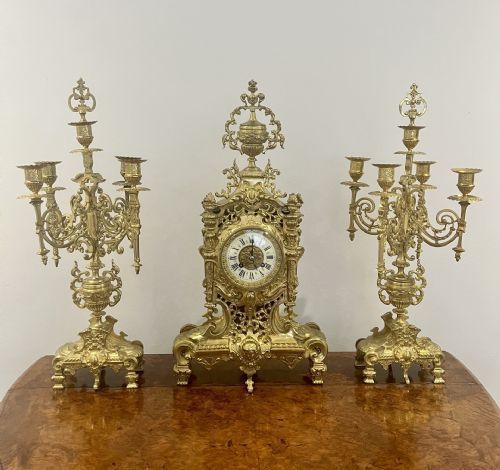
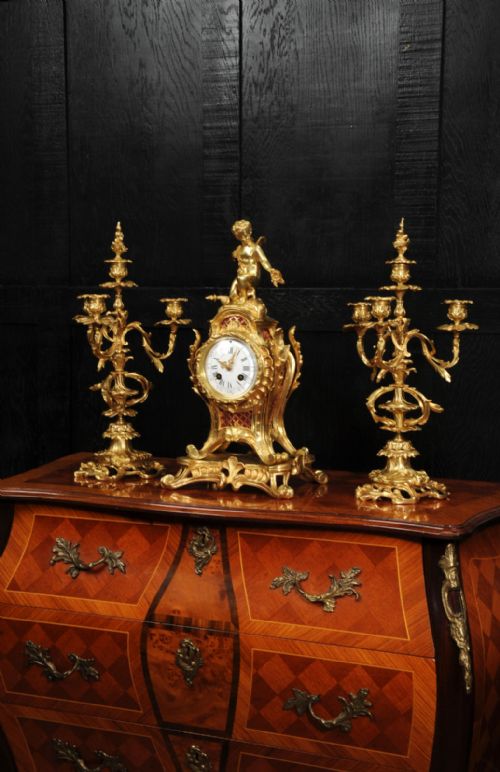
A rococo mantel clock set brings exuberant 19th-century French revival styling and matching garnitures to a room, offering ornate metalwork and painted porcelain figures.
Rococo Mantel Clock Set
A rococo mantel clock set comprises a central clock accompanied by matching garnitures such as candelabras, forming a unified decorative display for a chimney piece. These ensembles typically date from the 19th century and embrace French Rococo Revival or Louis XV Revival aesthetics.
The objects take the form of clock garnitures, clock sets, and mantel clocks built around ornate sculptural themes. Pieces often incorporate figures like cherubs and cupids alongside elaborate scrolls and asymmetrical foliage characteristic of the revival styles.
Originating predominantly from French workshops and continental makers during the Victorian era, these sets combine timekeeping with high-status interior ornamentation. Surviving examples showcase diverse material combinations ranging from gilt bronze to decorated porcelain.
How they were made
Makers utilised cast bronze, brass, and ormolu to form the heavy, scrolling chassis of the clock and its matching garnitures. These metal elements were frequently gilt or polished to achieve a bright, reflective surface finish.
Porcelain components, including painted panels and dial faces, were integrated into the metal frames, often drawing on styles associated with Sevres, Meissen, or KPM Berlin. Glass covers protected the delicate dials while steel components functioned within the internal clock movements.
Rococo Mantel Clock Set Retail Price Guide 2026
Typical asking prices for rococo mantel clock set among the pieces listed under this phrase on Sellingantiques today, from the lower quarter to the upper quarter. They describe what is for sale here now, not the wider market.
Cupids and cherubs frequently peer out from the gilt scrollwork, keeping watch over the mantelpiece.
What varies in quality
The standard of ciselure and casting defines the crispness of the scrollwork and figural details across the ormolu and bronze mounts. Finer sets display deep, sharp relief and careful hand-chasing after casting, whereas lesser examples appear softer and more uniform.
The artistry of the porcelain panels and the integration of secondary materials like red marble or Imari ceramics elevate the overall ambition of the set. Superior manufacturing is evident in the harmonious proportion between the central clock and its flanking garnitures.
Vincenti of Paris·Raingo Fres Paris
The Rococo Mantel Clock Set Glossary
- Garniture
- A set of ornamental objects designed to match and display together, typically comprising a central clock flanked by two candelabras or urns.
- Ormolu
- Gilding technique where finely ground high-carat gold is applied to a bronze base, or the gilded bronze object itself. This finish provides the characteristic golden gleam on 19th-century French sets.
- Rococo Revival
- A 19th-century design movement resurrecting the 18th-century French Louis XV style characterised by asymmetry, C-scrolls, and naturalistic shell motifs.
- Imari porcelain
- Japanese porcelain decorated in underglaze blue and iron red with gold accents, frequently mounted in European ormolu for these clock sets.
Rococo Mantel Clock Set: Frequently Asked Questions
How do I set up a rococo mantel clock set?
Place the central clock and its matching garnitures on a stable, level mantelpiece or surface to ensure accurate timekeeping and safe display of the heavy metal components.
Carefully check the pendulum and internal mechanical parts before winding the movement, taking care not to force the hands past their limits.
What periods do these clock sets come from?
The available sets originate predominantly from the 19th century, spanning the Victorian era and decades such as the 1850s, 1870s, 1880s, and 1890s.
They reflect French design revivals that looked back to the earlier Louis XV reign for their decorative vocabulary.
What materials are used in these sets?
Makers constructed these pieces using metals such as bronze, brass, ormolu, and steel, paired with glass to protect the clock face.
Many examples incorporate porcelain panels, enamel dials, and occasionally red marble or Imari ceramic elements.
What are garnitures?
Garnitures are the matching decorative pieces, such as candelabras or urns, that accompany the central clock to create a balanced three-piece or multi-piece mantel display.
They share the same stylistic motifs, materials, and finishing techniques as the main clock body.