

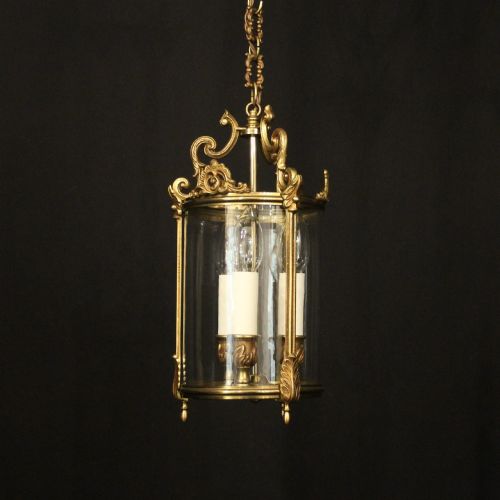
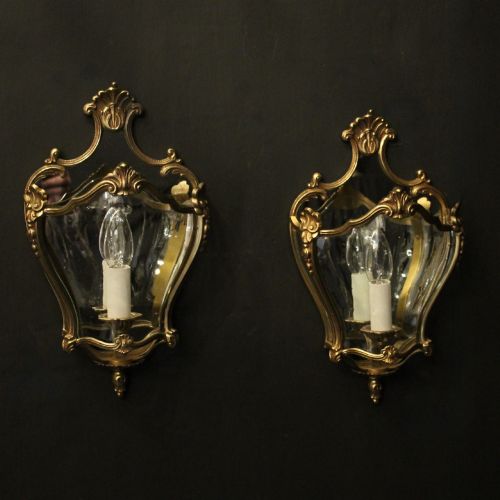


Rococo Bronze Lantern
A rococo bronze lantern brings ornate French style and warm metalwork to an entrance hall.

Rococo Bronze Lantern
A rococo bronze lantern is a hanging or wall-mounted light fitting shaped by florid asymmetrical curves, scrolling foliage, and shell motifs drawn from eighteenth-century French design. These pieces illuminate hallways, corridors, and reception spaces with character, drawing the eye upward with intricate metalwork frames enclosing glazed panels.
Most examples found here hail from France, dating across the nineteenth and early twentieth centuries, though English interpretations also appear. They span various formats, including single-hanging hall lanterns, multi-light chandeliers, pairs of half-lanterns, and matching wall sconces designed for flanking doorways.
The aesthetic leans heavily into French Rococo Revival and Louis XV style, often executed through cast bronze that has been gilded or silvered. Buyers encounter robust fixtures ranging from twin-light configurations to large four-light models suited to grander entranceways.
How they were made
These lanterns rely upon cast bronze and brass frameworks, shaped into flowing organic scrolls and pierced rocaille motifs characteristic of the style. The metal components are frequently finished with a layer of gold leafing, producing gilded bronze or silvered bronze surfaces that reflect candlelight or electric illumination.
Glass panels are individually cut and fitted into the metal armature, often featuring curved or bevelled edges to catch the light from internal bulbs. The structural joints are pinned or screwed together securely, supporting the weight of multi-light internal clusters and heavy metal frames.
Rococo Bronze Lantern Retail Price Guide 2026
Typical asking prices for rococo bronze lantern among the pieces listed under this phrase on Sellingantiques today, from the lower quarter to the upper quarter. They describe what is for sale here now, not the wider market.
The listings here encompass pieces spanning the nineteenth century through to the 1930s, utilising materials including bronze, brass, glass, and silvered bronze.
What varies in quality
The distinction between ordinary and exceptional pieces lies in the crispness of the bronze casting and the depth of the chasing work. Finer examples display sharp, undercut foliage and delicate asymmetry that feels organic rather than mechanical, whereas lesser pieces show softer, shallower relief work.
Surface finishing also dictates the hierarchy, with genuine fire-gilding or well-applied silver leaf ageing gracefully compared to flat modern metallic paints. The quality of the glass panes and the solidity of the internal light clusters further separate standard production from superior workshop output.
The Rococo Bronze Lantern Glossary
- Rococo
- A decorative style originating in France during the eighteenth century, defined by asymmetry, C-scrolls, and shell-like ornamentation. It replaced heavier baroque forms with lighter, more fluid designs.
- Gilded Bronze
- Bronze metal coated with a thin layer of gold leaf or applied gold powder. This technique protects the base metal while providing a rich, warm lustre.
- Hall Lantern
- A lighting fixture specifically proportioned for narrow entranceways and corridors. These units are typically suspended from chains or flush-mounted to ceilings and walls.
- Louis XV Style
- A nineteenth-century revival movement copying the curved, ornate furniture and decorative arts made during the reign of the French monarch. It heavily influences nineteenth-century and early twentieth-century lighting.
- Chasing
- The manual process of refining a metal casting using small punches and hammers. Artisans use chasing to sharpen details and clean up textures on bronze frames.
Rococo Bronze Lantern: Frequently Asked Questions
Where should I hang a rococo bronze lantern?
These lanterns suit high-ceilinged entrance halls, stairwells, and grand corridors where their detailed metalwork can be appreciated from multiple angles. Wall-mounted versions also work well flanking a formal entryway or fireplace.
Ensure the hanging height allows adequate clearance beneath the fixture while positioning it to cast light evenly across the surrounding space.
Are these lanterns wired for electricity?
Most surviving examples from the nineteenth and twentieth centuries have been adapted for modern electrical wiring over time. Internal bulb holders are fitted inside the glass housing to provide practical illumination for daily use.
Buyers should have a qualified electrician inspect older internal wiring before installation to ensure it meets current safety standards.
How do I clean a gilded bronze lantern?
Dust the metal frame and glass panels regularly with a soft, dry microfibre cloth to prevent grime accumulation. Avoid harsh chemical cleaners or abrasive polishes, which can strip away delicate gold or silver surface finishes.
For stubborn dust trapped within intricate rococo scrolls, use a clean, dry artist's paintbrush to gently sweep out the crevices.
How can I tell a nineteenth-century lantern from a later reproduction?
Examine the construction methods, joint fixings, and the quality of the bronze casting beneath any accumulated patina. Earlier pieces often display hand-finished chasing work, heavy cast components, and older wiring hardware that differs from modern mass-produced items.
Evaluating the wear patterns on the gilding and the weight of the metal helps confirm the period of manufacture.