
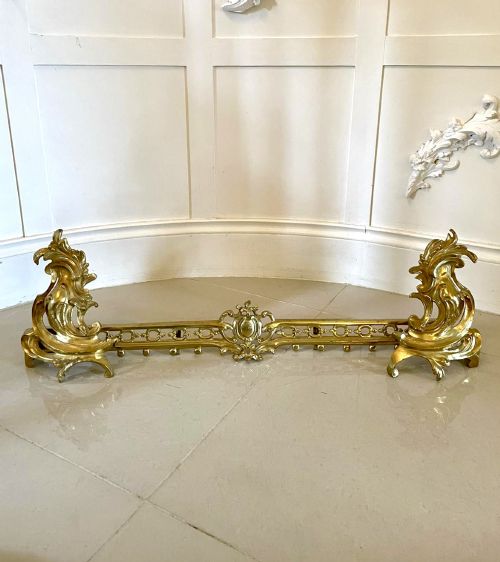
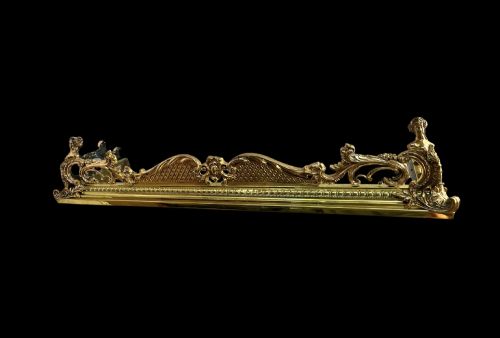
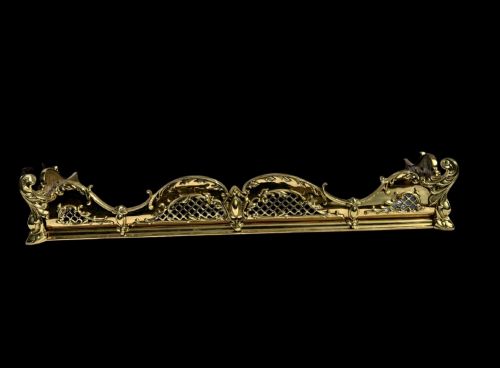


Rococo Brass Fire Fender
A rococo brass fire fender frames the hearth with asymmetric scrollwork and shell motifs, bringing French taste to the Victorian fireside.
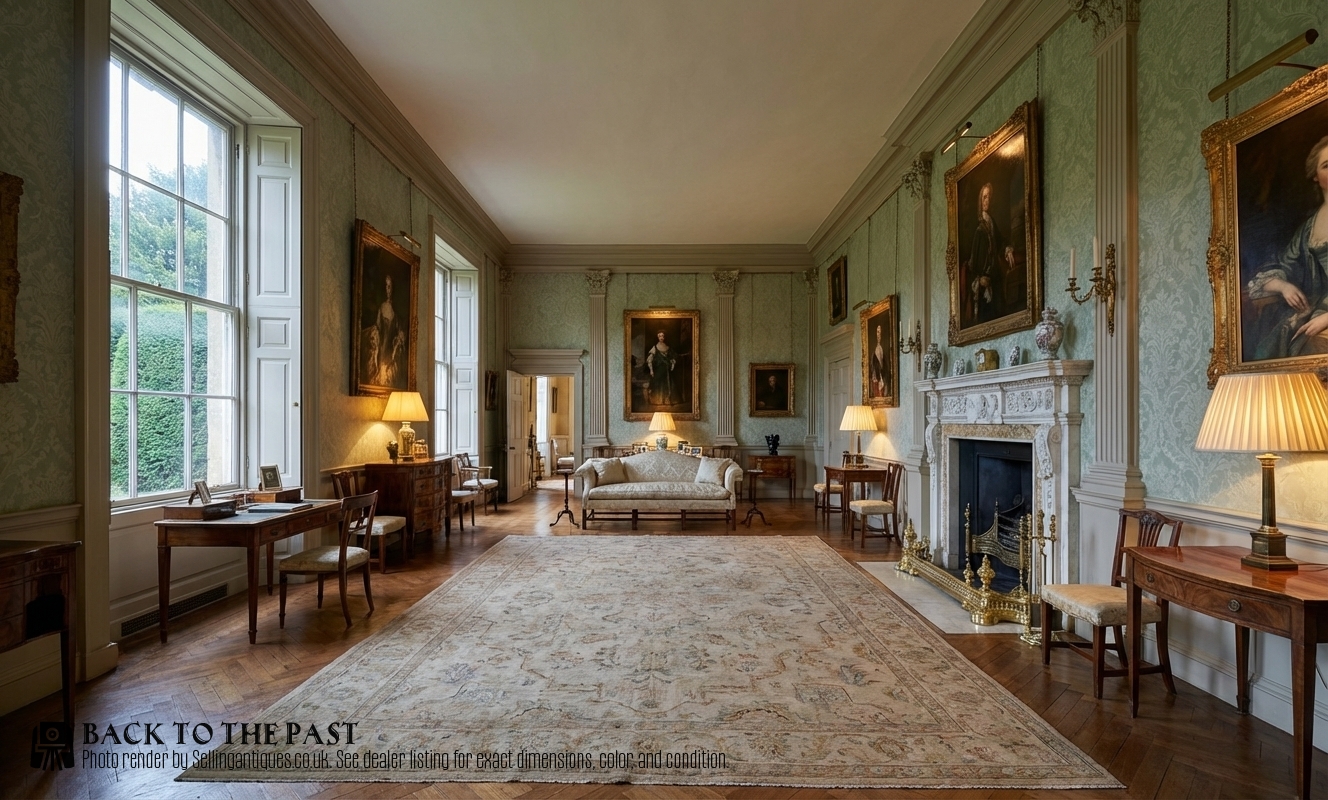
Rococo Brass Fire Fender
A rococo brass fire fender sits on the hearth to contain ash and protect the floor from stray embers, taking its design from mid-nineteenth-century revival styles. These items appear in formats that include extending frames, adjustable widths, and matched pairs of chenets.
The pieces on this page span the Victorian era into the early twentieth century, drawing heavily on French Louis XV design vocabulary. Makers of the period interpreted these continental forms through cast brass, gilt bronze, and ormolu.
Most examples combine cast brass bodies with steel or cast iron components for structural strength around the grate. Buyers frequently encounter adjustable mechanisms that allowed nineteenth-century households to fit the accessory to varying hearth dimensions.
How they were made
Foundries produced the primary decorative sections through sand casting in brass or bronze, yielding thick, heavy elements capable of holding intricate ornamental detail. Workers then refined the raw metal surfaces by hand, applying chased detailing and pierced scrollwork.
Gilding techniques varied from fire-gilding with mercury to later electroplating methods, imparting a rich gold tone to the bronze and brass surfaces. Iron and steel components provided the internal framework and weight needed for daily fireside use.
Listings span the Victorian era, specifically featuring items dated between 1850 and 1920 alongside broader nineteenth-century examples.
What varies in quality
The distinction between standard production and finer work lies in the crispness of the chasing and the depth of the cast ornament. Superior examples retain sharp, undercut details in the foliage and scrollwork rather than the softened contours of a worn secondary mould.
Materials also divide the range, as pieces utilising heavier gauge cast brass or genuine ormolu and parcel gilding show superior weight and finish retention. The complexity of the extending mechanism and the precision of the fit reflect the original workshop investment.
The Rococo Brass Fire Fender Glossary
- Ormolu
- Gilded bronze, where a gold amalgam is applied to a bronze base through heat treatment. This technique creates a durable, warm metallic lustre characteristic of luxury French metalwork.
- Chenet
- An alternative term for an andiron, placed at the front of the hearth to support logs or frame the fire opening. They often match the decorative language of the associated fender.
- Rococo
- An eighteenth-century artistic style defined by asymmetry, C-scrolls, and naturalistic motifs like shells and acanthus leaves. The nineteenth-century revival pieces on this page draw directly from these earlier French designs.
- Extending fender
- A hearth guard constructed in sliding sections to accommodate different fireplace widths. This practical design allowed a single accessory to move between rooms or houses.
Rococo Brass Fire Fender: Frequently Asked Questions
How do I adjust an extending fender?
Most extending models feature an inner sliding rail that moves smoothly within an outer channel to fit the hearth opening.
Take care not to force the mechanism if accumulated soot or oxidation has stiffened the sliding joint over time.
Were these fenders made in France or Britain?
The evidence shows both French manufacture and British production influenced by French Louis XV styles.
Design vocabulary and foundry marks often point to the origin of the piece.
What is the difference between brass and ormolu?
Brass is an alloy of copper and zinc used for the structural body of many fenders.
Ormolu specifically denotes gilded bronze, which provides a deeper, richer gold appearance on high-status decorative mounts.
Can these fenders be used with modern fires?
They function well around electric, gas, or open solid fuel hearths provided dimensions align correctly.
Ensure adequate clearance from direct high flames to protect nineteenth-century gilding and delicate cast details.