

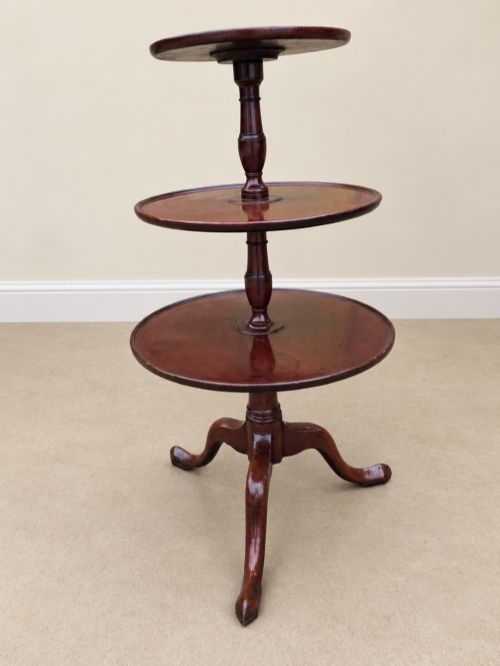
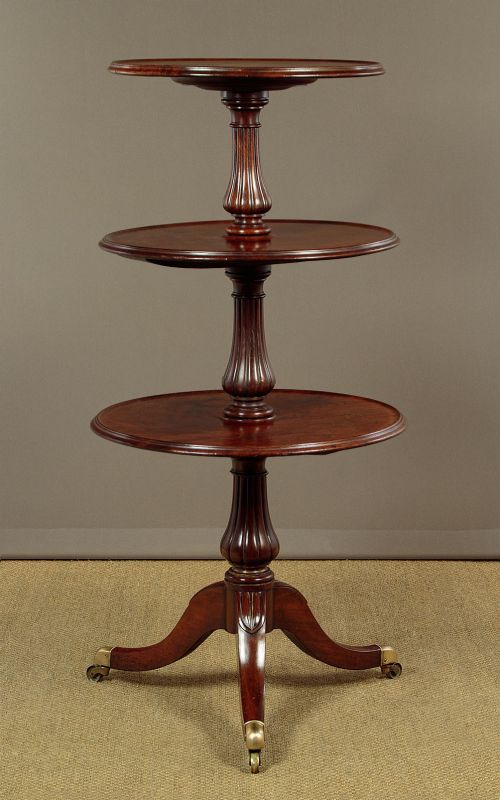
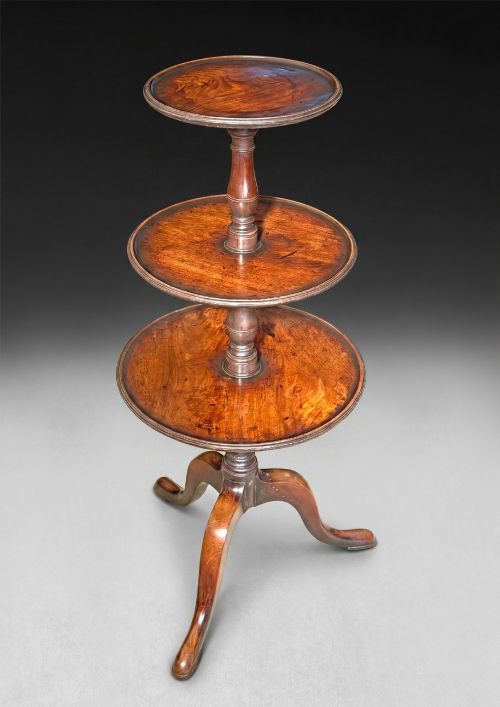


Revolving Mahogany Dessert Stand
These revolving mahogany dessert stand examples are tier-upon-tier of dining-room utility, built to hold fruit and sweet dishes out of reach of the servants.
Revolving Mahogany Dessert Stand
When you search for a revolving mahogany dessert stand, you are looking at tiered pieces designed to hold food without cluttering the main dining board. They appear primarily as three-tier dumb waiters dating from the Georgian, Regency, and George III periods, alongside later 1920s interpretations.
The form relies on graduated circular trays mounted on a central column, designed to rotate so guests could help themselves during dessert courses. Most examples found here take the shape of sturdy dumb waiters, occasional tables, and tiered tables rather than small table-top stands.
How they were made
Cabinet makers constructed these stands using dense mahogany for the trays and central columns, selecting timber with rich grain patterns. Brass fittings often secure the pivoting mechanisms or provide castors on the tripod base, allowing the heavy tiers to turn smoothly.
The tiers are turned from solid mahogany or laid down in veneers over stable secondary woods, joined to tapering pedestals with sturdy peg or dowel construction. Turners shaped the columns with rings, urns, or reeded details, while the tripod legs frequently terminate in pad or brass claw feet.
Revolving Mahogany Dessert Stand Retail Price Guide 2026
Typical asking prices for revolving mahogany dessert stand among the pieces listed under this phrase on Sellingantiques today, from the lower quarter to the upper quarter. They describe what is for sale here now, not the wider market.
Dining rooms once relied on these quiet tiers so guests could gossip freely without servants overhearing the local scandal.
What varies in quality
Quality rests upon the crispness of the timber turning and the stability of the revolving mechanism between the tiers and the central shaft. Superior examples display thoughtful proportions where the graduated trays diminish gracefully from bottom to top, rather than appearing heavy or blockish.
The choice of mahogany grain and the cleverness of folding actions or tier supports separate standard utilitarian pieces from workshop items of greater ambition. Original brass castors and unwarped timber trays preserve the balance required when rotating laden dessert tiers.
The Revolving Mahogany Dessert Stand Glossary
- Dumb waiter
- A tiered serving stand designed to hold dishes close to the dining table without the presence of servants. They typically feature two or three graduating circular trays.
- Tripod base
- A three-legged support structure radiating from a central column, commonly used on these stands to ensure stability on uneven floors.
- Revolving
- The property of the trays to spin horizontally around the central pillar, allowing diners access to different dishes from a seated position.
- Graduated tiers
- Trays of decreasing diameter arranged vertically, where the largest platter sits at the bottom and the smallest at the top.
Revolving Mahogany Dessert Stand: Frequently Asked Questions
What is a revolving mahogany dessert stand used for?
These pieces served as auxiliary serving furniture in formal dining rooms, holding fruit, cakes, and wine glasses during dessert courses. Their rotating tiers allowed guests to help themselves without disturbing the conversation or waiting for household staff.
Today, they function well as display furniture in sitting rooms or dining spaces, holding books, plants, or decorative items while retaining their traditional rotating capability.
How do I tell a Georgian stand from a later one?
Georgian and George III examples display hand-turned mahogany columns, subtle patination, and traditional joinery such as pegged tenons. The timber grain feels deep and warm from decades of wax polishing.
Later nineteenth-century or 1920s versions often feature sharper machine turning, brighter finishes, or different secondary woods beneath the mahogany surfaces. Examining the underside of the trays reveals the age of the timber and the methods used by the cabinet maker.
Do all these stands fold down?
Not all tiers are designed to collapse or fold away, though certain Georgian examples incorporate clever folding mechanisms for easy storage between meals. Most standard three-tier dumb waiters remain rigid structures fixed to a central pillar.
When a piece does feature folding brackets or pivoting trays, it allows the stand to flatten against a wall when not in active use in the dining room.
Where should I place a tiered stand at home?
These stands suit corners or empty wall spaces in dining rooms and drawing rooms where their vertical height adds architectural interest without taking up much floor area. Because the trays revolve, ensure there is sufficient clearance around the piece to spin each tier freely.
Avoid positioning them in direct sunlight or beside intense heat sources, as dry conditions can cause the mahogany timber to shrink or the joints on the central column to loosen.