

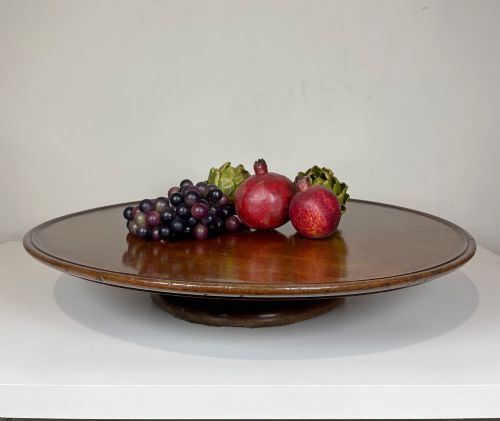
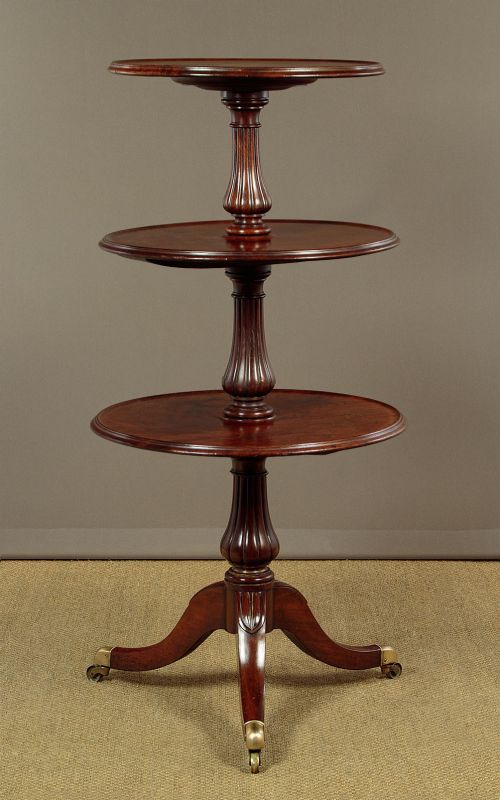
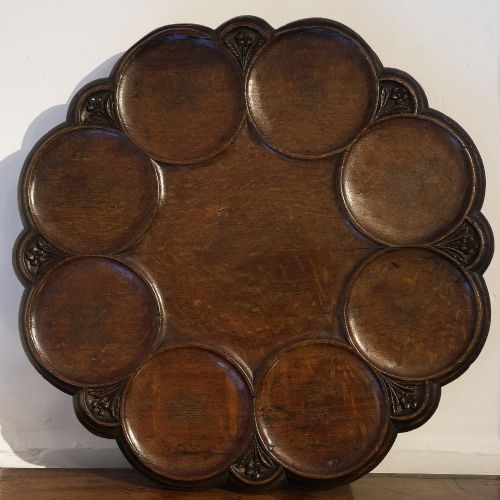
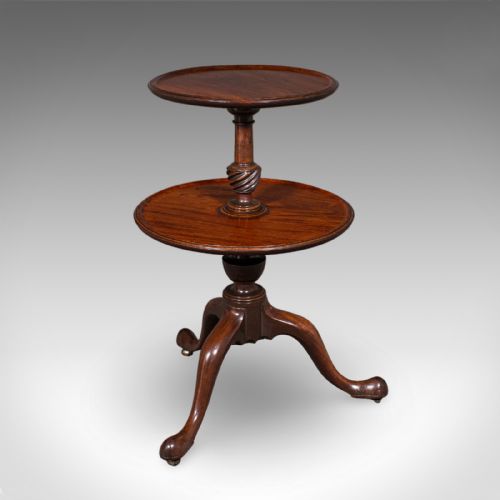


Georgian Revolving Serving Table
A georgian revolving serving table is a tiered dining accessory designed to hold dishes without servants, offering tiered mahogany surfaces for the table.
Georgian Revolving Serving Table
Buyers frequently encounter three-tier examples alongside two-tier afternoon tea serving stands and smaller table-top lazy susans dating from the early nineteenth century and the eighteenth century. English country workshops and urban cabinet makers produced these practical dining aids for formal meals and supper sets.
The primary function of a georgian revolving serving table involves holding porcelain, silver plate, and glassware within easy reach of diners who wished to serve themselves. Pieces span the George III era through to later 1920 interpretations, maintaining the classic revolving mechanism.
How they were made
Makers constructed a georgian revolving serving table predominantly using solid and veneered mahogany, frequently combining it with oak for internal framing and brass for pivoting mechanisms. Turning lathes shaped the central pillars, while cabinet makers joined tiered circular trays to revolving pivots.
Additional materials visible in the evidence include ebony accents, porcelain sections, and glass elements integrated into supper sets and rotating trays. Workshops relied on traditional joinery to secure tripod or pedestal bases beneath the rotating tiers.
Georgian Revolving Serving Table Retail Price Guide 2026
Typical asking prices for georgian revolving serving table among the pieces listed under this phrase on Sellingantiques today, from the lower quarter to the upper quarter. They describe what is for sale here now, not the wider market.
Coalport porcelain met rotating dining accessories in 1815, proving that Victorians and Georgians took their snacks while spinning.
What varies in quality
The grade of a georgian revolving serving table depends on the choice of timber and the precision of the turning work on the central column. Superior examples display finely figured mahogany grain on the circular trays and robust, well-fitted brass revolving hardware that moves smoothly.
Proportion and stability separate standard pieces from finer ones, with better items possessing balanced tripod legs and securely fixed tiers that avoid wobble. The crispness of the edge mouldings and the quality of the wood patination indicate the skill of the original workshop.
The Georgian Revolving Serving Table Glossary
- Dumb waiter
- A tiered freestanding serving table designed to hold food, porcelain, or glass without the presence of servants. These rotating pieces allow diners to access dishes easily.
- Lazy Susan
- A revolving tray placed on a table top or serving stand to distribute condiments or dishes. Versions in the evidence include porcelain supper sets.
- Tripod base
- A three-legged support structure commonly found beneath the central column of a revolving serving table. This design provides stable footing for multiple heavy tiers.
- Mahogany
- A dense tropical hardwood prized for its deep colour and durability, utilised extensively by Georgian cabinet makers. It takes a high polish and displays rich grain patterns.
Georgian Revolving Serving Table: Frequently Asked Questions
What is a georgian revolving serving table used for?
A georgian revolving serving table served dining rooms by holding extra courses, glassware, and silver plate close to the table. Diners spun the tiers to reach items without needing assistance from household staff.
These pieces also functioned as afternoon tea stands and supper sets during the eighteenth and nineteenth centuries. Their multi-tiered design maximised space on crowded dining floors.
How many tiers do these tables have?
Surviving examples typically feature either two or three graduated circular tiers mounted upon a single central pillar. Three-tier variations are especially common among George III and Regency pieces.
Table-top versions like lazy susans operate on a single rotating level rather than multiple vertical tiers. Each tier increased the holding capacity of the serving stand.
What woods were used in these tables?
Mahogany serves as the principal timber for the vast majority of pieces recorded in the evidence. Cabinet makers selected it for its strength and rich reddish-brown appearance.
Oak also appears in structural components, while ebony sometimes provides contrasting detail. Brass hardware facilitates the revolving action of the tiers.
How do I date a georgian revolving serving table?
Dating relies on observing stylistic markers from periods such as the Georgian era, George III reign, and the Regency period. Turning styles on the central pillar and the construction of the tripod base shift across these decades.
Evidence shows production spanning the late eighteenth century through to the early nineteenth century, with occasional later revivals. Wood patination and hardware design offer further clues to age.
What is the difference between a dumb waiter and a lazy susan?
A dumb waiter stands as a tall freestanding piece of furniture with multiple revolving tiers supported by a column and tripod base. It sits beside or between dining chairs.
A lazy susan operates as a lower, single-level revolving tray designed to sit directly on a dining table or within a supper set. Both utilise the principle of rotation to share food and tableware.