

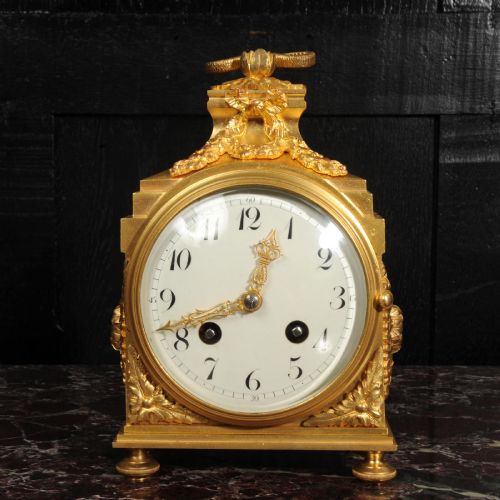


Restored Brass Carriage Clock
A restored brass carriage clock brings the heavy cast frames, bevelled glass panels and refined mechanical work of the nineteenth century straight into your study.
Restored Brass Carriage Clock
When you search for a restored brass carriage clock, you are looking at portable mechanical timepieces produced in France and Britain during the Victorian era and the late nineteenth century. The examples on this page span from the 1870s through to 1900, capturing a period when mechanical precision met elaborate casing design.
The most common forms you will meet here are French carriage clocks and repeating carriage clocks housed in polished brass, gilt brass, or ormolu frames. Many feature bevelled glass windows that reveal the moving escapement within, alongside decorative enamel panels, bandings, or painted scenes.
The selection ranges from standard rectangular brass cases to grand sonnerie models equipped with date work and moon-phase complications. You will also encounter specialised pieces such as double-sided dials, gorge cases, and giant repeating formats signed by notable makers like Brunelot and Drocourt.
How they were made
The makers of these timepieces built the heavy structural frames using cast brass, gilt bronze, or ormolu, applying fire gilding or polished finishes that catch the light. Heavy bevelled glass panes were fitted precisely into the top, sides, and door to protect the delicate inner mechanism while offering an unobstructed view of the escapement.
White enamel dials were painted with Roman or Arabic numerals and fitted with fine blued steel hands, sometimes complemented by subsidiary enamel paintings or decorative bandings. The interior movements rely on complex brass gear trains, spring barrels, and escapements that require meticulous hand-adjustment during the restoration process.
Restored Brass Carriage Clock Retail Price Guide 2026
Typical asking prices for restored brass carriage clock among the pieces listed under this phrase on Sellingantiques today, from the lower quarter to the upper quarter. They describe what is for sale here now, not the wider market.
Listings feature French and British carriage clocks spanning the Victorian era and the late nineteenth century, from 1870 to 1900.
What varies in quality
The distinction between a standard carriage clock and a superior example lies in the complexity of the internal movement and the richness of the exterior case decoration. Repeating mechanisms, grand sonnerie striking trains, and auxiliary complications like moon-phases and date work elevate the mechanical ambition of the piece.
Casting quality and decorative embellishment also divide the range, from simple polished brass frames to heavy ormolu mounts, bronze side panels, and intricate hand-painted enamel bandings. Signed works by established makers demonstrate superior finishing and enduring mechanical reliability.
Brunelot·Captain Henry·Alfred Drocourt·Drocourt
The Restored Brass Carriage Clock Glossary
- Carriage clock
- A small, portable spring-driven timepiece designed for travel during the nineteenth century. They typically feature a flat top with a swinging carrying handle and glass panels on all sides.
- Repeater
- A mechanical complication that strikes the hours and quarters on demand when a plunger on the case is pressed. This feature allowed owners to check the time in the dark.
- Ormolu
- Gilded bronze produced by applying a mercury and gold amalgam to a bronze base and heating it. It creates a durable, rich metallic lustre found on finer nineteenth-century clock cases.
- Gorge case
- A distinct rectangular carriage clock case style characterised by stepped mouldings on the top and bottom frame. It is frequently associated with high-quality French manufacturing.
- Grand sonnerie
- A sophisticated striking mechanism that automatically chimes both the hours and the passing quarters on bells or gongs. It represents a high tier of nineteenth-century horological engineering.
Restored Brass Carriage Clock: Frequently Asked Questions
How do I wind a carriage clock?
Use the matching key on the winding arbors located on the backplate of the movement. Turn gently until you feel firm resistance, taking care not to overwind the mainspring.
Most nineteenth-century movements run for approximately eight days on a full wind. Ensure the clock is placed on a level surface before setting the time.
What is a repeating carriage clock?
A repeater contains an extra set of gongs and hammers that sound the last elapsed hour and quarter-hour when you press the button on top of the case. This allowed travellers to hear the time at night without lighting a candle.
The mechanism requires careful adjustment during restoration to ensure the strike sequence matches the position of the hands.
How do I date a brass carriage clock?
Examine the style of the case, the typography of the dial, and any signatures or registration marks stamped on the backplate. The pieces on this page primarily date from the 1870s through to 1900.
Stylistic shifts from plain polished brass to ornate enamel paintings and gilded bronze panels help narrow the decade of production.
Where should I place a carriage clock?
Position your clock on a stable, vibration-free mantelpiece, desk, or table away from direct sunlight and damp conditions. A level surface is essential for the balance wheel and escapement to beat evenly.
Because these are heavy brass and glass objects, keep them away from table edges where they might be easily knocked.