
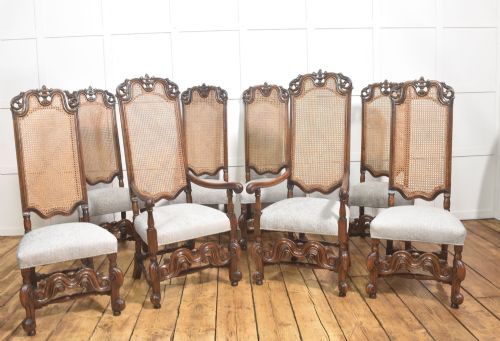

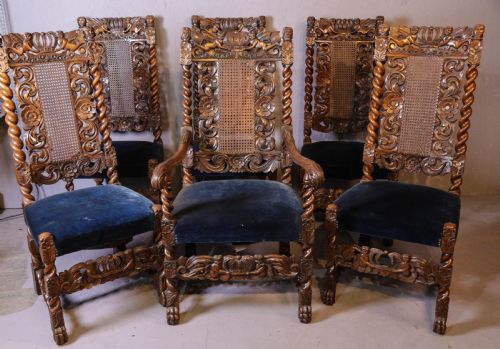


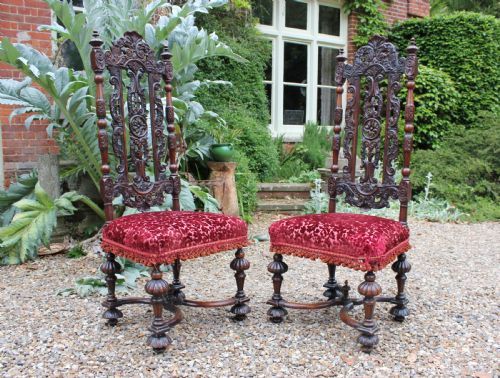


Restoration Style Dining Chairs
Carrying the carved frames and high backs of the seventeenth century, restoration style dining chairs bring regal presence and stately presence to a formal interior.

Restoration Style Dining Chairs
Restoration style dining chairs echo the grand seating of the seventeenth century, drawing on Carolean, William and Mary, and Baroque design idioms. When searching for restoration style dining chairs, collectors encounter pieces ranging from authentic late seventeenth-century originals to later nineteenth- and twentieth-century revivals.
The selection includes large sets of dining chairs alongside smaller pairs of side chairs, armchairs, and hall chairs. Walnut and oak form the backbone of these offerings, frequently paired with cane inserts and rich textile upholstery.
Revival iterations from the Victorian era and the early twentieth century sit alongside genuine seventeenth-century examples. Buyers frequently meet walnut high-back forms featuring intricate crest rails and barley twist supports.
How they were made
Carved timber frames form the structural foundation of these chairs, utilising dense hardwoods such as walnut, oak, and beech. Craftsmen shaped these woods through heavy carving, piercing, and turning to create dramatic crest rails and stretcher bases.
Cane weaving provides lightweight resilience for seats and tall back panels, often complemented by luxurious textiles including velvet, tapestry, and upholstery fabric. Painted wood surfaces also appear, offering alternative visual textures across different revival periods.
Restoration Style Dining Chairs Retail Price Guide 2026
Typical asking prices for restoration style dining chairs among the pieces listed under this phrase on Sellingantiques today, from the lower quarter to the upper quarter. They describe what is for sale here now, not the wider market.
Listings feature walnut and oak timbers most frequently, complemented by cane work, velvet, and tapestry fabric across centuries.
What varies in quality
Depth and crispness of timber carving separate ordinary revival pieces from exceptional examples. Superior chairs exhibit sharp, undercut details on scrolling foliage and crowns rather than soft, rounded relief.
The integrity of the frame construction and the preservation of original cane work dictate long-term stability and authenticity. Higher quality pieces maintain tight joinery and mature timber patination acquired over centuries of use.
Waring and Gillow
The Restoration Style Dining Chairs Glossary
- Carolean
- Pertaining to the reign of Charles II, characterised by lavishly carved woodwork, tall cane backs, and rich baroque motifs. This style heavily influences later revival dining chairs.
- Cane
- Plant material woven into an open mesh pattern for seats and backs. It offers both flexibility and decorative lightness in heavy wooden frames.
- Baroque
- An ornate artistic style emphasising dramatic curves, grand scale, and elaborate ornamentation. It manifests in the sweeping lines and rich carvings of these chairs.
- Stretcher
- A horizontal timber connecting the legs of a chair to provide structural rigidity. In this style, stretchers often feature decorative carving matching the crest rail.
- Crest rail
- The top horizontal member of a chair back. It typically receives the most elaborate carving on high-back restoration seating.
Restoration Style Dining Chairs: Frequently Asked Questions
Are these chairs comfortable for daily dining?
High-back restoration chairs prioritize formal upright posture over soft lounging. Their tall cane or upholstered backs offer firm support during long meals.
Adding loose cushions can soften the seat while preserving the historic appearance around the dining table.
How do I distinguish original seventeenth century pieces from revivals?
Original pieces display authentic timber shrinkage, tool marks, and dry patination acquired across centuries of handling. Revival pieces from the Victorian era or nineteen-ten often show machine assistance or uniform wear.
Examining the construction joints and underside timber helps clarify the true age of the chair frame.
How should I care for cane panels?
Cane requires moderate humidity to prevent the natural fibres from becoming brittle and snapping. Avoid placing these chairs directly next to active heat sources or in overly dry rooms.
Cleaning should involve only a damp cloth without harsh chemical polishes.
Can I mix different eras around one table?
Mixing seventeenth-century styles with later Victorian revivals creates a layered interior that reflects years of collecting. Similar timber tones and carved motifs help unify disparate chairs within a single set.
Matching the chair height to the dining table remains the primary functional consideration.