


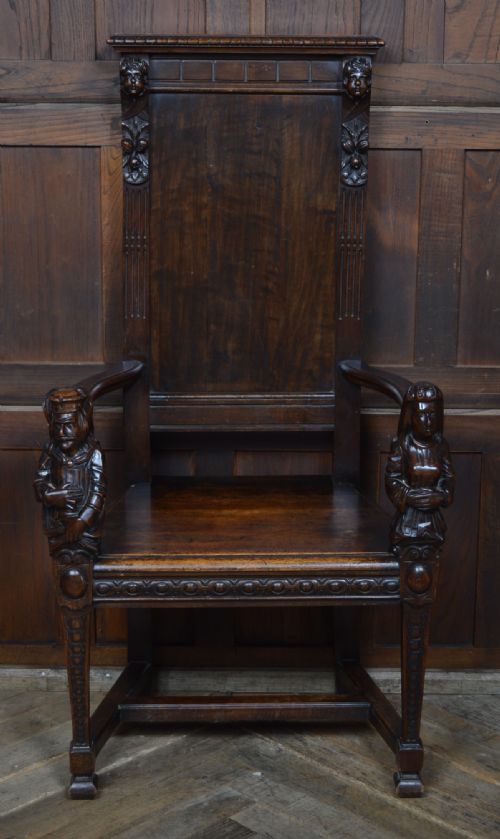

Renaissance Revival Hall Seat
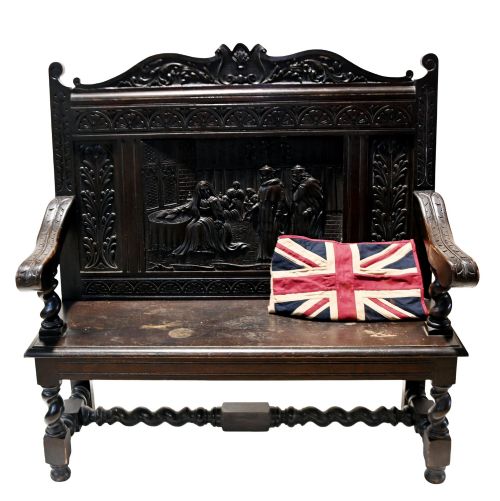
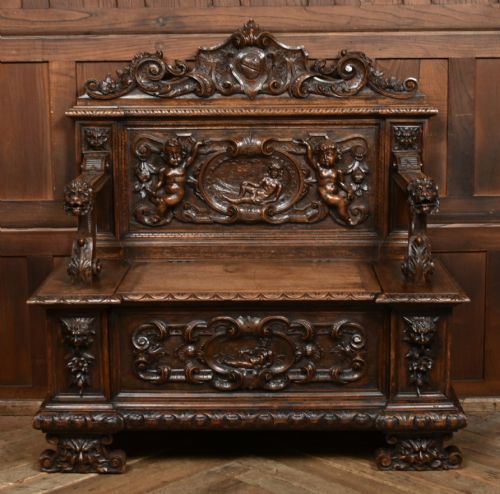
These renaissance revival hall seats and settles bring grand architectural presence and robust historic carving directly to an entrance hall.
Renaissance Revival Hall Seat
When you search for a renaissance revival hall seat, you encounter substantial seating forms rooted in nineteenth century historicism, drawing heavily on Italian, Flemish, and Gothic design vocabulary.
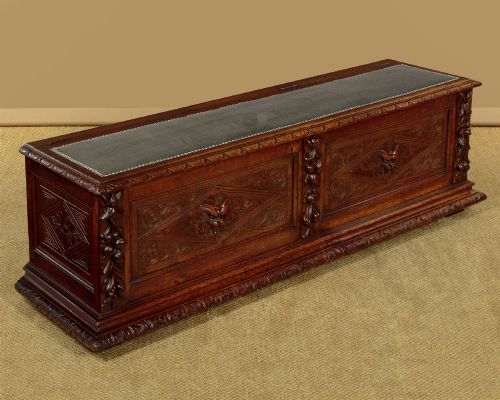
The selections available here span solid oak and walnut settles, box benches, monk's benches, and elaborate x-frame armchairs designed to anchor a large hallway or vestibule.
Most pieces date from the Victorian era, utilising deep relief carving, figural elements, and architectural paneling that emulate earlier centuries.
How they were made
These items rely on dense cabinet timbers, primarily solid oak, walnut, and occasional fruitwood or pine, selected for their structural stability and capacity to hold crisp, deep-relief carving.
Joinery methods combine traditional mortise and tenon construction with turned components, bone inlay, and hinged panels that conceal storage within box seats and settles.
Upholstered elements, where present, integrate textiles or leather secured with brass decorative tacks.
The listings here demonstrate a strong preference for nineteenth-century oak and walnut construction, dominated by settle and bench forms.
What varies in quality
Quality rests upon the depth, sharpness, and architectural proportion of the hand-carved ornamentation, distinguishing ambitious workshop output from simpler vernacular production.
The choice of timber significantly dictates the grade of the piece, with richly figured Italian walnut and dense quarter-sawn oak representing the superior end of the range.
White, Allom & Co.
The Renaissance Revival Hall Seat Glossary
- Cassapanca
- A traditional Italian wooden bench featuring a storage box base with a back and armrests. It often displays extensive carved paneling.
- Settle
- A wooden bench with high solid back, solid arms, and frequently a box seat beneath the cushion. It was designed to block draughts in large halls.
- Savonarola chair
- An X-framed folding armchair constructed from multiple curved wooden slats. It derives from Italian Renaissance forms.
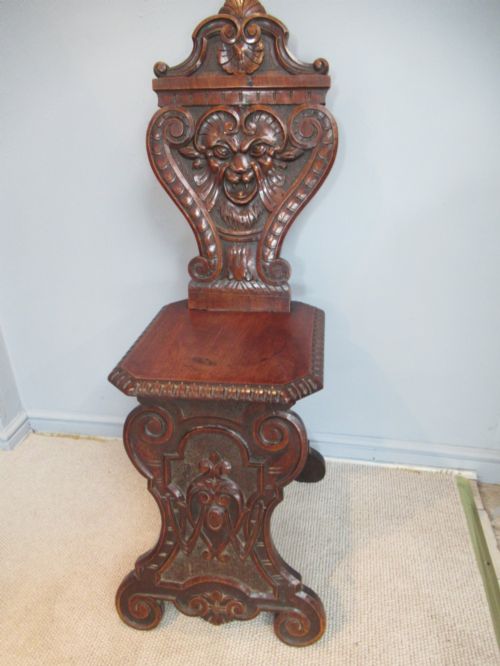
- Sgabello
- A light wooden chair featuring a sculpted seat and two carved board legs rather than four standard posts. It served as hallway seating in Renaissance Italy.
- Monk's bench
- A multipurpose convertible furniture form featuring a hinged back that folds down to create a table. It is frequently associated with heavy oak revival styles.
Renaissance Revival Hall Seat: Frequently Asked Questions
Where should I place a hall seat?
These substantial pieces demand generous spatial context to anchor a wide corridor, vestibule, or large reception room properly. Their architectural lines look best against plain walls that allow the carved details to stand clear.
Position them away from direct heat sources to protect historic timber and any integrated leather or textile elements from drying out over time.
How do I use a monk's bench?
The primary function is dual purpose, operating as a sturdy bench for seating while offering a concealed box compartment beneath the seat for storage. Many examples feature a pivoting back that transforms the upper portion into a small table top.
This adaptability made them practical pieces in historic interiors and useful for modern living spaces requiring discreet storage.
How do I distinguish Italian from Flemish styles?
Italian Renaissance revival examples often favor figured walnut, bone inlay, curule frames, and classical figural carving derived from sixteenth-century prototypes. They lean toward refined architectural symmetry.
Flemish and Dutch influenced pieces typically employ heavy carved oak, robust paneling, and exaggerated high backs that emphasise rustic texture and dense ornamentation.
What is an X-frame chair?
An X-frame chair, also known as a curule or Dante chair, uses crossing wooden slats that form a distinctive scissor-like support structure beneath the armrests. This ancient form was revived during the nineteenth century with elaborate carving.
Such chairs provide a portable yet visually commanding seating option that suits narrow hallway spaces.