
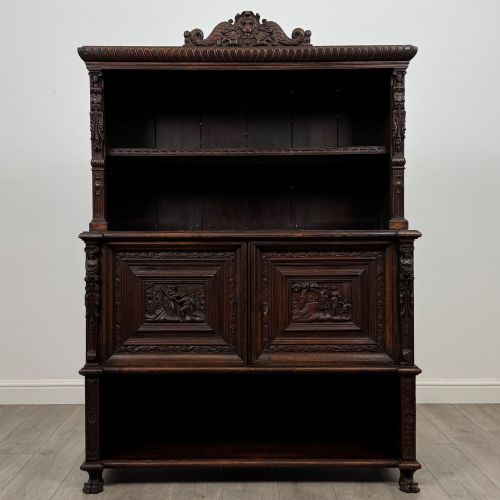


Renaissance Revival Dresser
A renaissance revival dresser brings bold architectural presence and deep historic carving into a room, offering both grand display and substantial storage.
Renaissance Revival Dresser
When you search for a renaissance revival dresser, you are looking at heavy timber case furniture that borrows motifs from sixteenth-century European architecture, including columns, pilasters, and strapwork. The pieces on this page span the nineteenth century, including Victorian interpretations and specific continental styles from France and Italy.
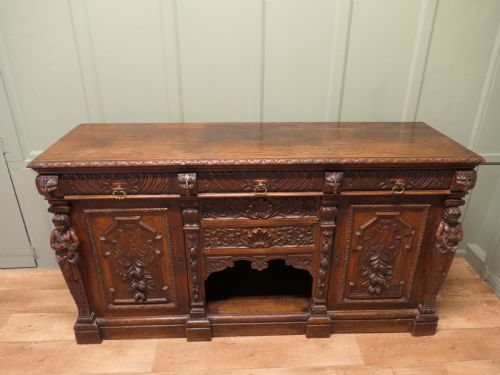
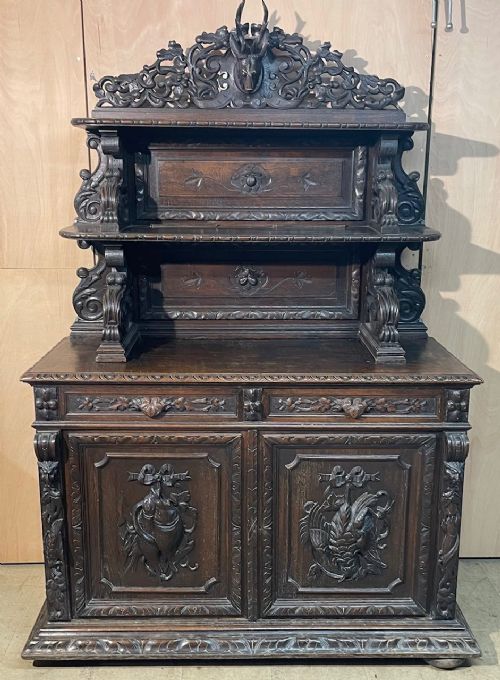
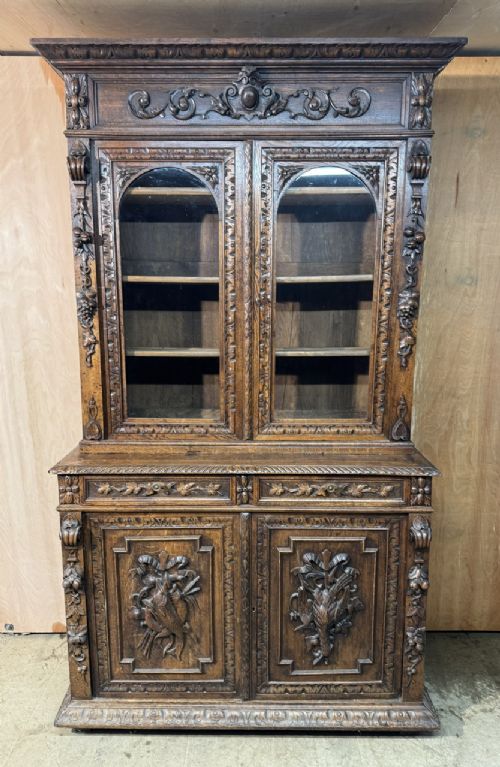
You will most commonly encounter oak sideboards, buffet cabinets, and mirror-back servers that carry deep relief carvings of foliage, figures, and mythic motifs. These substantial forms often combine display shelving with enclosed cupboards beneath, reflecting their origins as grand dining room storage.
The selection ranges from French provincial walnut dressers and Flemish carved oak cabinets to Italian fantasy buffets and pedestal sideboards. While some carry the heavy dark patina of the Victorian era, others appear in bleached oak or incorporate marquetry and mother-of-pearl inlay.
How they were made
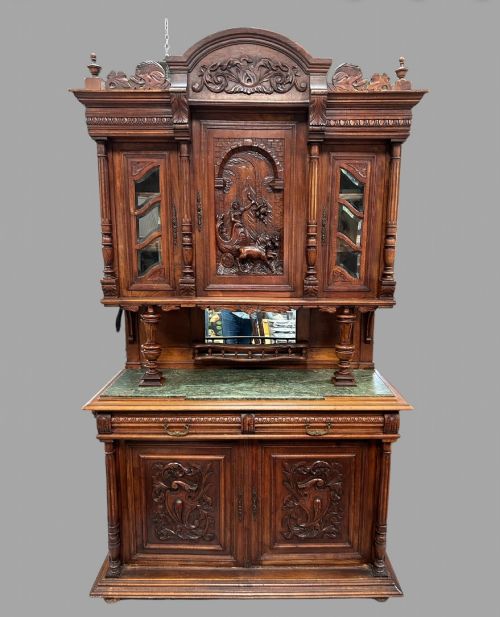
Cabinetmakers built these pieces primarily using solid oak and walnut, often employing heavy timber framing to support deep, sculptural carvings and projecting cornices. Selected pieces integrate contrasting materials such as marble tops, mirrored glass panels, and brass hardware to break up the dark expanse of wood.
Surface ornamentation relied on meticulous hand chiselling rather than applied veneer, creating high-relief panels featuring green man carvings, hunting scenes, and architectural flourishes. Marquetry inlays and mother-of-pearl details occasionally accent the walnut surfaces on French and continental pieces.
A green man carved into the oak watches over your dining room from the frieze.
What varies in quality
The distinction between ordinary production and exceptional work lies in the depth and animation of the carving, where master sculptors created figures with distinct facial expressions and muscular definition rather than repetitive, shallow stamping. Pieces attributed to renowned makers such as Valentino Panciera Bessarel or Sigmund Jaray demonstrate a command of proportion and sculptural ambition that elevates them far above standard workshop output.
Structural ambition also separates the tiers, with superior examples incorporating architectural elements like integrated bookcases, stained glass inserts, and heavy marble slabs that fit seamlessly into the timber frame. The choice of timber grain, the precision of the joinery, and the integration of secondary woods all reveal the maker's investment of time and skill.
Sigmund Jaray, Wien
The Renaissance Revival Dresser Glossary
- Green man
- A sculptural face carved from foliage or branches, symbolising rebirth and frequently found peering from nineteenth-century oak furniture. These masks anchor the corners and friezes of heavy sideboards.
- Buffet de corps
- A traditional two-tier French dining room cupboard featuring a recessed upper section supported by columns or pilasters above a deeper base. They provide imposing storage with extensive carved panels.
- Marquetry
- The art of creating decorative patterns on furniture surfaces by fitting together thin veneers of different coloured woods or shell. It adds pictorial detail to cabinet doors and drawer fronts.
- Ststrapwork
- A carved ornament resembling flat leather bands cut, folded, and interlaced in geometric or scroll patterns. It frames panels and friezes on sixteenth-century inspired revival pieces.
Renaissance Revival Dresser: Frequently Asked Questions
What is a renaissance revival dresser?
A renaissance revival dresser is a heavy nineteenth-century storage piece, typically a sideboard or buffet, styled after sixteenth-century European architecture and ornament.
These pieces feature deep carvings, columns, and heavy cornices designed to anchor a formal dining room or hallway.
Where were these dressers made?
These items originated across nineteenth-century Europe, with significant examples coming from France, Italy, and Britain during the Victorian era.
Continental workshops often produced regional variations such as Flemish oak cabinets or French provincial walnut sideboards.
How do I style a large carved sideboard?
Due to their imposing scale and dark timbers, these sideboards work best against large, plain walls in rooms with good natural light.
Pair them with simple ceramics or glass objects on the surface to balance the heavy carved wood below without cluttering the architectural lines.
How do I tell Victorian from earlier pieces?
Nineteenth-century revival pieces combine historic sixteenth-century motifs with Victorian construction techniques, machine-sawn secondary timbers, and nineteenth-century hardware.
True seventeenth-century work shows entirely hand-rived timbers, pegged joinery, and different tool marks appropriate to earlier hand production.