
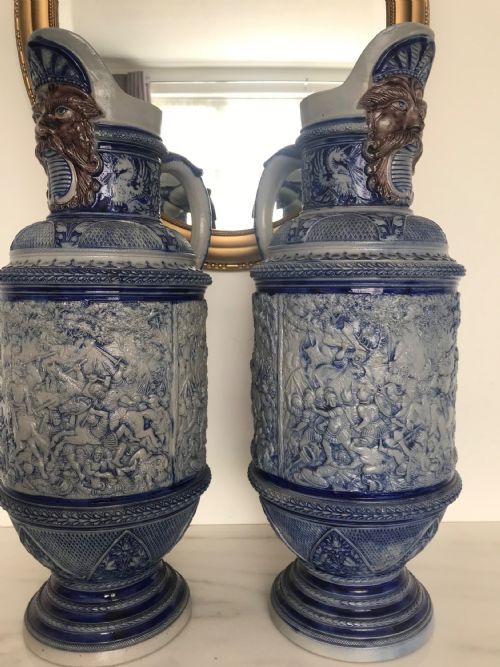


Relief Ceramic Pitcher
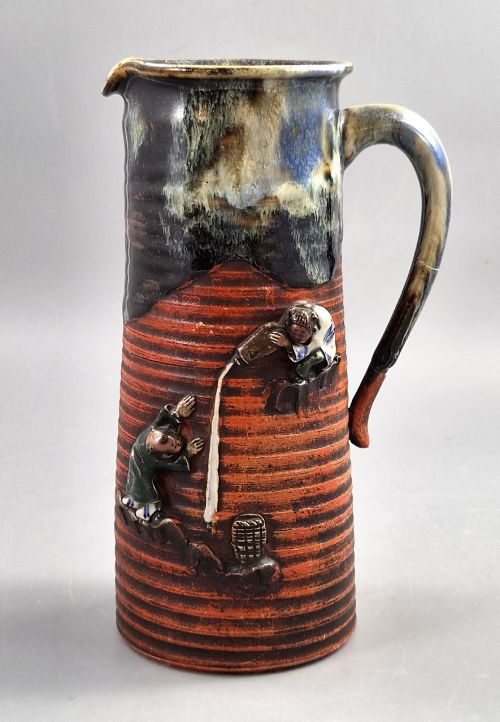
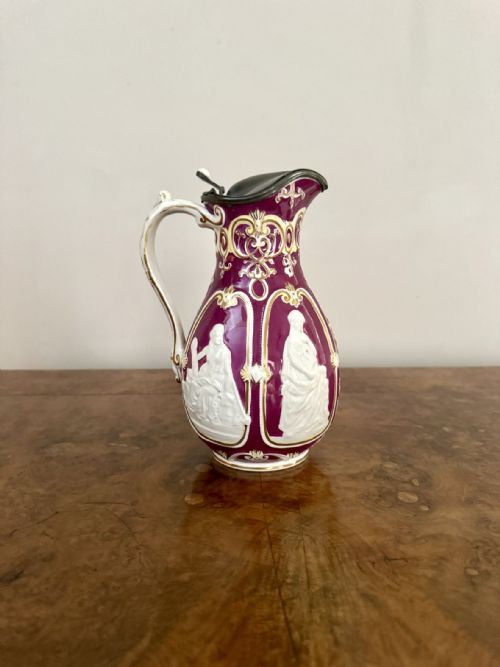
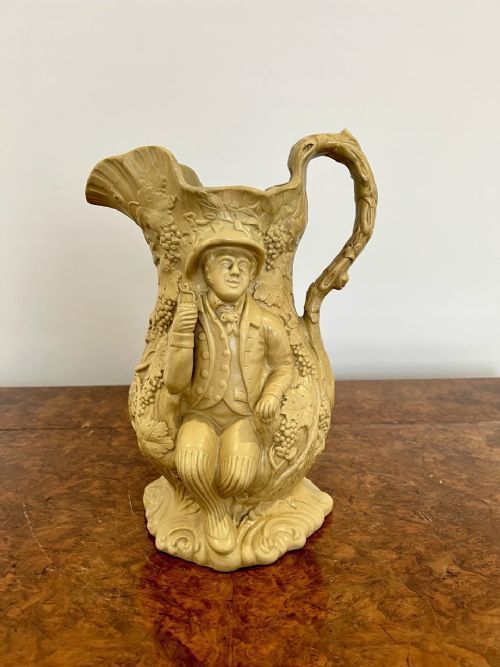
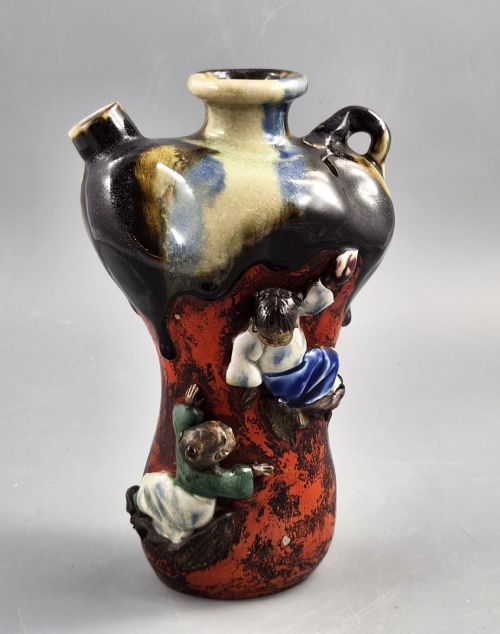
These relief ceramic pitcher pieces bring moulded historical scenes and botanical motifs to table use, shaped through centuries of pottery traditions.
Relief Ceramic Pitcher
A relief ceramic pitcher takes many forms across the Victorian, Georgian, and late nineteenth-century periods, ranging from salt-glazed stoneware harvest jugs to buff-coloured bacchanalian vessels. When seeking a relief ceramic pitcher, buyers encounter everything from cobalt-decorated Westerwald wares to salt-glazed Doulton Lambeth pieces.
The objects serve primarily as jugs and pitchers for water, ale, and milk, alongside decorative vases and tea sets. Makers produced these pieces utilising diverse styles including Art Nouveau, German Historismus, and Victorian Classical Revival.
How They Were Made
Potters utilised stoneware and earthenware bodies, applying salt glaze or ceramic glazes to seal the vessels. Many pieces employ relief moulding to raise figures, battle scenes, or bacchanalian dances directly from the clay surface.
Certain English and German workshops integrated pewter lids or silver rims to finish the salt-glazed stoneware and majolica bodies. Parian ware production involved a specific bisque porcelain mixture that yielded a smooth, unglazed finish resembling marble.
The listings span the Georgian period, the Victorian era, and the Meiji and Taisho periods.
What Varies in Quality
The definition and depth of the moulded relief separate standard utility items from exhibition-grade pieces. Crisp details on figures and foliage indicate superior execution by the modeller.
Choice of glaze and colour application further distinguish the work, from simple salt glazing to polychrome majolica and cobalt blue highlights. The inclusion of hallmarked metal mounts or specialised handles adds secondary refinement.
Simon Peter Gerz·Doulton Lambeth·Charles Meigh·Jones And Walley·George Jones·Phillips And Bagster
The Relief Ceramic Pitcher Glossary
- Relief moulding
- A technique where clay is pressed into a mould to create raised ornamental designs on the body of the vessel. This method allowed potters to achieve intricate historical and mythological scenes.
- Salt glaze
- A finish achieved by throwing common salt into the kiln during high-temperature firing, producing a pitted, orange-peel texture. This glaze creates a durable surface suited for utilitarian stoneware.
- Parian ware
- A type of fine bisque porcelain developed in the nineteenth century to imitate marble sculpture. It yields a matte, white finish frequently utilised for classical revival jugs.
- Majolica
- A colourful lead-glazed earthenware that gained popularity during the Victorian era. It relies on bright metal-oxide colours painted over an opaque tin or lead glaze.
- Stoneware
- A heavy, dense ceramic fired at high temperatures until vitrified and completely non-porous. It withstands liquids without interior glazing and holds sharp exterior relief details.
Relief Ceramic Pitcher: Frequently Asked Questions
How are these pitchers cleaned?
Wash salt-glazed and glazed ceramic pieces gently in warm soapy water using a soft cloth.
Avoid soaking items with pewter lids or metal rims to protect the original joins.
Were these jugs used daily?
Many sturdy stoneware and earthenware pitchers served practical roles for ale, water, or milk in Victorian homes.
More delicate parian ware and majolica examples often fulfilled decorative or display purposes.
How do I spot salt glaze?
Look for a slightly textured surface resembling the skin of an orange, created by salt vaporisation inside the kiln.
This finish is typical of traditional German and English stoneware production.
What defines Art Nouveau styling?
Art Nouveau examples feature flowing organic lines, plant motifs, and stylized floral forms typical of the late nineteenth century.
These pieces often combine stoneware bodies with muted or natural colour palettes.