
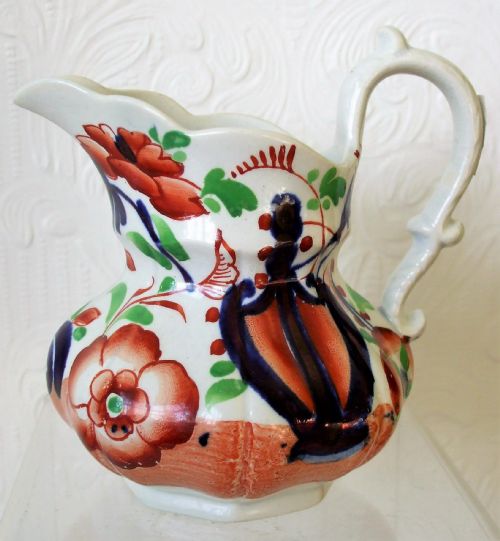


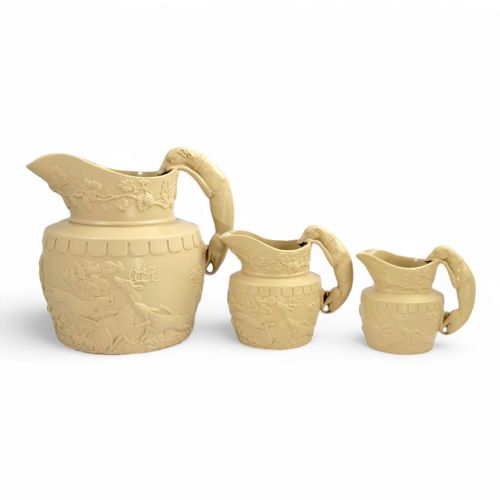


Moulded Earthenware Pitcher
A moulded earthenware pitcher brings tactile relief work and functional weight to a table, offering both robust service and sculptural form.
Moulded Earthenware Pitcher
A moulded earthenware pitcher is a functional pouring vessel shaped in a mould to create raised surface decoration rather than relying purely on painted design. When collectors search for a moulded earthenware pitcher, they seek tangible relief patterns that define the body, ranging from natural foliage to architectural motifs.
The pieces available here primarily span the nineteenth century, encompassing Georgian, Regency, Victorian, and Edwardian eras. These domestic vessels take various forms including milk jugs, pouch jugs, and large exhibition pitchers.
Moulded relief work gives these pitchers a distinct texture in the hand. The forms vary from intimate table milk jugs to substantial exhibition pieces designed to display technical ceramic skill.
How they were made
Makers utilised earthenware and pearlware clays pressed or cast into metal or plaster moulds to achieve sharp, three-dimensional surface details. This technique allowed workshops to produce consistent relief patterns such as cabbage leaves or sprigged motifs at scale.
Glazes applied over the fired clay body include salt glaze, majolica, and rich copper lustre to seal the porous earthenware and provide colour. Salt glazing creates an orange-peel texture on stoneware bodies, whilst majolica glazes impart vibrant green, brown, and ochre tones to relief-moulded plant forms.
The inventory here spans the nineteenth century, including Georgian, Regency, Victorian, and Edwardian periods executed in earthenware, stoneware, and pearlware.
What varies in quality
The sharpness of the moulded relief distinguishes finer pitchers from softer, worn examples where the mould detail has grown tired through repeated use. Crisp undercut foliage and sharply defined sprigging indicate a primary pressing from a fresh mould.
Surface finish and glaze application also dictate the standing of a piece, with carefully controlled copper lustre or crisp polychrome enamels elevating standard domestic ware into exhibition quality. The weight and balance of the handle, particularly on sculptural hound or branch handles, reveal the modeller's skill.
Ridgway and Sons·Phillips and Bagster·George Jones
The Moulded Earthenware Pitcher Glossary
- Pearlware
- A refined earthenware developed by Josiah Wedgwood in the late eighteenth century, featuring a bluish glaze that pooled in recesses to make the ceramic appear whiter. It forms the body of many early moulded jugs.
- Salt glaze
- A vitreous coating created by throwing common salt into the kiln during high-temperature firing, resulting in a pebbled surface texture. This finish protects stoneware pitchers from moisture penetration.
- Majolica
- A colourful lead-glazed earthenware style popularised in the Victorian era, known for vibrant hues applied over moulded botanical and animal reliefs. It provides a glossy, reflective surface.
- Sprigged
- A method of decoration where separately moulded clay reliefs are applied to the unfired body of a vessel using slip as an adhesive. Cream-coloured sprigs often contrast against darker stoneware bodies.
- Copper lustre
- A metallic glaze technique imparting a reflective, coppery sheen to the ceramic surface. It was widely utilised on nineteenth-century Staffordshire milk jugs and pitchers.
Moulded Earthenware Pitcher: Frequently Asked Questions
How were these pitchers used originally?
These vessels served practical domestic roles on dining tables and sideboards, primarily for holding milk, cream, or water during meals.
Larger examples functioned in the dairy or kitchen for food preparation, whilst exhibition pieces sat on display to demonstrate the household's refined taste.
Can I use an antique pitcher daily?
Most nineteenth-century earthenware and pearlware pitchers remain structurally sound for gentle daily service or serving cold liquids.
However, delicate handles, historic glaze crazing, and porous ceramic bodies mean hand washing is essential to preserve the surface.
How do I distinguish Georgian from Victorian pieces?
Georgian pitchers, particularly pearlware examples from around eighteen hundred, tend to feature restrained plant moulding like cabbage leaves under subtle glazes.
Victorian and Edwardian versions often embrace heavier coloured majolica, bolder metallic lustres, or distinct figural handles such as hounds.
What causes the different glaze textures?
Different firing methods and chemical compositions create the distinct tactile finishes seen across these pitchers.
Salt glazing produces a pitted, orange-peel texture on stoneware, whereas lead-based majolica and copper lustre provide smooth, glossy, reflective surfaces over earthenware.