


Relief Cast Bronze Vase
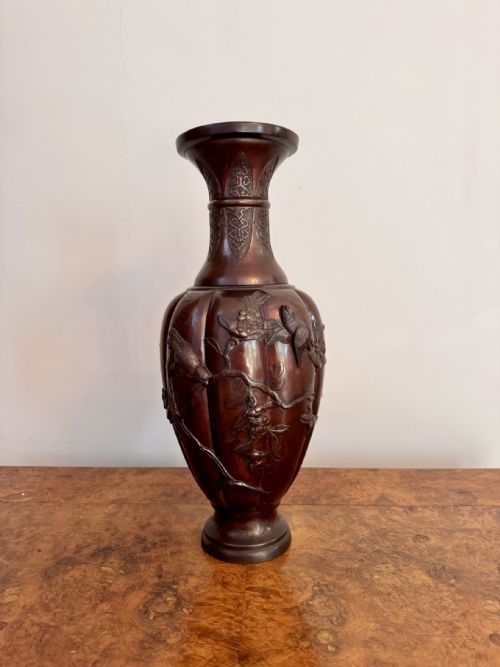
A relief cast bronze vase brings sculptural depth into a room, forged in metal and finished with patination from the nineteenth century.
Relief Cast Bronze Vase
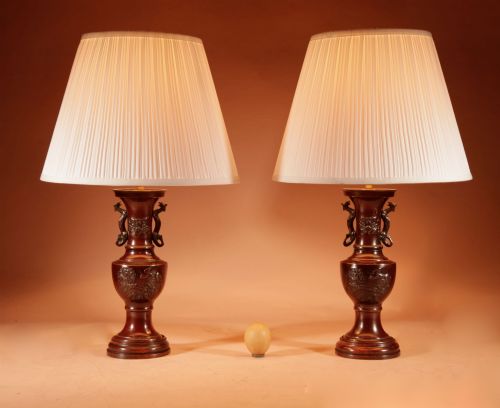
A relief cast bronze vase combines heavy metal casting with raised surface ornament, drawing heavily on Japanese Meiji period workshops and nineteenth century European foundries. These pieces range from monumental pairs to modest stem vases, often doubling as jardinieres or table lamps.
The version most frequently met on this page is the Japanese Meiji period bronze vase, standing alongside Chinese Qing dynasty vessels and French neoclassical campana shapes. Makers utilised lost-wax and sand-casting methods to achieve striking dimensionality in the motifs.
Vessels span the Victorian era and the turn of the twentieth century, appearing singly or in matched pairs. Their forms serve both decorative and functional roles as urns, bouquet pots, and wine-coolers.
Materials and Casting Techniques
Foundries relied primarily on bronze and patinated bronze, occasionally incorporating brass or mixed metals for contrast. Surface treatments frequently involved applied pigment and gold leaf to highlight raised details.
The relief decoration was achieved through meticulous casting and subsequent chasing, where artisans refined the metal by hand. Secondary elements such as fabric shades or wooden bases appear in assembled lamp conversions.
Design styles represented include Japanese Meiji, Chinese Qing dynasty, and French neoclassical interpretations.
Distinctions in Execution and Weight
Quality rests in the crispness of the relief casting and the depth of the metal patination. Substantial weight and balanced proportions distinguish the finer productions from lighter commercial pieces.
The refinement of hand-chased details on dragons, foliage, and figures separates standard decorative items from exceptional foundry works.
Barbedienne
The Relief Cast Bronze Vase Glossary
- Relief casting
- A method where figures or ornament project from a flat background. This technique creates tactile depth across the body of the vessel.
- Patinated bronze
- Metal treated with chemicals or heat to produce an aged surface colour. It protects the alloy and adds tonal variation.
- Campana-shaped
- An inverted bell profile modelled on classical antiquity. French neoclassical examples frequently employ this silhouette.
- Meiji period
- The era of Japanese history spanning from eighteen sixty-eight to nineteen twelve. Works from this time demonstrate supreme technical mastery in metalwork.
- Jardiniere
- A large ornamental pot designed to hold plants. These vessels often share the heavy cast construction of standard vases.
Relief Cast Bronze Vase: Frequently Asked Questions
What is a relief cast bronze vase?
A relief cast bronze vase is a vessel featuring decorative motifs raised above the surface plane, produced through traditional foundry methods.
These pieces reflect distinct cultural aesthetics, ranging from Japanese Meiji period naturalism to European neoclassical revivals.
How were these bronze vases used?
They served primarily as interior display pieces, holding floral bouquets or standing empty on mantels and pedestals.
Larger versions functioned as wine-coolers or jardinieres for indoor plants, while later adaptations converted vessels into table lamps.
How do I date a bronze vase?
Dating relies on stylistic markers, casting quality, and the specific character of the surface patination. Nineteenth-century pieces often bear period-specific foundry marks or stylistic idioms tied to the Meiji or Victorian eras.
Comparing the weight, relief depth, and secondary materials helps place the object within its historical window.
How do I live with antique bronze?
Bronze requires minimal maintenance, needing only gentle dusting to preserve the patinated surface. Avoid harsh chemical cleaners that strip the historic finish.
Position vessels away from excessive moisture and secure heavy pairs on stable surfaces to support their substantial weight.