
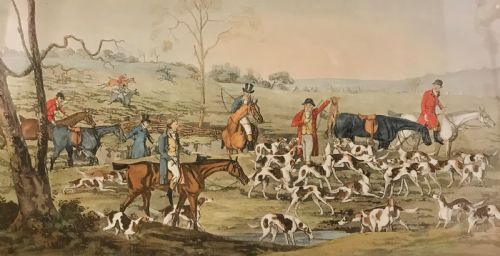
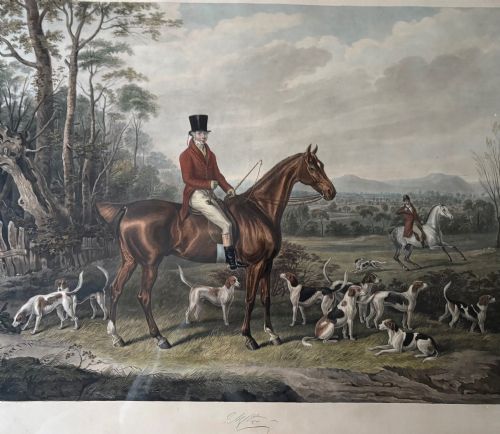


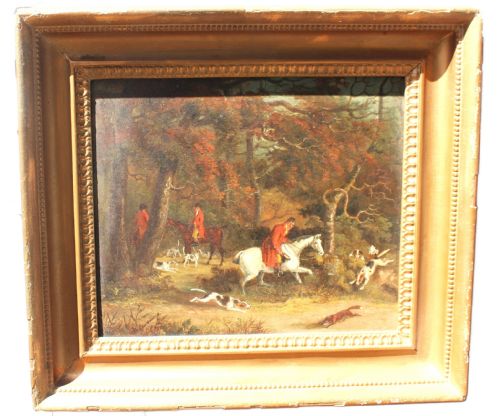


Regency Sporting Art
Regency sporting art captures the energy of the field, the stable, and the country house through oil paintings, watercolours, and prints.
Regency Sporting Art
Regency sporting art encompasses depictions of horses, hounds, country gentlemen, shooting scenes, and rural pastimes originating primarily from the Georgian and nineteenth-century periods.
The objects take the form of oil paintings on canvas or wood, watercolours, ink drawings, and framed prints or engravings.
Subjects range from individual portraits of named hunters and prize bull bitches to coaching scenes, hunting pursuits, and traditional pastimes like football or skittles.
Materials and methods
Works in this field rely on oil on canvas or wood panels, transparent watercolours on paper, and printed techniques such as lithography and engraving.
Framed works frequently utilise period wood frames, sometimes incorporating gold leaf accents alongside glass protection for works on paper.
A bull bitch named Lucy shares the record with John 'Mad Jack' Mytton.
Distinctions in quality
Quality rests upon the precision of draughtsmanship in animal anatomy and human posture, alongside the artist's ability to render light across a landscape or stable interior.
Signed works and those attributed to recorded painters command greater attention than anonymous decorative prints, though well-preserved period impressions maintain a distinct appeal.
John Ferneley Senior·Samuel Raven·Clifton Tomson·James Ward·John Nost Sartorius·James Barenger·Samuel John Egbert Jones·Dean Wolstenholme·Benjamin Marshall
The Regency Sporting Art Glossary
- Aquatint
- An intaglio printmaking technique that produces areas of tone resembling watercolours. This method is frequently found in nineteenth-century sporting prints.
- Lithograph
- A planographic printing process using stone or metal plates. These allow for the reproduction of illustrations such as hunting scenes.
- Signet ring
- A finger ring bearing a carved or raised seal. Examples in this category relate to historical sporting figures and wax seal impressions.
- Panel painting
- An artwork executed on a wooden support rather than canvas. These pieces often date from the early nineteenth century or Georgian eras.
Regency Sporting Art: Frequently Asked Questions
What subjects appear in sporting art?
The subjects focus on horses, dogs, shooting expeditions, coaching travel, and country pursuits.
Animals appear both as named individual portraits and as participants in wider hunting or racing landscapes.
Are these pieces original oils or prints?
The selection includes both unique hand-painted works in oil and watercolour, and period printed material.
Engravings, lithographs, and aquatints represent the reproducible side of nineteenth-century visual culture.
How do I date a piece?
Dating relies on stylistic markers, costume details, framing materials, and specific publishing dates where recorded.
Many works originate from the Georgian and Regency eras through to the mid-nineteenth century.
How should I display works on paper?
Works executed on paper or as watercolours require protection behind glass to prevent atmospheric damage.
Keep framed prints away from direct sunlight to preserve the ink, paper, and hand-applied pigments.