
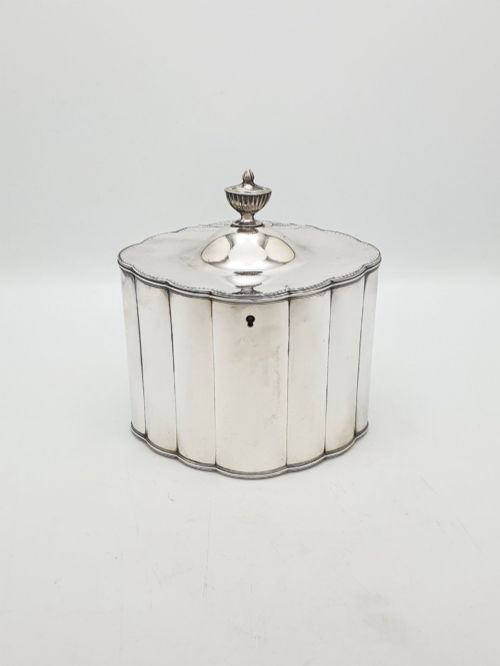


Regency Silver Tea Caddy
A regency silver tea caddy brings Georgian elegance to the table, offering a prized home for dry leaves.
Regency Silver Tea Caddy
When you search for a regency silver tea caddy, you are looking at containers designed to store and preserve fine tea leaves in the Georgian period. The examples on this page span the Georgian and Regency eras, encompassing the wider material culture of tea storage including caddy spoons and biscuit boxes.
You are most likely to meet tortoiseshell tea caddies alongside silver and Sheffield plate items, reflecting the varied material tastes of the early nineteenth century. Forms range from octagonal boxes to bow-fronted double containers and circular vessels.
The objects connect directly to the domestic rituals of the nineteenth century, housing luxury goods that required secure, compartmentalised storage. Pieces in this category include work by makers such as William Rudkins, alongside broader nineteenth-century examples in burr maple.
What varies in quality
Quality rests on the crispness of the silversmith's work and the precise matching of tortoiseshell panels across the wooden core. Finer items display meticulous assembly in hinges, locking mechanisms, and internal partitions.
The choice of materials dictates the tier of the piece, with solid sterling silver and finely figured tortoiseshell marking out superior examples against plated copper or standard wood.
Miniature tortoiseshell caddies allowed affluent Victorians to indulge in miniature luxury storage.
William Rudkins
The Regency Silver Tea Caddy Glossary
- Regency
- A period in British history spanning from 1811 to 1820, characterised by distinct neoclassical design influences. Items from this era often feature clean geometric lines and refined ornamentation.
- Sheffield Plate
- A composite material made by fusing a thin sheet of silver to a thicker copper base. This technique preceded modern electroplating.
- Tortoiseshell
- The mottled shell of certain turtle species, used as an expensive veneer on luxury boxes and caddies. It is highly prized for its translucent amber and brown patterns.
- Caddy Spoon
- A small spoon specifically designed for measuring loose tea leaves from a caddy into a teapot. These spoons often feature shell bowls or intricately engraved handles.
Regency Silver Tea Caddy: Frequently Asked Questions
What is a regency silver tea caddy?
A regency silver tea caddy is a decorative container made during the early nineteenth century to store dry tea leaves securely.
These boxes often feature precious metals, tortoiseshell, or glass, reflecting the high value placed on tea during the Georgian period.
How were tea caddies used?
Tea caddies were kept in the parlour or dining room to protect expensive leaves from moisture, odours, and theft.
The mistress of the house usually held the key, portioning out the leaves herself for each pot of tea brewed.
How do I identify a Regency piece?
Regency pieces often display neoclassical motifs, symmetrical forms, and clean architectural lines inspired by ancient Greece and Rome.
Materials like tortoiseshell, Sheffield plate, and burr maple are common indicators of this decorative era.
Can I still store tea in them?
While historic caddies were built for storage, modern collectors generally use them for display rather than daily utility.
Older linings and adhesives can degrade over time, making delicate interiors unsuited for holding loose goods.