


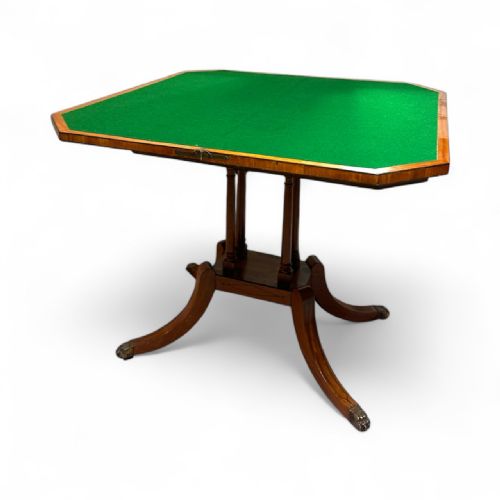
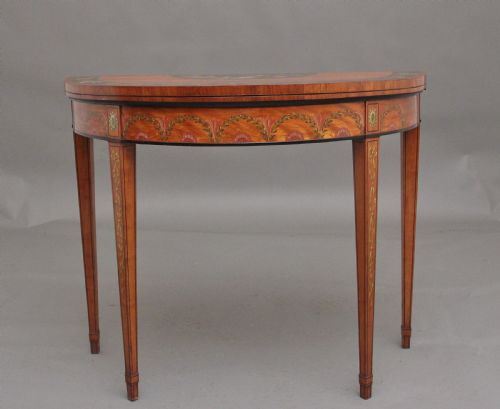
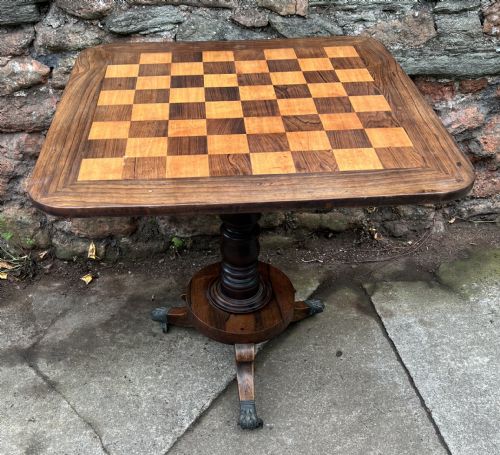

Regency Satinwood Card Table
Regency satinwood card tables are versatile folding game surfaces that bring warm timber tones and refined classical lines to a period interior.
Regency Satinwood Card Table
A regency satinwood card table offers a clever folding top that transforms from a slim console into a baize-lined surface for evening entertainment. These pieces belong primarily to the nineteenth century, Georgian, and Regency periods, drawing on classical forms designed for drawing rooms and parlours.
Buyers will encounter various formats on this page, including side tables, occasional pieces, and specialised games tables. Materials extend beyond satinwood alone to incorporate rosewood, olive wood, ebony, and paint.
Origins and styles span Grand Regency designs alongside Victorian interpretations and Maltese patience tables. Each example demonstrates how furniture makers adapted classical proportions to suit domestic card playing.
Construction and Materials
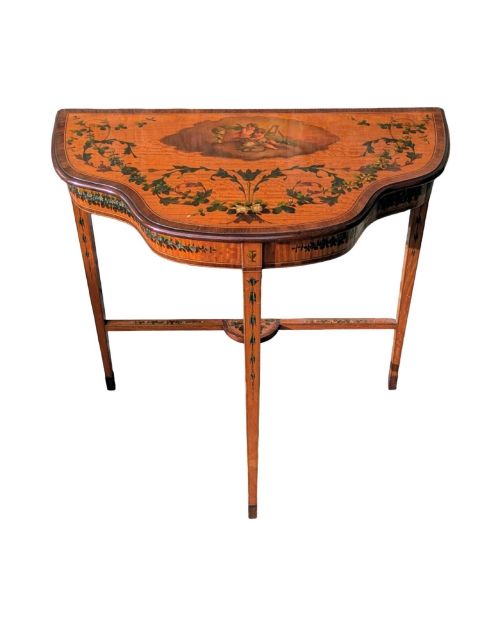
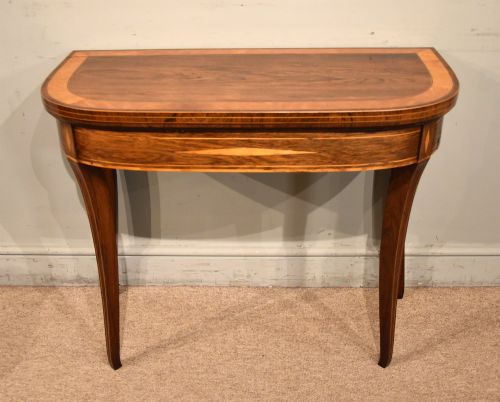
Cabinet makers utilised timber veneer over solid timber foundations, applying contrasting woods such as ebony and rosewood for inlay and banding. Satinwood provides a pale, reflective ground that highlights the deeper grain of darker borders.
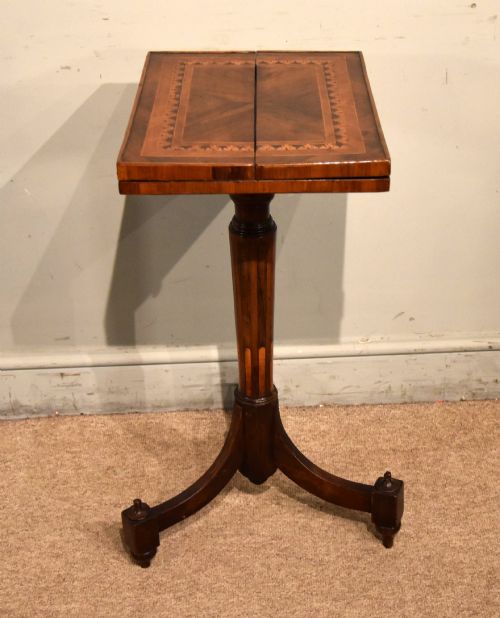
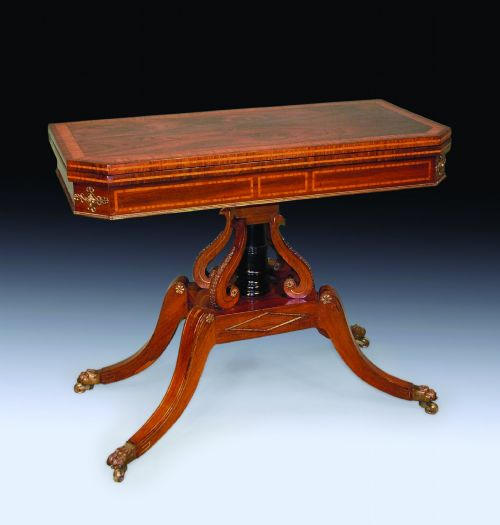
Scroll pedestal bases and finely turned legs support the upper surfaces, whilst fold-over mechanisms rely on precise wooden hinges or pivot joints. Certain examples incorporate polychrome paintwork and detailed chequered top surfaces.
Listings feature items spanning the eighteenth century, the Regency period, and Victorian revivals.
Judging Quality and Craftsmanship
The distinction between standard examples and superior pieces rests upon the selection of timber veneers and the precision of the contrasting inlay. Finer tables display exceptional grain matching across the fold-over top and sophisticated integration of secondary woods like ebony and olive wood.
Structural refinement in the pedestal base and the sharpness of painted or polished details separate workshop productions from lesser alternatives. The handling of scroll supports and the alignment of chequered patterns indicate the level of care invested by the original maker.
The Regency Satinwood Card Table Glossary
- Satinwood
- A hard, durable timber with a natural golden sheen and smooth grain. It was frequently used as a veneer on high-end furniture.
- Card Table
- A specialised table featuring a hinged top that folds open to reveal a baize or leather playing surface. These tables were essential for card games in polite society.
- Veneer
- A thin slice of figured timber applied over a secondary timber foundation to create decorative exterior surfaces. This technique allowed makers to display striking grain patterns.
- Pedestal Base
- A central column support resting on splayed legs, often carved with scroll work. It replaced traditional four-leg configurations on many tables of this period.
- Inlay
- The technique of embedding contrasting strips of timber or ebony into the primary wood surface. It creates geometric borders and decorative panels.
Regency Satinwood Card Table: Frequently Asked Questions
What is a regency satinwood card table?
A regency satinwood card table is a fold-over furniture piece designed for parlor games during the late eighteenth and nineteenth centuries. These tables feature reflective satinwood veneers often contrasted with dark woods like rosewood and ebony.
When closed, the pieces function as side or occasional tables against a wall. Opening the top reveals a flat surface previously used for card playing and social gatherings.
How do you use a card table today?
Modern owners often place these tables in hallways, living rooms, or bedrooms as decorative side consoles. The fold-over top remains functional for occasional use or display purposes.
Keeping the timber polished and away from direct heat sources preserves the delicate satinwood veneer. They serve well for holding lamps, books, or small decorative objects.
How do I identify a Georgian piece?
Georgian tables typically exhibit restrained classical proportions and precise ebony or timber stringing. The emphasis rests on elegant woodwork rather than heavy ornamentation.
Comparing the secondary timbers and the style of inlay helps distinguish Georgian work from later Victorian interpretations. The overall geometry reflects earlier eighteenth-century design principles.
What is a patience table?
A patience table is a compact form of games table specifically designed for solitary card games like patience or solitaire. Examples from Malta often combined olive wood and satinwood veneers.
These specialised pieces share the folding top mechanism of standard card tables but are tailored in scale. They represent a distinct regional variation within nineteenth-century furniture production.