
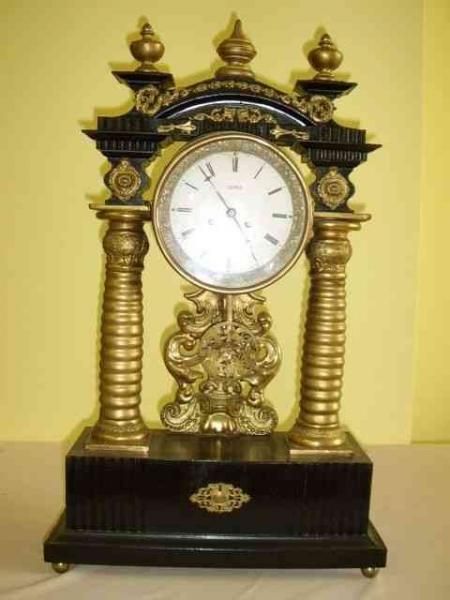
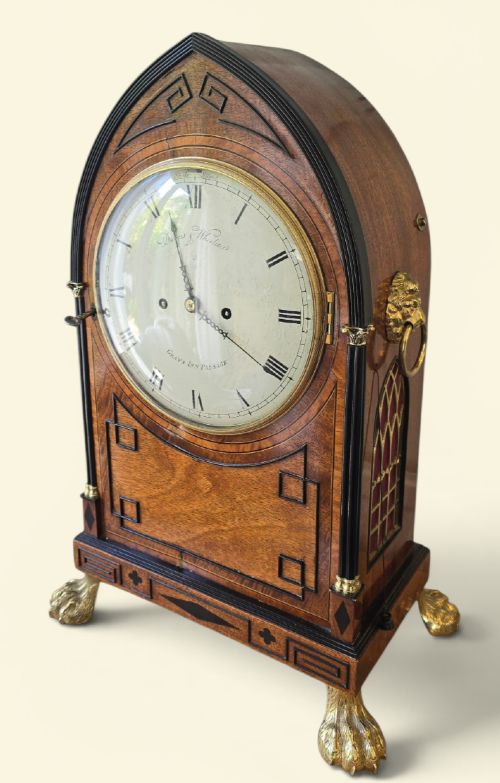


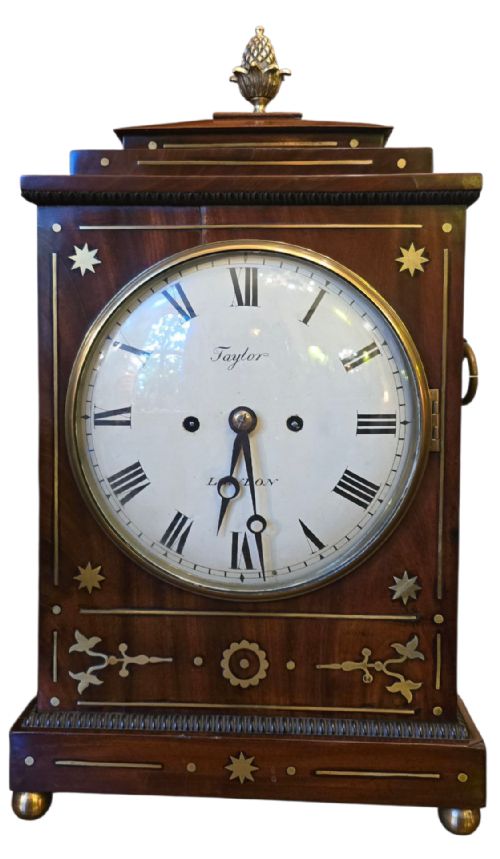


Regency Period Mantel Clock
These pieces are a regency period mantel clock, mechanical timekeepers housed in rich mahogany, bronze or ormolu that anchor a room with period proportion.
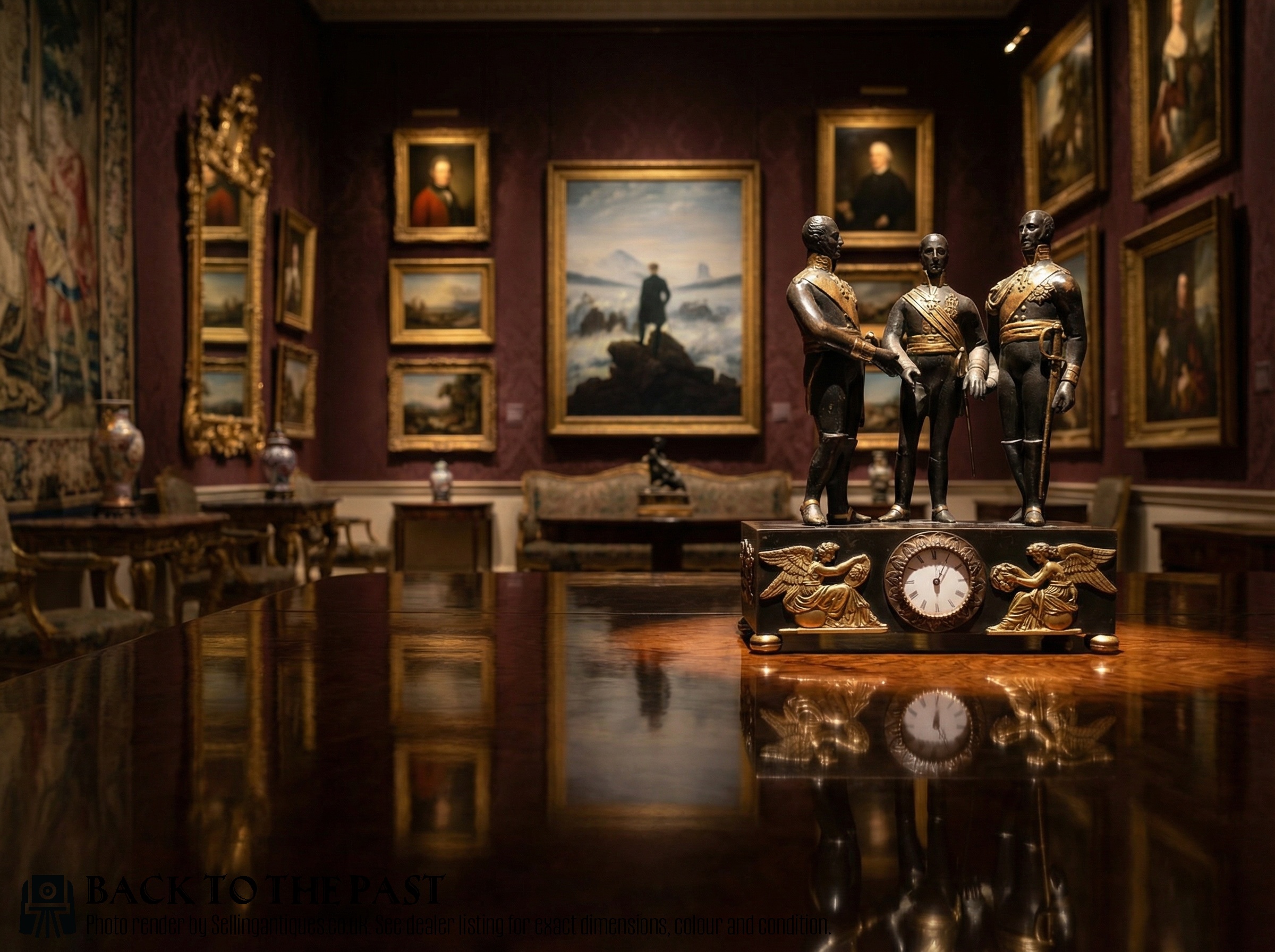
Regency Period Mantel Clock
A regency period mantel clock brings together the formal architectural styles of the early nineteenth century, drawing on Georgian traditions alongside French Empire and Regency Gothic Revival influences.
The pieces listed here appear in diverse forms ranging from compact mahogany bracket clocks with brass inlay to grand figural and portico mantel clocks in gilt bronze and ormolu.
Makers working during the Regency, George IV and late Georgian periods constructed these timepieces to sit proudly on a bracket or fireplace mantel as both practical instruments and sculptural centrepieces.
Materials and movement construction
Cases rely heavily on dense timbers such as mahogany and rosewood, frequently accented with contrasting ebonised wood, delicate brass inlay or intricate gilt bronze mounts.
Movements utilise fusee mechanisms, driven by chains or cords, to ensure even power delivery as the mainspring unwinds, paired with enamel dials for high legibility.
The listings here span the Regency, Georgian and 19th-century periods, utilising materials from Cuban mahogany and rosewood to gilt bronze and ormolu.
Judging the hierarchy of quality
Quality rests upon the crispness of the cast ormolu and gilt bronze mounts, where sharp chiselling distinguishes superior sculptural definition from soft, commercial output.
Cabinetwork displays refinement through tight wood grain matching, precise brass stringing, and well-proportioned architectural details rather than excessive ornamentation.
Movement execution shows in the finesse of the engraving on backplates and the structural integrity of the fusee train signed by established makers.
Desbois and Wheeler·L Vick·Taylor of London·Pons de Paul·William Hardy London·FB Adams London·Baetens London·Fatton Eleve de Breguet London
The Regency Period Mantel Clock Glossary
- Fusee
- A conical pulley used in spring-driven clocks to equalise the torque of the mainspring as it unwinds. This mechanism ensures more consistent timekeeping throughout the running period of the movement.
- Bracket clock
- A portable clock designed originally to sit on a bracket fastened to a wall to aid sound projection. Later examples simply retained the name despite standing directly on furniture.
- Ormolu
- Finely ground high-carat gold mercury-gilded onto a bronze base. This technique produces a warm, deep lustre characteristic of high-end French and English decorative metalwork.
- Verge escapement
- An early type of escapement mechanism controlling the release of power in a clock movement. It interacts with the balance or pendulum to regulate the beat.
Regency Period Mantel Clock: Frequently Asked Questions
Where should I place a heavy bronze clock?
Position the clock on a stable, level surface such as a sturdy mantelpiece or heavy sideboard that can comfortably bear the combined weight of bronze and marble.
Avoid locations near direct heat sources or damp areas that could affect the delicate wood case and internal metalwork.
What is the difference between a bracket clock and a mantel clock?
Bracket clocks traditionally featured a swinging handle on top for portability and were designed to rest on a dedicated wall bracket.
Mantel clocks encompass a broader range of freestanding architectural and figural cases meant to sit directly upon a shelf or furniture top.
How do I distinguish Regency style from French Empire?
Regency design often favours warm mahogany or rosewood timbers with restrained brass inlay and architectural bracket forms reflecting English taste.
French Empire pieces lean heavily toward classical mythology expressed through fire-gilded ormolu, patinated bronze figures and striking portico structures.