
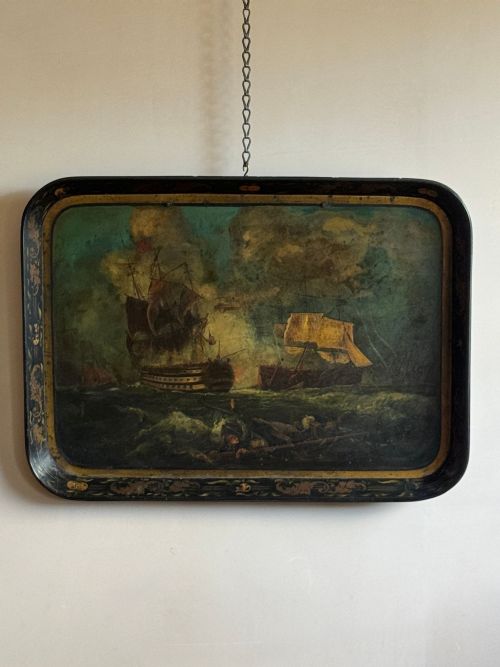


Regency Naval Painting
A regency naval painting captures the drama and personnel of Britain's maritime history through oil on canvas and detailed portraits.
Regency Naval Painting
When searching for a regency naval painting, collectors encounter a focused selection of marine art, portraits of officers, and related items from the nineteenth century.
The objects span oil paintings on canvas, watercolour portraits of naval officers, and related decorative pieces like japanned papier-mâché trays and maple-framed mirrors depicting naval engagements.
Portraits of prominent figures such as admirals dominate the selection, alongside marine scenes showing engagements and aftermaths from the period.
Materials and construction
Works of this period rely primarily on oil on canvas for portraits and marine scenes, supplemented by watercolour and enamel for miniatures.
Frames and related decorative objects utilise wood, gold leaf, giltwood, papier-mache, and lacquer, reflecting the craftsmanship of the eighteenth and nineteenth centuries.
Sir Sidney Smith appears holding both a sword and a torch, ready to illuminate the enemy.
Evaluating quality and attribution
Quality separates works by documented artists and academics from anonymous marine paintings and studio copies.
The finesse of brushwork in the depiction of uniforms, facial likenesses, and maritime rigging determines the standing of each piece.
Henry Bone ARA·Sir Thomas Lawrence PRA·Samuel Lane·Robert Ker Porter·Ambrosini Jerome
The Regency Naval Painting Glossary
- Regency
- A period in British history spanning the early nineteenth century, noted for distinct neoclassical styles in art and furnishings.
- Oil on canvas
- A painting medium where pigments are suspended in drying oils and applied to a stretched fabric support.
- Papier-mâché
- A composite material made of paper pulp or layers of paper reinforced with glue, used for trays and decorative objects.
- Reverse glass print
- An image applied to the rear of a glass panel so that it is viewed through the transparent front.
- Enamel miniature
- A small-scale portrait painted with vitreous enamels on a metal base, fired in a kiln for permanence.
Regency Naval Painting: Frequently Asked Questions
What is a regency naval painting?
These works comprise oil paintings, watercolours, and portraits depicting British naval officers, ships, and historic maritime engagements from the late eighteenth and early nineteenth centuries.
They serve as historical records and fine art pieces documenting the era's prominent naval figures.
How were marine portraits displayed?
Officers and their families hung formal portraits in grand residences and country houses to commemorate military service and rank.
Smaller miniatures and watercolour portraits were often kept as personal mementos or displayed in private drawing rooms.
How do I identify the period?
Identifying the period involves examining the style of the naval uniforms, the framing techniques, and the biographical dates of the depicted subjects.
Artistic conventions of the nineteenth century also help distinguish these works from later copies and Victorian maritime art.
Can I find works by known artists?
Selected pieces in this category carry attributions or signatures from established portraitists and painters of the Georgian and Regency eras.
Documentation regarding the sitters often aids in tracing the authorship and historical context of the painting.