
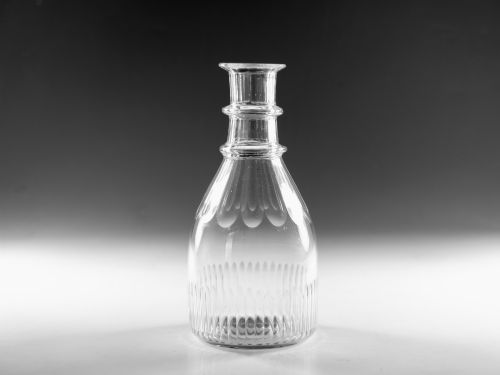
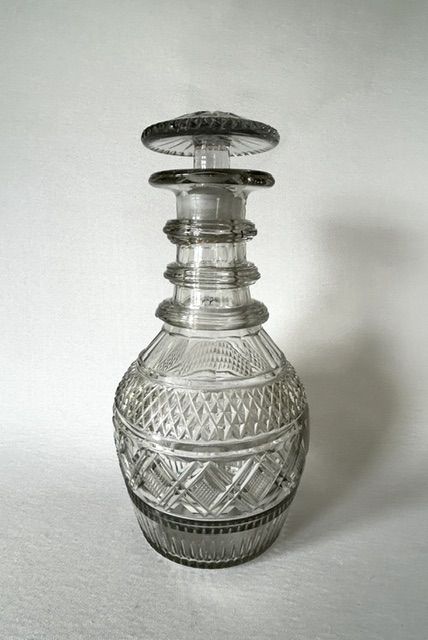


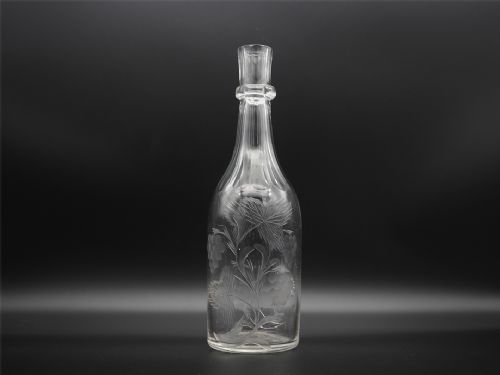
Regency Glass Wine Carafe
A regency glass wine carafe brings heavy lead crystal and bright cut decoration to the dining table.
Regency Glass Wine Carafe
A regency glass wine carafe is a heavy vessel designed to hold and serve wine at the dining table, appearing in forms such as ship's decanters, three-ring decanters, mell decanters, and half-bottle decanters. These pieces originate from the Regency, Georgian, and 19th Century periods, spanning dates from around 1800 to 1830.
Buyers browsing this selection will most frequently encounter English cut glass and lead crystal decanters featuring distinctive pillar cuts and neck rings. Irish examples also appear among the selection, alongside rarer variations such as amethyst glass and spirit decanters.
How they were made
These vessels are fashioned from lead crystal, clear glass, and lead glass, utilising traditional blowing techniques followed by wheel-cutting. The distinctive rings found on the necks and the deep vertical facets are worked cold into the heavy metal after initial shaping.
Makers shaped specific forms like the wide-based ship's decanter to remain stable at sea, while standard serving bottles and mell decanters received heavy bases to balance their tall profiles.
What varies in quality
The standard of a regency glass wine carafe rests upon the weight of the metal and the crispness of the wheel-cut facets. Deeper, sharper cutting and heavier lead crystal distinguish the finest pieces from lighter, simpler glassware.
Proportion and clarity also separate the output, where brilliant, untinted crystal and well-balanced neck rings indicate superior craftsmanship compared to duller metal with soft or muddy cutting.
The Regency Glass Wine Carafe Glossary
- Lead crystal
- Glass containing a significant proportion of lead oxide, which increases weight, brilliance, and the refraction of light. This heavier metal allows for deep, sharp wheel-cutting.
- Ship's decanter
- A form with a broad, flat base and a conical body designed to prevent tipping on the dining tables of rolling vessels at sea. They remain remarkably stable on land.
- Neck ring
- An applied or tooled horizontal ridge encircling the neck of a decanter, often numbering three on Regency examples. They provide a secure grip for the pouring hand.
- Mell decanter
- A bottle form with a mallet-shaped body, tapering gently from shoulder to base. These historic vessels date primarily to the Georgian and Regency eras.
Regency Glass Wine Carafe: Frequently Asked Questions
What is a ship's decanter?
A ship's decanter is a wide-based vessel designed to stay upright on a rolling dining table at sea. Its conical profile lowers the centre of gravity.
These pieces feature heavy lead crystal construction to withstand maritime travel while serving wine in domestic settings.
How do I date a decanter?
Dating relies on the silhouette, the presence of neck rings, and the style of cutting. Regency and Georgian examples often show distinct three-ring necks and heavy lead crystal.
Comparing the specific form against documented periods from around 1800 to 1830 helps establish the exact era of manufacture.
Can I use these for wine?
These historic vessels were made specifically for holding and serving wine at the table. Their heavy lead crystal construction holds up well to modern use.
Careful hand washing preserves the clarity of the clear glass and protects the sharp cut facets from damage.
What are neck rings?
Neck rings are horizontal glass ridges formed around the neck of a decanter. Regency examples frequently incorporate three distinct rings.
Beyond their decorative appearance, these rings provided a secure grip for the hand when pouring wine from a heavy crystal bottle.