

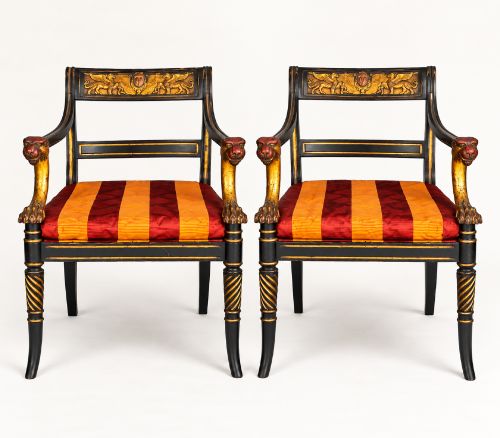
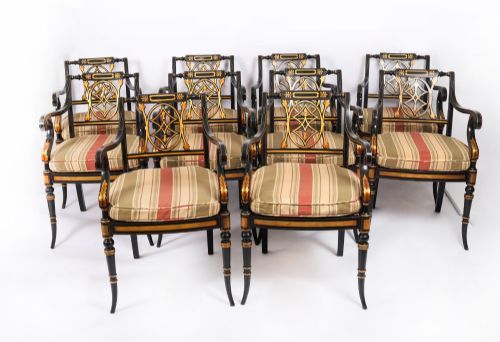
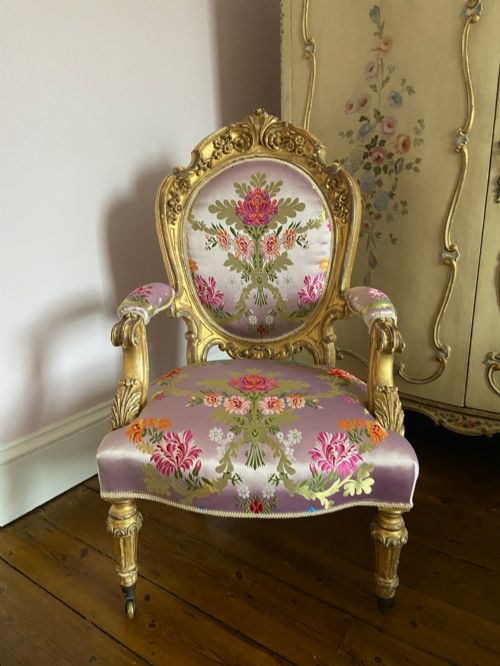
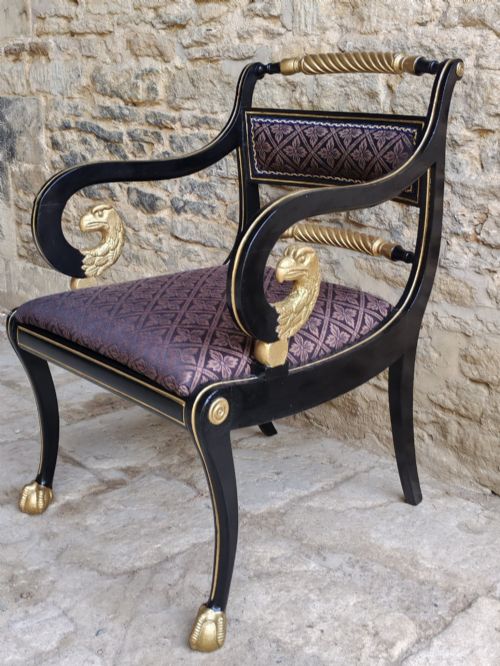
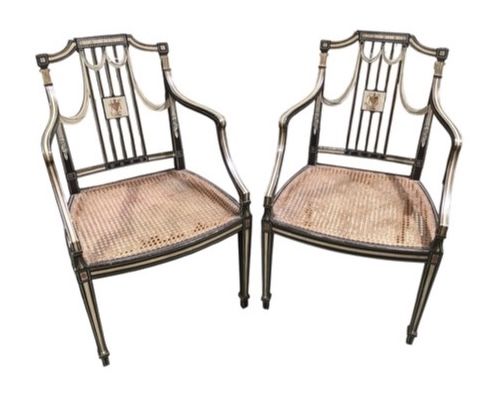


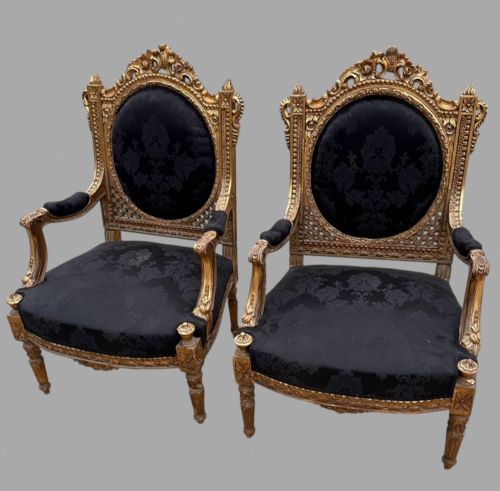


Regency Gilt Armchairs
Regency gilt armchairs bring neoclassical flair and bold gilding to a room, offering comfortable seating shaped by early nineteenth-century design.
Regency Gilt Armchairs
Regency gilt armchairs comprise seating forms originating in the Regency period alongside later twentieth-century revivals. These library chairs, elbow chairs, and open armchairs combine classical restraint with gilded surfaces.
The pieces listed here span the Regency era proper around eighteen-twenty, as well as Georgian, nineteenth-century, and twentieth-century revivals in Regency style, Grand Regency, and Rococo Revival. Buyers meet both authentic early nineteenth-century seating and later twentieth-century interpretations.
Makers and designers of the initial period drew on French neoclassical and English patterns, such as designs by George Smith. Later twentieth-century workshops reproduced these historic forms using ebonised wood, parcel gilt, and painted finishes.
How they were made
Carpenters shaped timber, beech, and walnut into structural frames for these armchairs, applying carved details and decorative turning. Workshops then prepared the wooden surfaces to receive gilding, paint, or ebonisation.
Giltwood and parcel gilt finishes involve applying thin sheets of gold leaf over a prepared base, highlighting carved motifs. Artisans also utilised black lacquer, simulated satinwood, and painted decoration alongside gilt highlights.
Upholsterers finished the seating using fabric and silk to cover the pads and backs. These textile choices complemented the gilded woodwork and painted frames recorded in the inventory.
Regency Gilt Armchairs Retail Price Guide 2026
Typical asking prices for regency gilt armchairs among the pieces listed under this phrase on Sellingantiques today, from the lower quarter to the upper quarter. They describe what is for sale here now, not the wider market.
What varies in quality
The depth and crispness of the carved woodwork separate finer examples from simpler production. Period pieces from the Regency era demonstrate sharper execution in the carved details of the arms and legs compared to some later revival interpretations.
The application and survival of the giltwood, parcel gilt, or painted finish define visual success. High-grade surfaces retain their original burnishing and gilding integrity, whereas secondary treatments can obscure the definition of the underlying timber.
The Regency Gilt Armchairs Glossary
- Regency
- An English design period spanning the early nineteenth century defined by neoclassical lines and ancient Greek, Roman, and Egyptian influences. It forms the primary stylistic reference for these armchairs.
- Giltwood
- Timber decorated with gold leaf applied over a prepared ground. This material creates the bright metallic surfaces characteristic of these chairs.
- Parcel Gilt
- A finish where only specific carved details or raised elements are gilded while the rest of the wood remains painted, ebonised, or in its natural timber state. It provides contrast against dark wood or painted grounds.
- Ebonised Wood
- Timber treated with stain or paint to imitate ebony. This dark finish frequently appears paired with gilt highlights on Regency revival elbow chairs.
- Library Chair
- A sturdy upholstered armchair designed for reading rooms. These chairs often feature generous armrests and supportive backs.
Regency Gilt Armchairs: Frequently Asked Questions
What is a regency gilt armchair?
A regency gilt armchair is an upholstered seat featuring gilded woodwork, created during the early nineteenth century or in later twentieth-century revivals. These pieces draw on neoclassical styles and include library chairs and open armchairs.
They combine structural timber frames with gold leaf, paint, or ebonised finishes, providing both decorative presence and functional seating.
How do I spot a real regency chair?
Authentic Regency period chairs date from the early nineteenth century and exhibit period construction methods and materials like beech, walnut, and genuine gold leaf. Examining the timber framing and carved detail helps distinguish them from twentieth-century revivals.
Revival pieces often show twentieth-century manufacturing techniques while following the same classical design vocabulary of the original era.
Where were these chairs used?
These chairs served primarily in formal libraries, drawing rooms, and parlours of grand houses. Their gilded frames and upholstered silk or fabric seats complemented sophisticated interior schemes.
Today, buyers place them in reception rooms or studies as statement seating that introduces classical proportion to a space.
What is parcel gilt?
Parcel gilt is a decorative technique where only select portions of a wooden frame receive gold leaf application. The remaining areas display painted finishes, ebonised wood, or natural timber.
This method highlights specific carved motifs on the arms and crest rails without fully gilding the entire structure.