
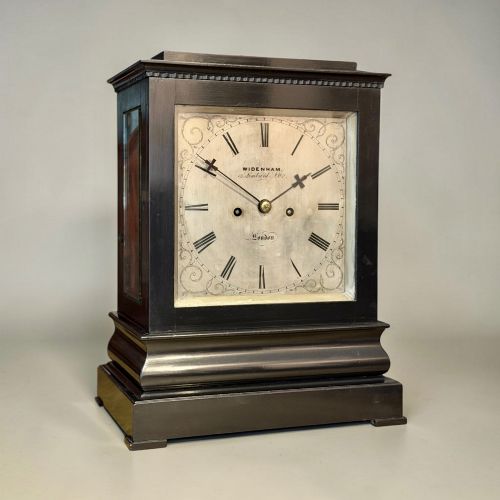
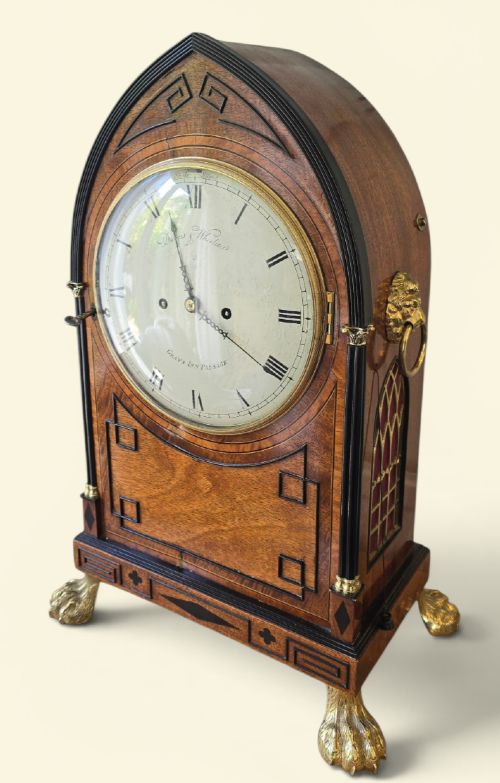


Regency Ebonised Table Clock
These regency ebonised table clock examples combine dark wooden cases with precise movement, offering both striking visual presence and reliable timekeeping.
Regency Ebonised Table Clock
When buyers search for a regency ebonised table clock, they encounter sophisticated timepieces originating from periods such as the Georgian, Regency, William IV, and Victorian eras. These objects take forms like mantel clocks, bracket clocks, and miniature timepiece variants.
The selections available here showcase distinct silhouettes, ranging from traditional bracket designs to balloon clocks and lancet-top forms. Makers from London feature prominently, constructing pieces designed to sit securely on flat surfaces.
Originating predominantly from the eighteenth and nineteenth centuries, these clocks reflect the horological standards of workshops working between seventeen fifty and the Victorian period. Buyers meet variations in case architecture and dial arrangement across these historical styles.
How they were made
Workshops constructed these clocks using timber such as ebonised wood, mahogany, and ebony, complemented by metal components like brass, gilt brass, and steel. Glass protects the dial faces while silvered metal provides a clear background for numerals.
Makers employed twin fusee movements to regulate the power delivered by the mainspring, ensuring consistent tension. Cabinets were shaped carefully from dense woods, then finished with ebonising techniques to achieve a dark, uniform surface.
Listings feature periods spanning from seventeen fifty through the Georgian, Regency, and William IV eras into the Victorian age.
What varies in quality
The refinement of the internal movement and the crispness of the exterior woodwork dictate the standing of an individual piece. Superior examples exhibit precise engraving on dial plates and well-proportioned case mouldings that remain faithful to their period of origin.
Widenham of London·Desbois and Wheeler·John Bull of Bedford·Des Granges of London·Grimaldi and Johnson·Arnold and Frodsham·Berguer of the Strand·John Leroux London·William Smith London
The Regency Ebonised Table Clock Glossary
- Bracket clock
- A portable timepiece traditionally designed to sit on a wall bracket or table surface. These clocks often feature carrying handles on top.
- Fusee
- A conical pulley used in spring-driven clocks to equalise the torque of the mainspring as it unwinds. This mechanism improves timekeeping accuracy.
- Ebonised
- Wood treated to imitate ebony through staining or painting. This finish gives the timber a deep black appearance.
- Lancet-top
- A case shape featuring a pointed, arched top resembling a lancet window. This silhouette appears frequently on nineteenth-century bracket clocks.
- Silvered metal
- A metallic dial plate coated with a thin layer of silver to enhance legibility. Engraved numerals and markings stand out against this finish.
Regency Ebonised Table Clock: Frequently Asked Questions
What is a regency ebonised table clock?
These are mechanical timepieces housed in dark wooden cases, originating primarily from the eighteenth and nineteenth centuries.
They function as both decorative furnishings and precise instruments for measuring hours in domestic settings.
How were these clocks used originally?
Owners placed them on tables, mantelpieces, or brackets within principal rooms to coordinate household schedules.
Their portable nature allowed staff to move them between rooms as required by daily routines.
How do I care for an antique clock?
Keep the timepiece away from direct sunlight, extreme temperature changes, and damp environments to protect the wood and internal metal.
Consult a professional horologist for periodic oiling and maintenance of the fusee movement.
How do I identify a Regency period clock?
Examine the case architecture for classical proportions, dark ebonised finishes, and specific dial signatures associated with period makers.
Reference marks on the movement plates often link the piece to recorded London workshops from the early nineteenth century.