
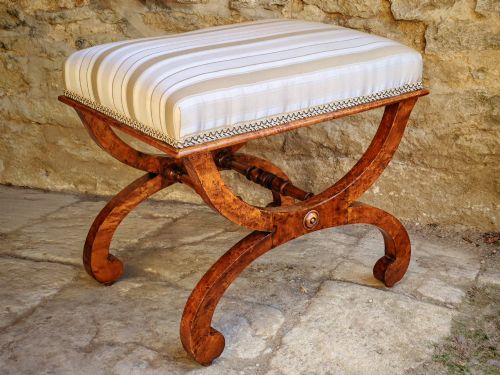


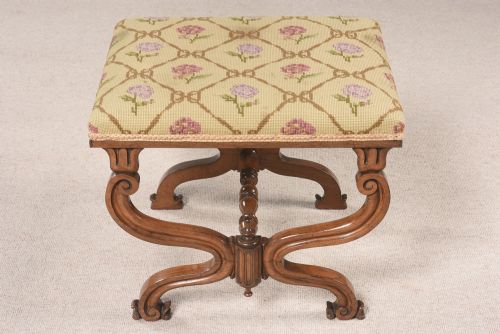

Regency Curule Footstool
These regency curule footstool examples combine neoclassical elegance with X-frame forms, offering collectors distinct seating options.
Regency Curule Footstool
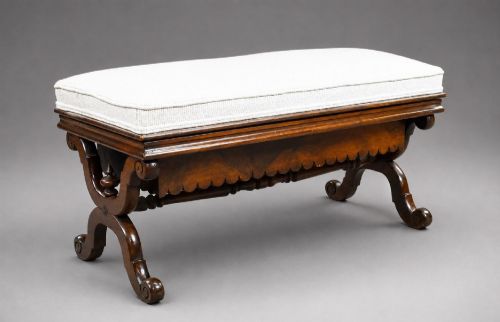
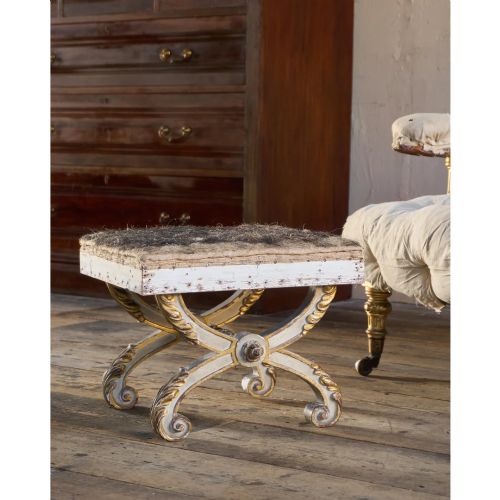
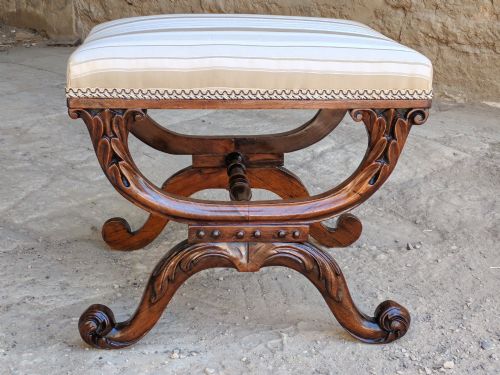
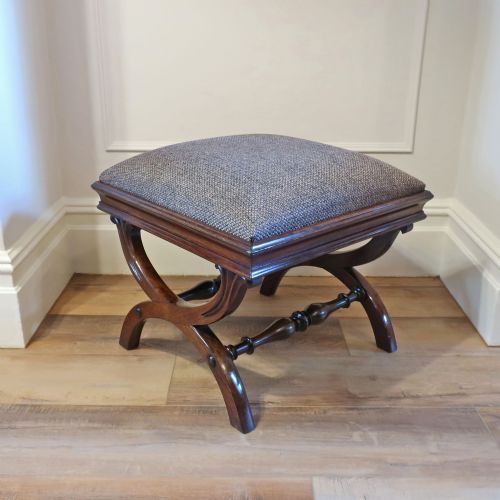
A regency curule footstool draws upon classical X-frame shapes reminiscent of ancient Roman seats, developing through the Georgian, Regency, and William IV eras into distinct domestic furnishings. These pieces manifest primarily as stools, footstools, and ottomans, serving both decorative and functional roles in period interiors.
The most common versions met on this page belong to the Regency and 19th Century periods, constructed with X-framed profiles. Surviving examples encompass matched pairs and individual seats, frequently designated as window seats or footstools in the listing titles.
Origins span English workshops, Irish cabinet makers, and French Empire ateliers, reflecting diverse neoclassical influences. Collectors encounter variants influenced by William IV and Early Victorian aesthetic shifts while retaining the foundational curule silhouette.
How they were made
Maker construction relies heavily on dense timbers such as mahogany and rosewood, alongside occasional burr maple and giltwood frames. Artisans shaped these woods into curved X-frame supports that required precise joinery to bear weight steadily.
Upholstery completed the pieces, utilising diverse textiles ranging from plain fabric to elaborate floral trellis tapestry and standard upholstery. Brass detailing sometimes accented the wooden frames, enhancing the visual richness of the finished stool.
Some X-frame stools travelled from Ireland to France without losing their footing, proving that good curves transcend borders.
What varies in quality
The refinement of the timber carving and the sophistication of the X-frame proportions distinguish finer examples from simpler provincial work. Timbers selected for their grain pattern, such as figured rosewood or burr maple, indicate higher workshop ambition.
The integrity of the frame construction and the preservation of original upholstery materials, including period tapestry and brass elements, influence the standing of individual pieces. Attributions to documented makers like Miles & Edwards add considerable distinction to a listing.
Miles & Edwards
The Regency Curule Footstool Glossary
- Curule
- A shape derived from ancient Roman magistrate seats, featuring intersecting curved legs that form an X-frame. This structural form defines the primary silhouette of these stools.
- Giltwood
- Wood that has been treated with gold leaf or gilt preparation to create a metallic sheen. This finish appears on more ornate neoclassical and French Empire examples.
- Neoclassical
- A style drawing inspiration from the classical art and architecture of ancient Greece and Rome. It heavily influences the clean lines and symmetry seen in Regency furnishings.
- Tapestry
- A form of heavy textile art hand-woven with pictorial or decorative designs. Period pieces often feature floral trellis patterns executed in this technique.
Regency Curule Footstool: Frequently Asked Questions
What is a curule footstool?
A curule footstool is a low seat defined by its intersecting X-shaped legs, taking inspiration from ancient Roman curule chairs. These pieces were designed to complement neoclassical and Regency interiors.
In domestic settings, they functioned as movable footstools, low seats, or window ottomans. Their distinctive profile sets them apart from standard four-legged stools.
How do I identify a Regency footstool?
Regency footstools typically exhibit neoclassical design elements, robust timber frames in mahogany or rosewood, and characteristic X-frames. Dating relies on stylistic cues and construction methods associated with the early nineteenth century.
Makers of this era favoured clean architectural lines combined with classical restraint. Surviving pieces often retain period upholstery or tapestries that match the aesthetic of the period.
Were these stools used as window seats?
Certain larger examples and ottomans served specific placement roles near windows or in formal reception rooms. Their low profiles ensured they did not obstruct views while offering convenient occasional seating.
Such pieces frequently appeared in pairs, designed to balance the symmetry of grand period interiors. Their upholstery was chosen to coordinate with surrounding drapery and furniture.
What woods were used for these stools?
Cabinet makers predominantly utilised mahogany and rosewood for their strength and deep colouration. More decorative variants incorporated burr maple or giltwood surfaces to achieve a more opulent finish.
The choice of timber usually reflected the prevailing fashion and the intended status of the room. Dense hardwoods ensured the curved X-frame remained structurally sound under daily use.