


Antique Cross Frame Seat
These antique cross frame seat pieces offer a sturdy X-shaped profile that brings classic classical form to any room.
Antique Cross Frame Seat
When you search for an antique cross frame seat, you encounter an array of stools, footstools, armchairs, and hall benches built around an intersecting X-shaped support structure. These functional furnishings trace their lineage back through periods such as the 19th Century, Victorian era, and early decades of the twentieth century. The forms range from compact dressing stools to substantial open armchairs and benches utilising bamboo or carved timber.
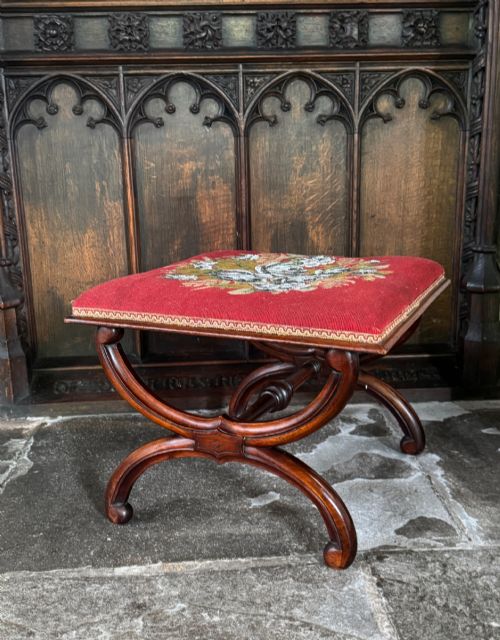
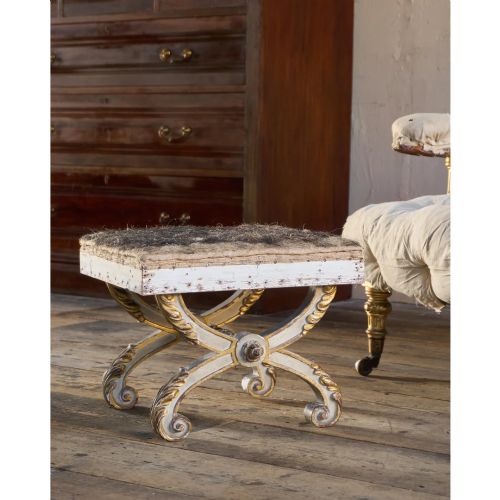
You are most likely to meet Victorian and nineteenth-century examples on this page, often executed in walnut, mahogany, or oak. Many feature upholstered seats in fabric, wool, or elaborate glass beads, while others incorporate cane or giltwood finishes. Styles span widely from Neoclassical and Empire to Gothic Revival and Victorian Aesthetic Movement, reflecting diverse historical revivals.
How they were made
Cabinet makers constructed the structural X-frames using dense hardwoods such as mahogany, oak, walnut, and rosewood, frequently incorporating carved details or gesso over giltwood. Some specialist pieces also employed bamboo to achieve a lighter silhouette for hall benches and occasional seating.
Upholstery techniques varied from traditional red damask and woven wool to intricate glass beadwork panels and stretched cane. Master craftsmen employed precise joinery at the central intersection to ensure the intersecting legs supported weight securely.
One enterprising maker once signed their X-frame footstool, ensuring humble feet could rest upon documented nineteenth-century artistry.
What varies in quality
The distinction between ordinary and exceptional pieces rests upon the crispness of the timber carving and the sophistication of the overarching style, whether Neoclassical, Empire, or Gothic Revival. Finer items display harmonious proportions in the curved X-members and superior surface patination on the polished hardwoods or gilded surfaces.
Upholstery and seating materials also dictate the tier of craftsmanship, with hand-worked glass beadwork or rich damask elevating a dressing stool above standard fabric coverings. Robust structural integrity at the frame intersection separates enduring collector pieces from lesser utilitarian versions.
The Antique Cross Frame Seat Glossary
- Curule stool
- An ancient Roman magistrate's chair shape characterised by curved legs crossing in an X. This classical silhouette was repeatedly revived during the Regency, Empire, and Victorian periods.
- Giltwood
- Timber coated with fine gold leaf or gilt preparation over a gesso base. It creates a brilliant reflective surface seen on Neoclassical and Empire revival seating.
- Damask
- A reversible figured fabric traditionally woven on a jacquard loom with patterns formed by contrasting warp and weft threads. It frequently upholsters formal antique stools.
- Cane
- Woven peeled rattan or bamboo strips utilised to form resilient, open-patterned seats. It appears on lighter seating forms like hall benches from the early twentieth century.
- Aesthetic Movement
- A late nineteenth-century design ethos prioritising visual beauty over narrative or moral function. Pieces from this era often embrace exotic materials or simplified forms.
Antique Cross Frame Seat: Frequently Asked Questions
What is a curule stool?
A curule stool is an ancient form of seating featuring curved legs that cross in the middle to form an X. This design originated in classical antiquity and was revived during the nineteenth century.
Such stools served as portable, prestigious seats for officials and wealthy households. Today they function well as occasional seating or dressing stools.
How do I identify a Victorian X-frame stool?
Victorian X-frame stools typically employ dense woods like walnut, mahogany, or rosewood. They often feature characteristic upholstery such as needlework or glass beadwork.
Examining the turning, carving style, and timber finish helps distinguish these pieces from later twentieth-century reproductions.
Where should I place an antique cross frame seat?
These versatile pieces work effectively at the foot of a bed, beside a fireplace, or as a dressing table seat. Their compact X-shape allows them to fit easily into smaller spaces.
Hall benches with cross frames suit narrow entranceways where a light, open silhouette prevents the hallway from feeling crowded.
Are these seats comfortable for daily use?
Many cross frame stools and chairs were designed for formal drawing rooms rather than prolonged lounging. However, upholstered versions with padded seats provide adequate support for short periods.
Footstools and dressing stools offer reliable ergonomics when paired with a matching armchair or dressing table.
What materials were used for the frames?
Cabinet makers utilised a variety of durable hardwoods including mahogany, oak, walnut, and rosewood. Giltwood and gesso finishes appeared on high-status Neoclassical and Empire pieces.
Later twentieth-century examples occasionally incorporated alternative materials such as bamboo for lighter hall furniture.