

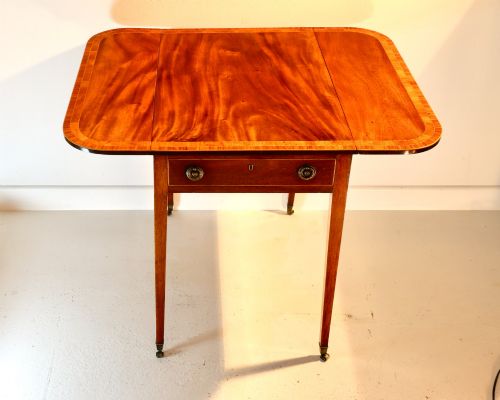
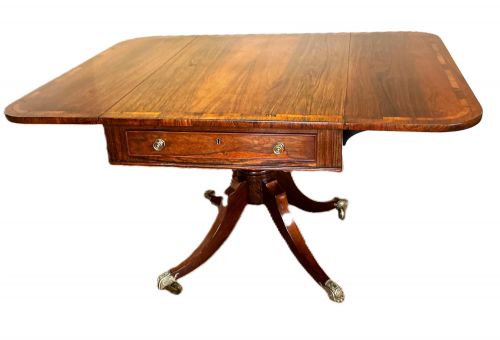


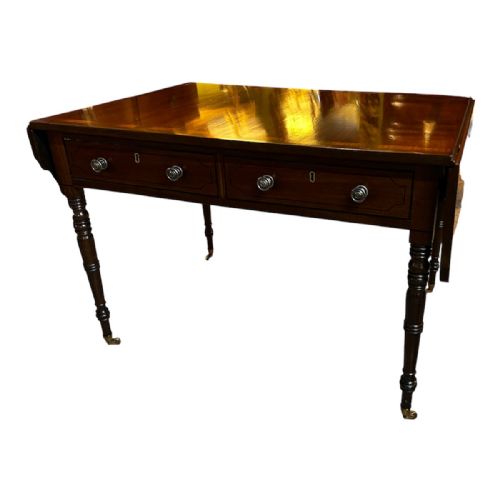


Regency Crossbanded Sofa Table
A regency crossbanded sofa table offers twin drop flaps and striking timber borders, built to sit behind a sofa or stand free in the room.
Regency Crossbanded Sofa Table
A regency crossbanded sofa table takes its primary form from the drop-flap tables designed during the Regency, Georgian, and eighteenth-century periods, often appearing with two small drawers and elegant end supports. You are most likely to meet mahogany examples enhanced with contrasting rosewood or satinwood borders, alongside occasional pieces from the Edwardian era.
These tables served originally for needlework or writing near the hearth, their freestanding design allowing them to be moved easily across a drawing room. Today, collectors value them for their slender proportions and the rich colour contrasts achieved by period cabinetmakers working with figured timbers.
How they were made
Cabinetmakers constructed these tables using solid and veneered timbers such as mahogany, rosewood, and satinwood, applying boxwood and wood inlay to create crisp geometric borders. The crossbanding technique involved laying thin strips of veneer across the grain of the primary timber to frame the top and drawer fronts.
Structural stability came from clever turning on pedestals and the use of brass castors on the feet, which allowed the drop flaps to be supported smoothly by wooden arms when raised. Joinery methods relied on traditional dovetails for the drawers and secure pegging for the framing.
Some nineteenth-century makers included dummy drawers on the reverse so the table looked symmetrical from every angle.
What varies in quality
The distinction between standard pieces and the finest examples lies in the selection of the timber figures, such as highly figured flame mahogany or richly grained coromandel and pollard oak. Master makers employed meticulous book-matching for veneers and precise, unbroken stringing lines.
Proportion and secondary woods also dictate the tier of craftsmanship, where superior tables feature heavy brass mounts, finely turned columns, and secondary drawer linings of oak rather than deal. The harmony between the crossbanded border and the central field determines the visual success of the piece.
James Mein Kelso
The Regency Crossbanded Sofa Table Glossary
- Crossbanding
- A border of veneer laid perpendicular to the grain of the main surface. This technique frames the top and draws the eye to the central timber.
- Drop flap
- A hinged leaf on either side of a table top that can be raised to extend the surface area or lowered when space is required.
- Satinwood
- A pale, lustrous timber native to India and Ceylon, prized for its golden yellow colour and smooth texture when polished.
- Pembroke table
- A small rectangular table with two folding flaps and one or two drawers, closely related in form to the sofa table.
- Stringing
- A thin inlay of contrasting wood used to create fine linear decoration around drawer fronts and table borders.
Regency Crossbanded Sofa Table: Frequently Asked Questions
What is a sofa table?
A sofa table is a small, versatile table designed with drop flaps on either side and usually featuring drawers beneath the top.
They were originally built to stand immediately behind a sofa in a formal drawing room during the Regency and Georgian periods.
How do I spot crossbanding?
Crossbanding appears as a distinct border around the edges of a table top or drawer front where the grain runs at right angles to the central panel.
Cabinetmakers used this method to frame the primary timber and add decorative contrast using woods like rosewood or satinwood.
Can I use one freestanding?
These tables are traditionally finished on all sides precisely so they can stand away from walls in the middle of a room.
Their polished backs and refined end supports make them suitable for central placement behind seating or within a library.
How do I tell the periods apart?
Eighteenth-century and Georgian examples often display simpler lines and heavier timber proportions, whereas Regency pieces introduce bolder brass inlays and exotic woods.
Edwardian revivals, appearing around nineteen-ten, tend to show lighter construction methods and paler mahogany figures.