




Lyre Leg Sofa Table
A lyre leg sofa table brings architectural grace to a room, offering twin scrolled supports beneath a rectangular drop-leaf surface.
Lyre Leg Sofa Table
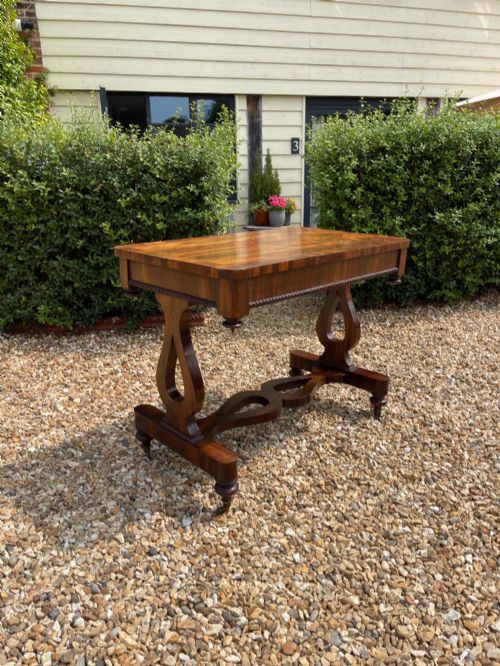
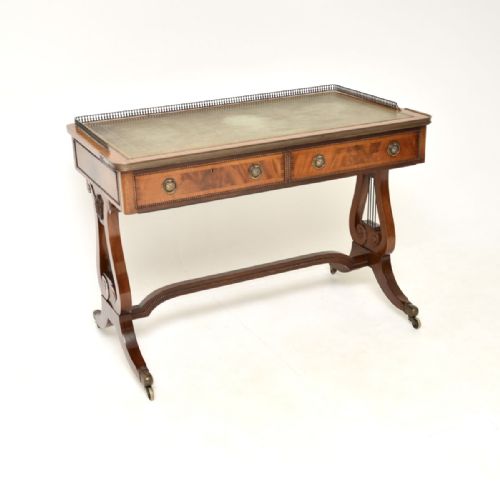
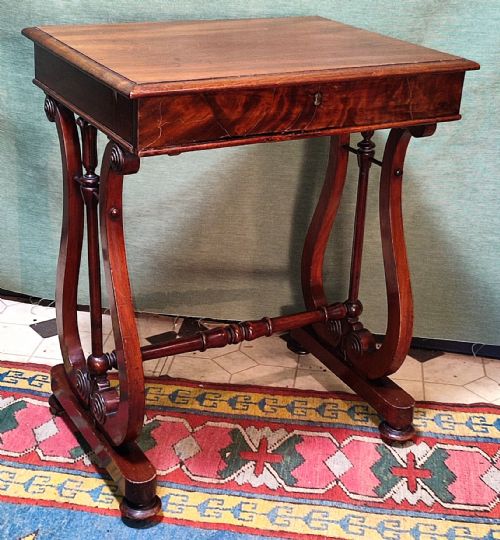
A lyre leg sofa table is a form of occasional or centre furniture designed with distinctive lyre-shaped trestle supports, most frequently encountered in mahogany across Regency, Victorian, and Edwardian periods.
The selection ranges from traditional nineteenth-century examples to later revivals from the early twentieth century, incorporating drop leaves and occasional drawers.
Beyond the standard sofa table configuration, related forms on this page include library tables, writing desks, and games tables that share the characteristic double-pedestal lyre base.
How they were made
Cabinet makers constructed these tables primarily from solid mahogany and flame mahogany veneer, often augmenting the primary timber with contrasting wood inlay such as satinwood and boxwood.
Functional surfaces frequently integrated leather inserts for writing or games, while structural stability relied on turned stretchers connecting the twin lyre pedestals, sometimes accented with brass fittings.
Listings feature items spanning the Regency period through to 1930, predominantly constructed from mahogany with brass and leather details.
What varies in quality
The standard of a lyre leg sofa table rests upon the selection of timber and the crispness of the carved scrollwork forming the lyre supports, where well-figured flame mahogany veneer and subtle boxwood stringing elevate the piece.
Proportion and structural integrity distinguish finer examples, particularly in how cleanly the drop leaves align with the central top and how securely the stretcher joins the pedestals.
Andrew Thomson & Sons
The Lyre Leg Sofa Table Glossary
- Lyre leg
- A structural support carved or shaped in the outline of an ancient Greek lyre instrument. It is typically paired with a matching pedestal to support larger rectangular tabletops.
- Drop-leaf
- A hinged flap on either side of a table that can be raised to extend the surface area or lowered when space is limited. Brass brackets and folding wooden fly brackets usually provide the under-support.
- Flame mahogany veneer
- A thin slice of wood cut from the branch junction of a mahogany tree, displaying a flickering, flame-like grain pattern. Cabinet makers applied this to prominent surfaces for visual depth.
- Stringing
- A narrow strip of contrasting timber inlaid into a channel on the furniture surface. Boxwood and satinwood are common choices for this linear decoration.
Lyre Leg Sofa Table: Frequently Asked Questions
What is a lyre leg sofa table used for?
These tables traditionally stood behind a sofa in the middle of a room, providing a surface for lamps or reading materials while keeping drop leaves lowered against the upholstery.
Today they function flexibly as slim desks, hall tables, or centrepieces in a sitting room where floor space requires a shallow profile.
How do I date a mahogany sofa table?
Dating relies on examining construction methods, secondary timbers, and stylistic markers such as the sharpness of the carved lyre and the presence of brass accents.
Earlier Regency examples often display heavier mounts and richer patination, whereas Edwardian and later revival pieces from the twentieth century show cleaner, lighter framing.
Are all lyre leg tables mahogany?
Mahogany is the predominant timber found across these listings, appearing in both solid form and as figured veneers.
Occasional variations incorporate contrasting woods like satinwood for inlay work, or substitute alternative timbers such as pollard and burr oak on specific top surfaces.
Can the drop leaves support weight?
The drop leaves are secured by hinged wooden brackets or pivoting arms that swing outward from beneath the main frame to hold the flaps steady.
While suitable for lamps, books, and writing materials, excessive downward pressure on the outer edges should be avoided to protect the hinge mechanisms.