
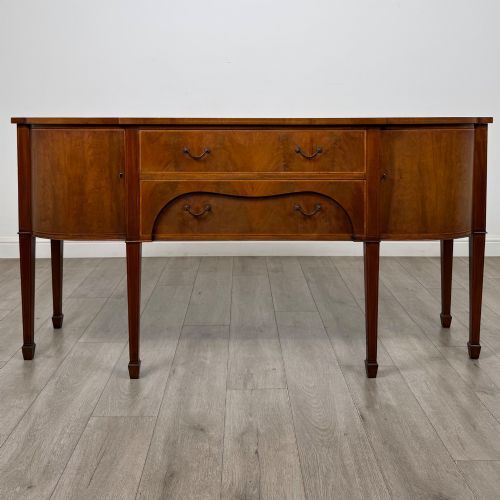
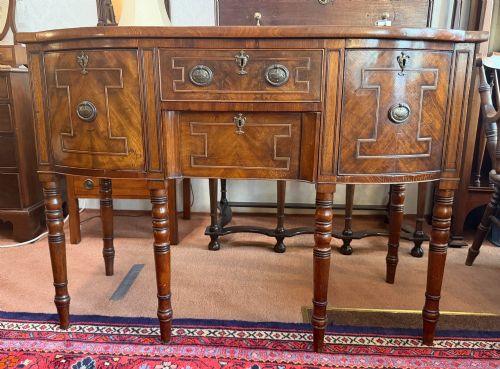
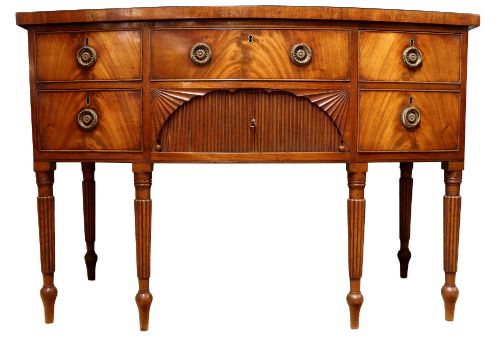
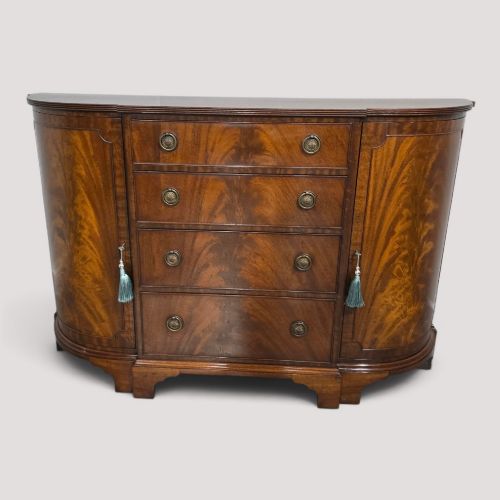
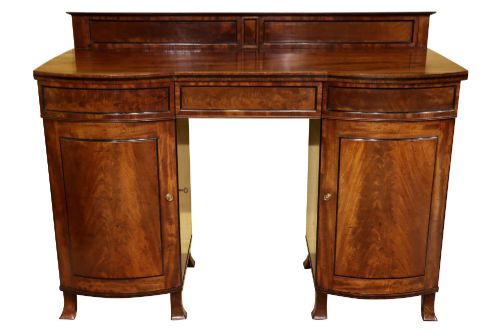
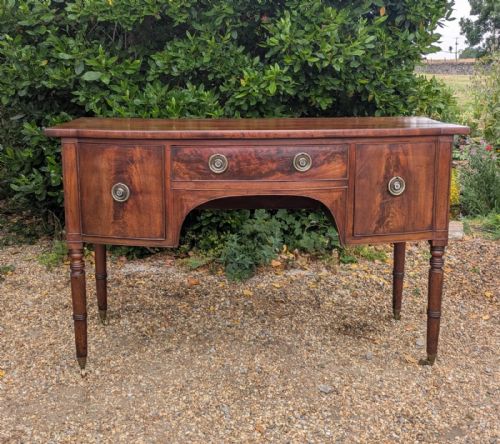


Regency Bow Front Sideboard
A regency bow front sideboard brings curving elegance to a dining room, offering deep surface space and concealed storage built to last.
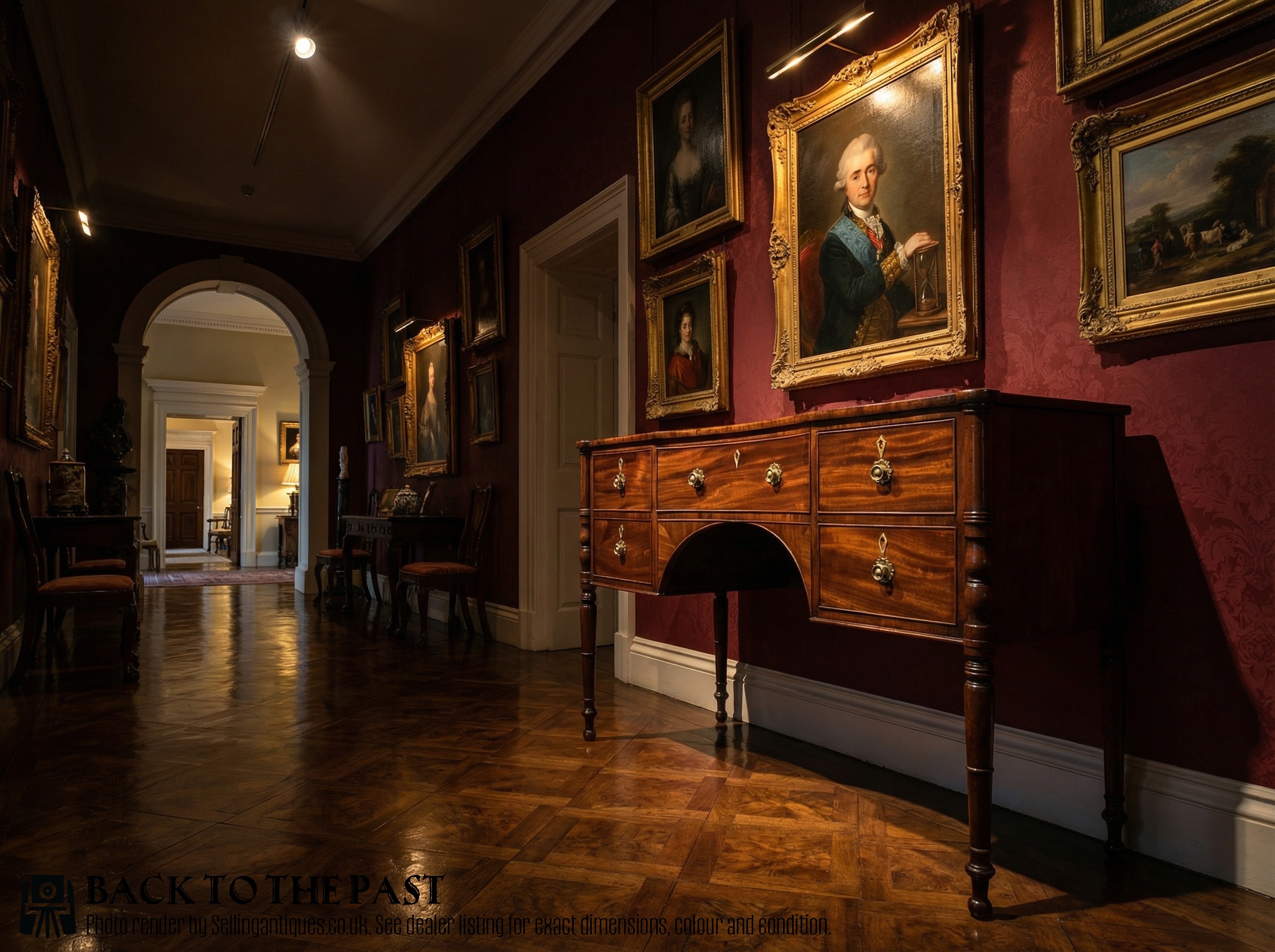
Regency Bow Front Sideboard
A regency bow front sideboard stands as a formal dining room server, designed with a convex curved front that softens the linear geometry of period interiors. These pieces appear most frequently in mahogany, spanning the nineteenth century alongside later twentieth-century revivals.
Makers designed these items to manage dining service, incorporating long top surfaces for platters alongside deep drawers and cupboards for linen and cutlery. The form ranges from substantial pedestal variants to neat, compact proportions suited for smaller halls and reception rooms.
Materials and Construction
Cabinetmakers relied heavily upon solid mahogany and flame mahogany veneer, chosen for rich grain patterns that respond well to traditional hand polishing. Secondary timbers such as oak frequently appear inside drawer linings.
Inlay work utilises contrasting woods like boxwood to trace fine stringing lines around drawer edges and panel borders. Brass fittings, including ring handles and lion mask pulls, complete the structural assembly.
Materials recorded across current and past items include solid mahogany, flame mahogany veneer, amboyna, burr veneer, oak, and boxwood.
Gradations in Quality
Superior examples display exceptional figured timber selection across the entire convex curve, maintaining grain continuity from drawer to drawer. Poorer versions rely on plain stock timber with minimal figure or decorative contrast.
The precision of the inlay work and the structural integrity of the curved drawer fronts dictate the tier of craftsmanship. Finer pieces retain original brass hardware and clean oak drawer linings without structural replacement.
The Regency Bow Front Sideboard Glossary
- Bow front
- A convex curved cabinet front that projects outward in an arc. This curved profile requires skilled joinery to shape solid wood and veneer correctly.
- Flame mahogany
- A veneer cut from the branch junction of the mahogany tree, producing a distinctive flame-like pattern. Cabinetmakers placed these dramatic veneers symmetrically across drawer fronts.
- Stringing
- Thin lines of contrasting wood inlaid into grooves on furniture surfaces. Boxwood often provides a pale line against dark mahogany.
- Pedestal sideboard
- A form featuring substantial end cabinets joined by a recessed central section. These larger variants suit spacious dining rooms.
Regency Bow Front Sideboard: Frequently Asked Questions
Where did they place these sideboards?
Dining rooms served as the primary location for these large storage items, where hosts used the broad top surface to display silver and serve food during meals.
Smaller versions occasionally found placement in grand halls or reception rooms as serving tables.
How do I spot a later copy?
Twentieth-century reproductions often display machine-cut dovetails and modern adhesives inside the drawer construction. Older originals rely entirely on hand-cut joinery and period secondary timbers.
Examine the hardware fixings and the ageing of the timber polish to determine the actual period.
Are the drawers deep enough for storage?
The central and side drawers offer generous depth for table linens, silver service items, and dining accessories. Deeper cupboards behind the outer doors accommodate larger platters and bottles.
Internal configurations vary according to the overall size of the individual sideboard.
Does the curved front need special care?
Maintain the curved timber surfaces with traditional beeswax and soft cloths to preserve the polished mahogany finish. Avoid placing furniture in direct sunlight or near heat sources to prevent veneer splitting.
Check brass fittings periodically to ensure the original mounts remain secure.