
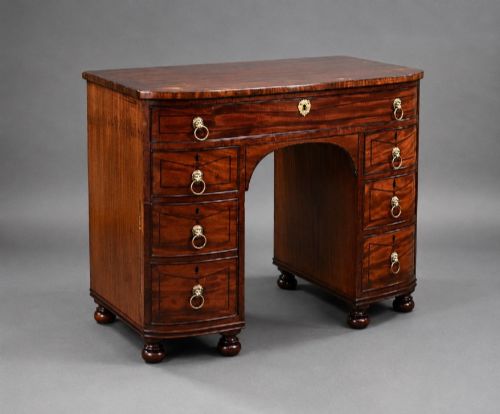


Regency Bow Front Desk
A regency bow front desk brings together curved mahogany surfaces and period craftsmanship to anchor a study with understated elegance.
Regency Bow Front Desk
A regency bow front desk is a writing surface featuring a convex curved front profile, most frequently encountered in mahogany across this selection. These pieces date principally from the Regency and Georgian eras, alongside later nineteenth century and Edwardian interpretations.
The form often overlaps with side tables, dressing tables, and writing chests, showing the adaptable domestic role these furnishings held. Side tables and dressing pieces share the same characteristic curved mahogany casework seen on the dedicated writing desks.
Makers adapted the bow front plan for different rooms, ranging from compact ladies writing tables to broader gentlemen's dressing chests. The evidence records pieces spanning genuine Regency creation through to later revival styles.
How they were made
Cabinetmakers built the structural carcases primarily from mahogany, frequently selecting flame mahogany veneer to create figured grain patterns across the curved drawer fronts. Boxwood and ebony stringing, alongside wood inlay, provided contrasting geometric borders on finer examples.
Makers utilised brass for drawer pulls, escutcheons, and occasional gallery rails, attaching them securely to the solid timber frameworks. Glass appears in associated dressing table mirrors, completing the functional suite of the period.
Mahogany is the dominant timber across these listings, accompanied by brass, boxwood, ebony, and glass.
What varies in quality
The distinction between standard examples and superior pieces rests on the choice of timber and the precision of the veneer work. Flame mahogany veneers matched symmetrically across a curved front demand expert handling by the cabinetmaker.
Refinement shows in the crispness of the boxwood and ebony inlay, the selection of solid secondary woods, and the integration of original brass hardware. Later revivals vary according to how closely they adhere to original Regency proportions.
S & H Jewell of London
The Regency Bow Front Desk Glossary
- Bow front
- A convex curved furniture front that swells outward toward the viewer. This shape softens the corners of a room and requires skilled joinery to execute.
- Flame mahogany
- A highly figured wood veneer displaying characteristic flickering flame patterns. Cabinetmakers reserved this timber for prominent surfaces like drawer fronts.
- Stringing
- Thin inlaid lines of contrasting wood, such as boxwood or ebony, used to outline panels and drawers. It defines the edges of Regency furniture.
- Escutcheon
- A protective plate surrounding a keyhole, usually made of brass. It prevents the timber around the lock from sustaining damage through repeated use.
- Regency
- A British design period spanning the early nineteenth century defined by classical restraint and elegant proportions. Pieces from this era often incorporate mahogany and subtle brass details.
Regency Bow Front Desk: Frequently Asked Questions
How do I spot a true Regency desk?
Examine the timber construction, secondary woods, and cabinetmaking techniques used inside the drawers and along the back panels. Genuine pieces from the period display hand-cut dovetails and timber seasoning consistent with early nineteenth century workshops.
Compare the proportions and brass hardware against documented examples from the Regency and Georgian eras. Later Edwardian revivals often utilise machine-sawn elements and different internal woods.
Where should I place a bow front desk?
Position the desk where the curved mahogany front can be appreciated without obstructing room traffic. They function well against flat walls or as freestanding elements in a study.
Ensure the surface receives adequate natural light for writing while protecting the timber from direct sunlight that might fade the mahogany finish.
Can I use a dressing table as a desk?
Many period dressing tables and writing desks share identical proportions and drawer configurations, making them suitable for writing tasks. The primary difference often lies in the inclusion of a mirror or specific compartment layout.
Assess the kneehole clearance and writing height of the specific piece to ensure comfort during extended periods of use.
How do I care for flame mahogany veneer?
Maintain the timber by keeping the surface dusted with a soft, dry cloth and avoiding silicone-based polishes. Apply a traditional beeswax sparingly to nourish the grain and protect the finish.
Keep the desk away from direct heat sources and dramatic humidity fluctuations to prevent the mahogany veneer from lifting or cracking.