
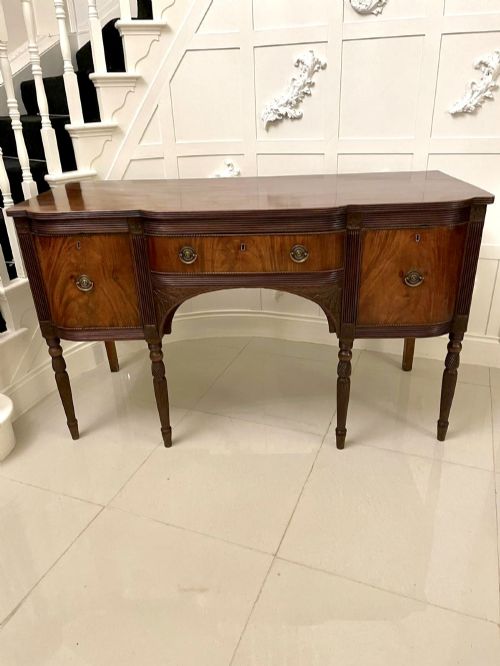


Reeded Leg Sideboard
These reeded leg sideboard examples bring architectural rhythm to a dining room, combining functional storage with clean linear detail.
Identifying your reeded leg sideboard
A reeded leg sideboard provides substantial dining room storage through pedestal or cabinet configurations framed by characteristic vertical carved mouldings. Pieces listed for this search phrase span the Georgian and Regency periods, showing how cabinetmakers refined these forms over decades.
The most common form met here is the mahogany sideboard featuring either a flat rectilinear top, a breakfront profile, or a sweeping bow front. These variations demonstrate the progression from eighteenth-century formal design to the lighter Regency aesthetic.
Materials and construction
Cabinetmakers built these sideboards using solid mahogany and flame mahogany veneer, often selecting cuts to display rich grain patterns across the primary surfaces. Secondary timbers provided sturdy internal framing for drawers and carcases.
Detailing relied on precise craftsmanship, including contrasting ebony inlay and cast brass hardware to accent the timber. Carvers shaped the characteristic parallel convex mouldings directly into the solid wood of the legs.
Retail Price Guide 2026
Typical UK retail prices for reeded leg sideboard, calculated from the Sellingantiques database of over a million retail prices indexed since 2003. This retail price guide relies exclusively on Sellingantiques data; no external sources or auction records are used, so the figures do not describe the wider market.
Some cabinetmakers snuck extra secret drawers behind decorative mouldings to guard the family silver from sticky-fingered footmen.
Judging quality and proportion
Superior examples separate themselves through the selection of highly figured timbers and the crispness of their carved reeding. Finer pieces display continuous grain matching across drawer fronts and doors, revealing greater attention from the workshop.
Proportion and decorative restraint dictate the upper tier of these pieces. Subtle additions like fine ebony stringing and original brass mounts elevate a sideboard beyond standard utility into the realm of high cabinetmaking.
The Reeded Leg Sideboard Glossary
- Reeded
- A decorative moulding formed of parallel convex strips resembling bundled reeds. This classical detail provides texture and vertical emphasis to furniture legs and pilasters.
- Bow front
- A cabinet front that curves outward in a convex arc. This shape softens the room presence of a large dining piece while increasing internal capacity.
- Breakfront
- A cabinet design where the central section projects forward from the flanking wings. This architectural arrangement creates depth and shadow across the front elevation.
- Flame mahogany
- A veneer cut diagonally across the branch junctions of the tree to produce a flickering, flame-like grain pattern. Cabinetmakers prized this figure for principal drawer fronts and doors.
Frequently Asked Questions
What is a reeded leg sideboard?
A reeded leg sideboard is a dining room storage piece featuring carved parallel vertical mouldings on its legs. These items date primarily from the Georgian and Regency eras.
Cabinetmakers utilised mahogany and veneer to construct these functional furniture pieces for elite dining spaces. The vertical carving distinguishes them from plain tapered or square leg variants.
How do I date a sideboard?
Dating relies on examining the timber selection, hardware, and overall architectural silhouette. Georgian pieces often display heavier proportions while Regency examples lean towards lighter lines.
Details such as ebony inlay and brass fixtures provide further chronological markers. Cabinet construction methods inside the drawers also indicate the period of manufacture.
Where should I place a sideboard?
These pieces function best against a dining room wall where they can serve food and store linens. Their generous proportions require adequate floor space to let the front design breathe.
Keep them away from direct heat sources and strong sunlight to protect the mahogany timber and veneer. Proper placement ensures the decorative reeding remains visible as a focal point.
How do I maintain mahogany furniture?
Maintain mahogany surfaces by dusting regularly with a soft dry cloth and avoiding silicone polishes. Periodic waxing feeds the timber and preserves the depth of the grain.
Keep humidity levels stable in the room to prevent the solid wood and veneers from cracking. Gentle care preserves the original finish accumulated over centuries.