
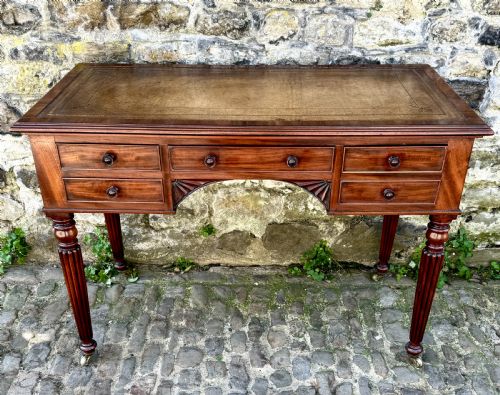


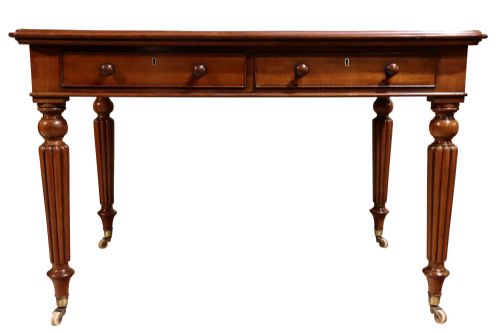


Reeded Leg Library Table
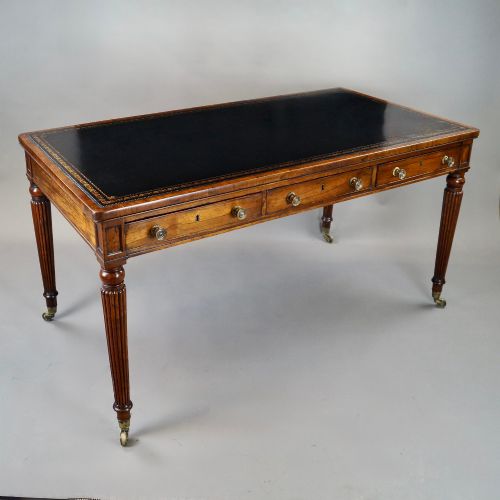
A reeded leg library table is a substantial writing desk grounded by turned columnar fluting, offering a stately workspace rooted in Georgian and Regency craftsmanship.
Reeded Leg Library Table
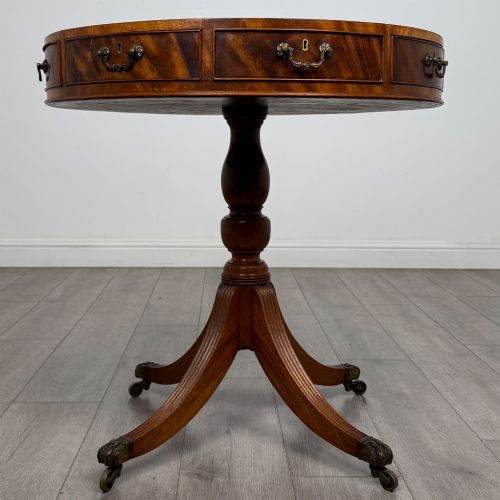
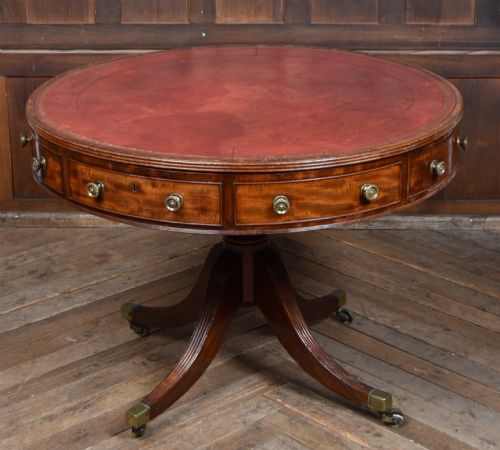
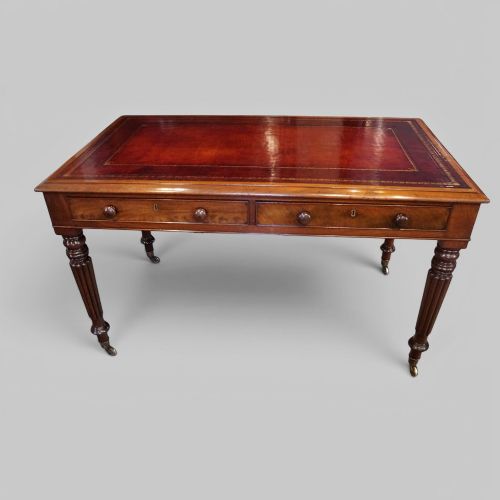
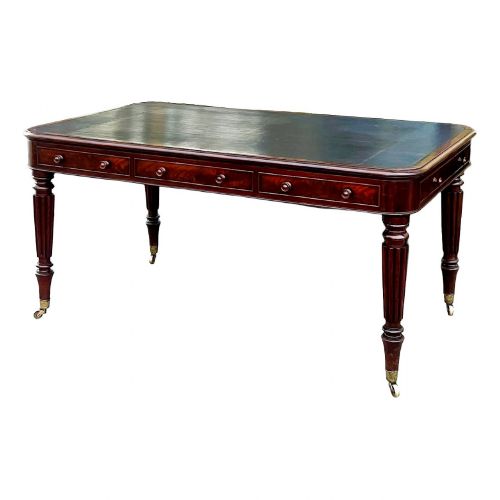
A reeded leg library table sits at the intersection of serious study and formal reception, emerging primarily across the Georgian, Regency, and Victorian periods. These pieces take the form of freestanding desks, drum tables, and partners writing tables designed to occupy the centre of a room rather than sit against a wall.
The specific version carrying reeded legs appears most frequently in mid-nineteenth-century Victorian interpretations alongside earlier Regency and George III forms. Cabinetmakers of these eras utilised mahogany as the primary timber, occasionally turning to rosewood for finer commissions destined for grand private libraries.
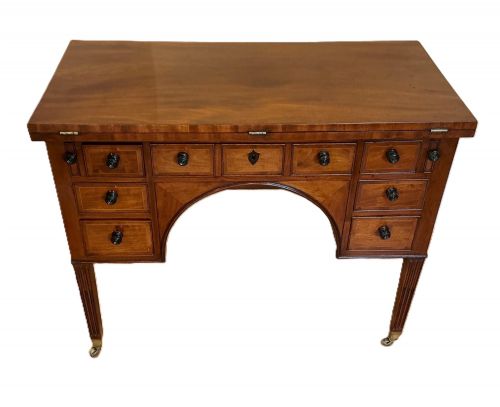
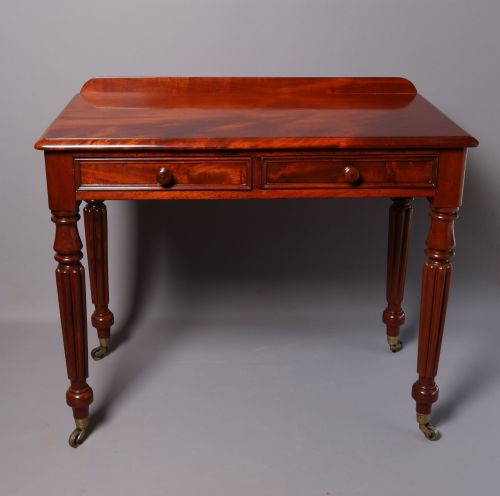
While many examples function purely as writing desks with banks of drawers, related forms on this page include occasional tables and dressing tables sharing the same architectural vocabulary. Buyers encounter everything from compact chamber tables to large partners desks meant for shared use.
What separates standard examples from exceptional work
Quality in a reeded leg library table rests on the crispness of the timber turning and the depth of the grain. Sharp, evenly spaced reeding indicates a confident hand at the lathe, whereas softer or uneven fluting points to hurried production.
The choice of secondary timbers inside the drawer linings and the precision of the dovetail joints reveal the workshop standards. Superior examples display thoughtful proportion between the heavy top and the slender columns below, maintaining structural integrity without sacrificing elegance.
Listings feature mahogany predominantly, complemented by rosewood, ebony, brass, ceramic, and leather across Georgian, Regency, and Victorian periods.
Gillows of Lancaster·Gillows
The Reeded Leg Library Table Glossary
- Reeding
- Parallel convex mouldings carved into the wood to resemble overlapping reeds or columns. This decorative turning technique adds vertical emphasis to table legs.
- Drum table
- A circular library table containing a revolving or stationary top surrounded by small frieze drawers. These pieces often stand on a central pillar supported by spreading legs.
- Partners desk
- A large double-sided writing table fitted with drawers on both long sides. It allows two people to work opposite one another in the centre of a room.
- Stringing
- Thin inlaid lines of contrasting timber or brass used to outline drawer fronts and tabletops. This technique defines the edges of the mahogany surface.
- Brass gallery
- A low metal railing fitted around the top edge of a writing table. It prevents books and papers from sliding off the surface.
Reeded Leg Library Table: Frequently Asked Questions
Where should a library table go?
These tables are designed to stand freely in the middle of a room rather than pushed against a wall. Their finished backs and panelled drawer surrounds mean they look correct from every angle.
Position one away from direct heat sources and strong sunlight to protect the polished mahogany and the inset leather writing surface from drying out.
How do I care for the leather top?
The leather writing surface benefits from occasional light waxing and dusting with a dry cloth. Avoid harsh commercial cleaners that can strip the original tooling and colour.
Keep sharp metal objects and excessive moisture away from the hide to preserve the integrity of the gold or blind tooling around the border.
How can I tell a Regency table from a Victorian one?
Regency tables typically display lighter proportions, sharper brass mounts, and crisper mahogany figuring dating from the early nineteenth century. Cabinetmakers of this era favoured classical architectural lines inspired by Greek and Roman models.
Victorian pieces produced around the middle of the century often feature heavier timbers, deeper drawers, and slightly more robust turning on the reeded legs to suit changing domestic tastes.