
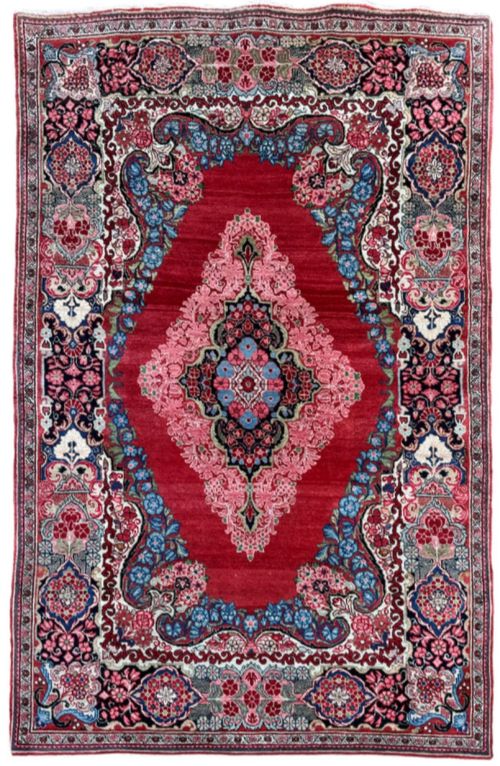

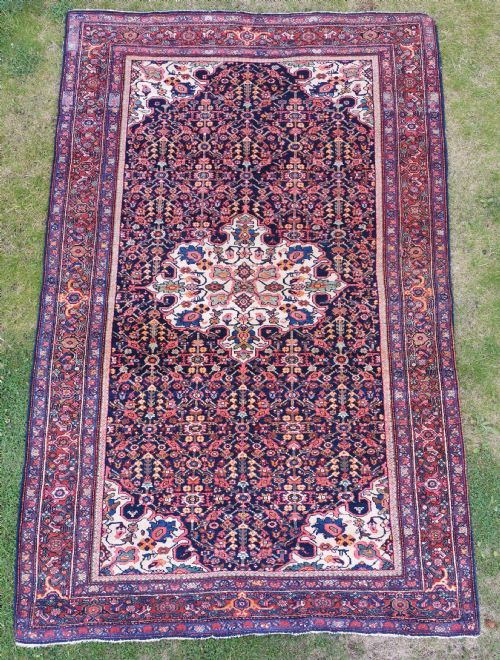
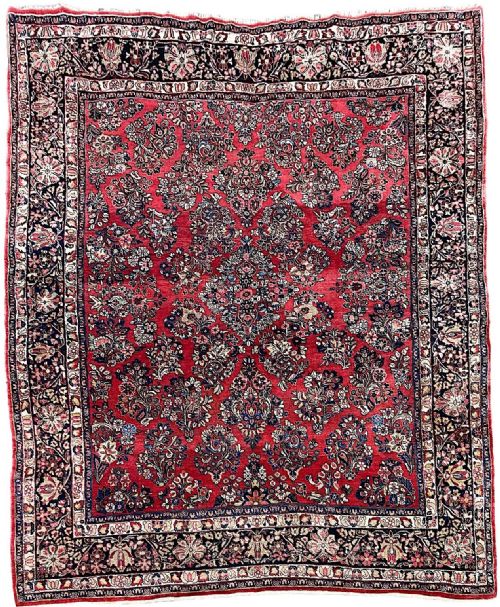


Red Wool Sarouk Rug
A red wool sarouk rug brings Persian craftsmanship into a room, offering durability and traditional design.
Red Wool Sarouk Rug
A red wool sarouk rug originates from West Persia and West Central Persia, taking the form of area rugs, carpets, and narrow runners. These pieces span from the mid-nineteenth century through the 1930s, encompassing styles such as traditional Persian, Ferahan, Jozan, and Mohajeran.
Buyers frequently encounter room-sized carpets and smaller scatter rugs bearing traditional motifs, rust backgrounds, and soft colours. The selection includes unusual layouts featuring birds, pomegranates, and boteh designs.
Originating primarily from specific Persian villages and weaving centres, these textiles function as durable floor coverings designed for heavy use. Each piece reflects regional weaving traditions established across the late nineteenth and early twentieth centuries.
Materials and construction
Construction relies on wool pile knotted onto a cotton foundation, providing both structural stability and a resilient surface. Weavers utilised this combination to achieve detailed patterning and long-lasting durability.
Techniques range from standard village weaving to very fine weaves executed in West Persia. Natural and traditional dyeing methods produced the characteristic rust backgrounds and soft colour palettes seen across the inventory.
Listings span from the mid-nineteenth century through the 1930s, utilising wool and cotton exclusively.
Assessing quality and execution
Quality separates through the density of the weave and the precision of the design execution. Pieces with exceptionally fine knots display intricate floral and pictorial motifs more clearly than coarser village examples.
The integrity of the wool pile and the condition of the cotton foundation dictate the longevity of each carpet. Original proportions, such as exceptionally long narrow runners, also influence desirability among collectors.
The Red Wool Sarouk Rug Glossary
- Sarouk
- A type of Persian rug originating from the village of Sarouk and surrounding districts in West Persia. These pieces are known for durable wool construction and traditional floral designs.
- Ferahan
- A stylistic classification linked to rugs produced in the Ferahan region of Persia. They often incorporate finely executed traditional motifs and harmonious colour combinations.
- Jozan
- A village in West Central Persia associated with high-quality rug production. Jozan pieces frequently share stylistic ties with broader Sarouk weaving traditions.
- Boteh
- A traditional Persian motif resembling a almond or paisley shape. It appears frequently in antique pile rugs to represent fertility and life.
- Runner
- A long, narrow carpet format designed for hallways and corridors. Surviving examples often display extended proportions suited to specific architectural spaces.
Red Wool Sarouk Rug: Frequently Asked Questions
Where were these rugs made?
These textiles originate from West Persia and West Central Persia, specifically from villages and weaving centres such as Sarouk, Jozan, Ferahan, and Mohajeran. Each producing area contributed distinct regional characteristics to the overall tradition.
Production spanned from the mid-nineteenth century through the 1930s, encompassing both village workshops and larger regional looms.
What is a Mohajeran Saroukh?
A Mohajeran Saroukh refers to rugs woven in the Mohajeran district, which produced carpets closely associated with the broader Sarouk tradition. These pieces often exhibit high-quality materials and traditional regional designs.
Collectors look for these specific attributions to understand the geographic and stylistic roots of an antique carpet.
How should I live with an antique runner?
Antique runners suit hallways, landings, and narrow corridors where their elongated proportions provide functional floor coverage. Placing a suitable underlay beneath the rug helps prevent sliding and reduces wear on the cotton foundation.
Regular, gentle rotation and professional cleaning maintain the integrity of the wool pile over years of domestic use.