
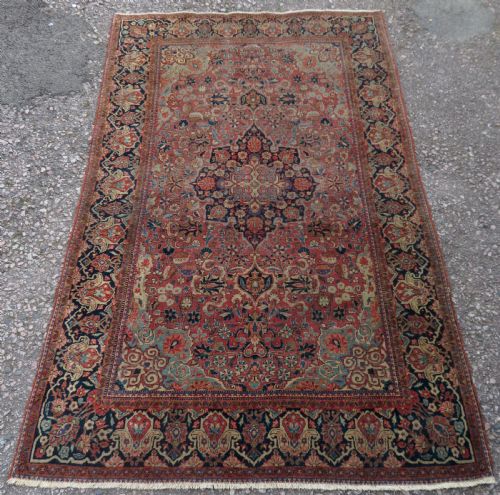
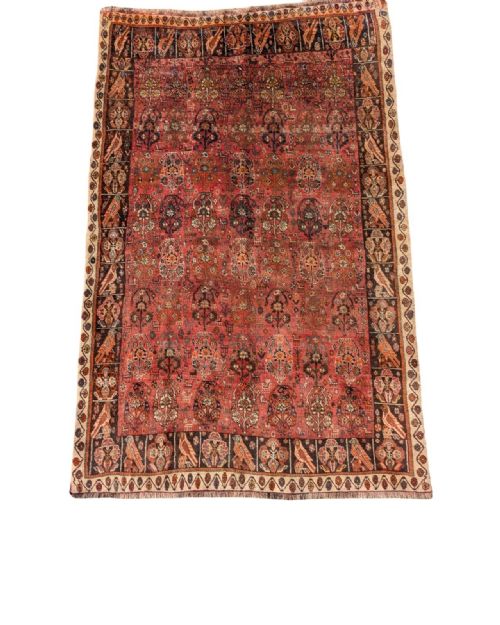
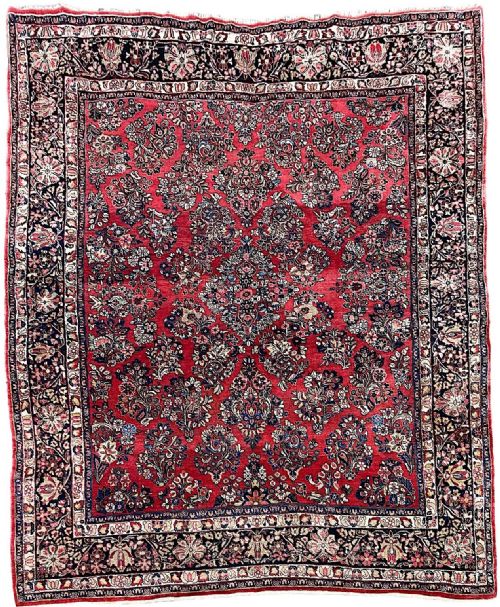


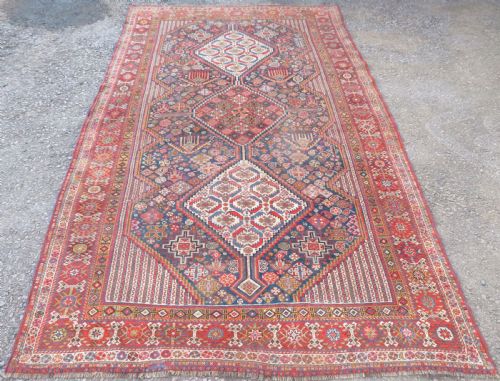


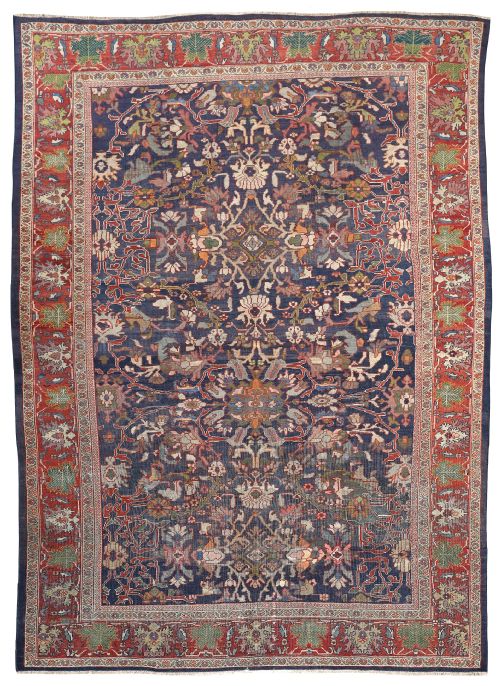
Navy Border Area Rug
These Persian and Caucasian floor coverings gathered under the navy border area rug search bring grounding weight and patterned geometry to a room.
Navy Border Area Rug
When you search for a navy border area rug, you encounter hand-knotted carpets and rugs originating from Persian and Caucasian weaving traditions, dating from the mid-nineteenth century through the early twentieth century. These pieces encompass village and tribal formats such as Heriz, Bakhtiar, Khamseh, and Shirvan alongside larger city workshops like Tabriz, Sarouk, and Isfahan.
The version you are most likely to meet on this page is a room-sized or scatter carpet featuring distinctive dark blue framing edges enclosing medallion or all-over field patterns. These textiles served functional roles in domestic interiors as durable floor coverings designed to withstand heavy foot traffic while providing warmth and decoration.
How they were made
The structural foundation relies on spun cotton or wool warps and wefts, upon which artisans tied dense rows of hand-spun wool pile using vertical knotting techniques. Natural dyes extracted from plant and mineral sources provided the deep indigo tones characteristic of the framing borders and the varied palette seen across the fields.
Weavers worked from memory or traditional tribal designs rather than rigid paper cartoons, particularly in village workshops, which accounts for the subtle irregularities in symmetry and motif placement found across the pieces.
Weavers occasionally wove tiny stray animals or shifting tribal symbols into distant corners, escaping the strict gaze of the workshop master.
What varies in quality
The refinement of the wool and the density of the knotting separate fine city workshops from coarser tribal weaving, dictating how sharply the geometric and floral motifs resolve against the ground. Superior handling of natural dyestuffs produces rich depth and gentle abrash, where colour shifts organically across the surface rather than remaining flat and uniform.
Structural integrity depends on the original tension of the weave and the evenly preserved wear across the wool pile, ensuring the textile lies flat and maintains its structural coherence after more than a century of existence.
The Navy Border Area Rug Glossary
- Abrash
- Natural tonal variation within a single colour field caused by different dye batches or changing wool supplies during the weaving process. This subtle striping indicates traditional hand-dyeing methods.
- Kelleh
- A long, narrow room-sized carpet format traditionally suited for specific architectural spaces such as corridors or long reception rooms. These elongated rugs balance length with a narrower width than standard carpets.
- Medallion
- A symmetrical central ornamental motif placed in the middle of the carpet field. It serves as the primary focal point around which corner brackets and secondary patterns revolve.
- Warp
- The vertical foundation threads stretched tightly on the loom before knotting begins. The visible fringes at either end of a finished rug are formed by these extending parallel strands.
- Weft
- The horizontal threads passed across and interlaced between the warp threads to secure each row of knots in place. Together with the warp, they form the hidden grid that supports the wool pile.
Navy Border Area Rug: Frequently Asked Questions
Where were these rugs made?
The pieces originate primarily from regions across Persia and the Caucasus, encompassing specific weaving centres like Heriz, Tabriz, and Shirvan.
Production spanned both nomadic tribal camps and established town workshops where traditional dyeing and knotting methods were passed down through generations.
How do I care for an old rug?
Protect the textile by placing it on a breathable, slip-resistant underlay that cushions the foundation and prevents shifting underfoot.
Vacuum gently using suction attachments without rotating brush bars, and arrange for professional specialist cleaning when deep maintenance is required.
How are different tribal designs told apart?
Distinctions emerge through the specific geometry of the borders, the structure of the central medallions, and the characteristic palette of each weaving group.
For instance, Heriz carpets often display bold, architectural corner spandrels and large geometric medallions, whereas Caucasian pieces favour sharper, highly stylised motifs.
What is a kelim?
A kelim is a flat-woven textile constructed without a raised pile by tightly interweaving warp and weft threads together.
This technique creates a lightweight, reversible fabric with a smooth surface that functions well as a decorative floor covering or hanging.