


Red Wool Chuval Rug
A red wool chuval rug is a tribal storage bag face woven by Central Asian nomads, prized for intricate guls and rich madder tones.
Red Wool Chuval Rug
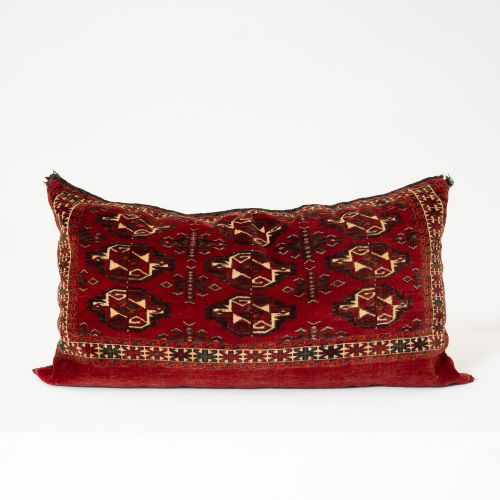
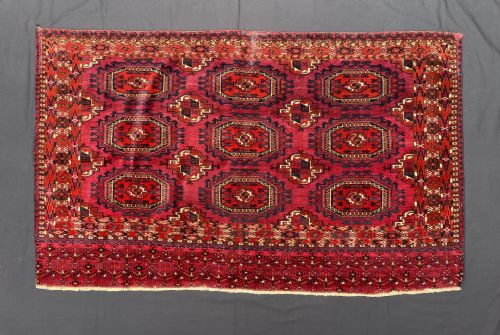
A red wool chuval rug represents a nomadic Central Asian storage bag face, traditionally woven by tribes such as the Tekke, Yomut, Ersari, and Saryk. These textiles functioned primarily as practical household containers within tribal dwellings before surviving as decorative collector items.
The selection on this page centres heavily on nineteenth-century tribal weaving, ranging from complete examples with original plain weave backs to fragmentary pieces. Most items date from the mid-nineteenth century through to the early twentieth century, reflecting the classic production periods of Turkmen groups.
Materials and construction
Nomadic weavers utilised hand-spun wool and cotton foundations, often incorporating natural dyes to achieve deep crimson, red, and ivory hues. Certain pieces integrate silk details or white cotton highlights alongside the dominant wool pile.
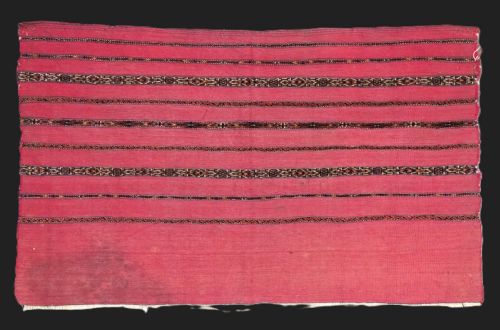
Construction techniques include finely knotted pile surfaces paired with flat-woven backs or hanging loops. Many surviving examples exist as bag faces separated from their original plain weave rear panels, whilst others retain complete structural integrity.
Listings span multiple tribal origins, including Tekke, Yomut, Ersari, and Saryk groups from the nineteenth and early twentieth centuries.
Variations in quality
Quality in a red wool chuval rug depends upon knot density and the precision of the geometric gul motifs. Finer weaves display tighter knotting and crisper definition across complex repeating medallion structures.
The complexity of design elements, such as the inclusion of multiple Salor guls, secondary elem panels, or scarce aina gul patterns, separates standard utility work from master-class tribal artistry.
The Red Wool Chuval Rug Glossary
- Chuval
- A large tent storage bag produced by Turkmen and other Central Asian tribes. These textiles were traditionally used to store household goods inside felt tents.
- Gul
- The primary medallion or octagonal motif repeated across Turkmen rugs. Different tribal groups developed distinct gul patterns to signify their specific lineage.
- Torba
- A smaller storage bag format compared to the chuval, featuring similar tribal iconography. These were hung inside the nomadic dwelling.
- Kizil
- A descriptive term denoting the rich red ground colour characteristic of these tribal textiles. Natural madder dyes typically produced these saturated crimson tones.
Red Wool Chuval Rug: Frequently Asked Questions
What is a red wool chuval rug used for?
These pieces functioned originally as large storage sacks inside nomadic tents to hold household belongings and bedding.
Today, collectors mount them as wall hangings or display them as small decorative floor rugs.
How do I identify a Tekke chuval?
Tekke examples typically display precise repeating octagonal guls arranged in a structured grid across a deep red wool field.
They frequently incorporate secondary motifs and finely knotted structures characteristic of the Tekke tribes.
Are these rugs made with natural dyes?
Many nineteenth-century examples utilise traditional natural dyes derived from plants and insects to achieve deep red and crimson tones.
Hand-spun wool absorbs these dye stuffs to create rich variations in colour across the surface.
What is a Salor gul?
A Salor gul is a complex secondary medallion pattern adopted by various Turkmen tribes within their primary weaving designs.
Its presence on a Tekke or Ersari piece indicates traditional design borrowing or inter-tribal influence.